

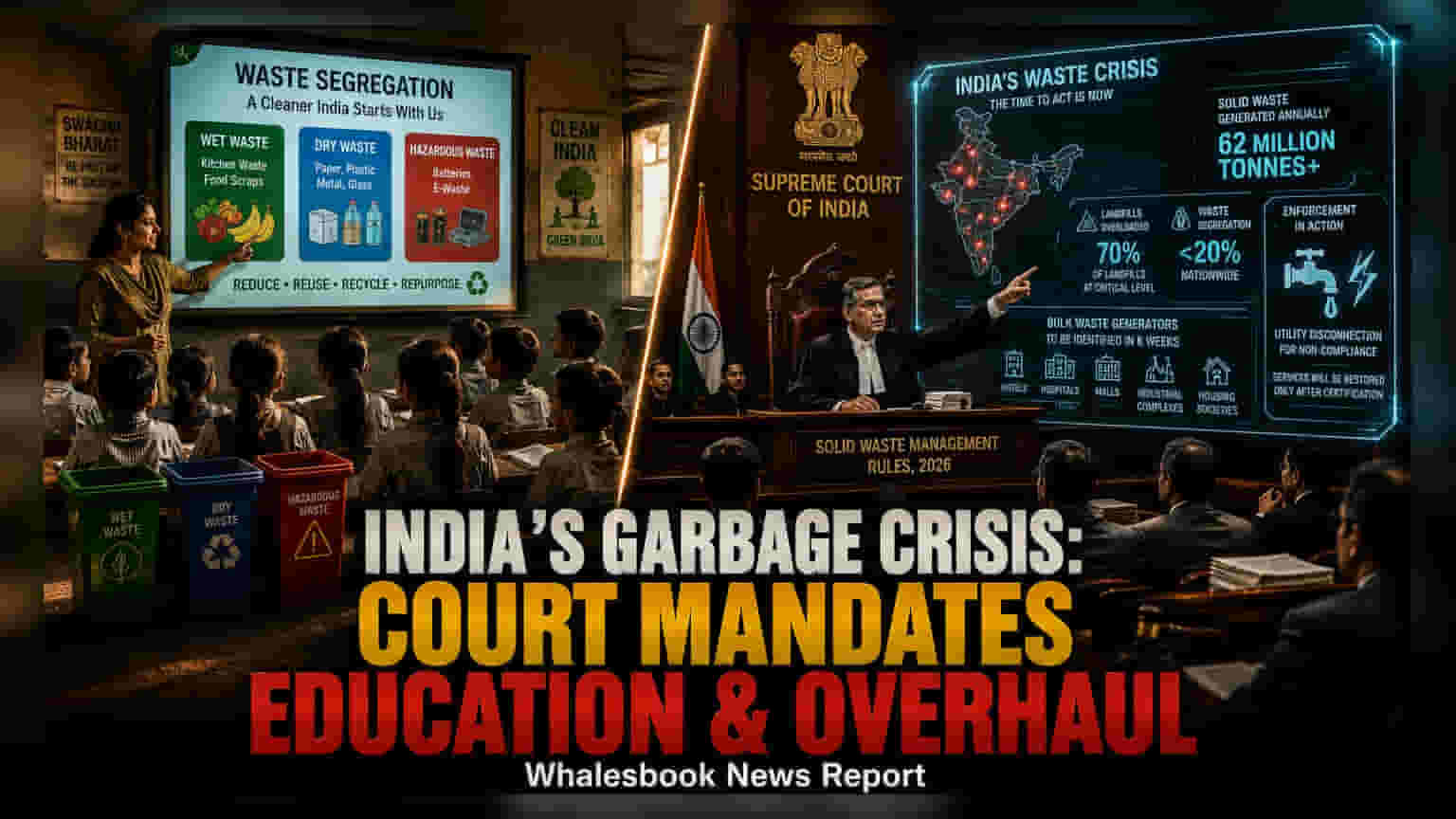
The Supreme Court has mandated strict enforcement of the Solid Waste Management Rules, 2026, specifically targeting bulk waste generators. Institutions failing to segregate and process waste now face the risk of water and electricity supply disconnections. This judicial push is expected to create demand for professional waste processing solutions while increasing compliance costs for large commercial establishments.
The Supreme Court of India has issued a stern directive aimed at resolving the country's mounting solid waste crisis. By emphasizing the collective responsibility of citizens and institutions, the court has directed the strict implementation of the Solid Waste Management (SWM) Rules, 2026. This move moves beyond mere policy recommendations, introducing clear enforcement mechanisms for large-scale waste producers.
At the center of this directive are bulk waste generators, which typically include large housing societies, hotels, hospitals, malls, and industrial complexes. The court has directed district collectors to identify these entities within six weeks. Under the new enforcement framework, local municipal bodies are empowered to impose penalties on non-compliant institutions, including the temporary disconnection of essential utilities like water and electricity. These services would only be restored once the establishment provides certification of compliance with waste segregation and processing standards.
For investors and market participants, this directive signals a significant shift in the operational environment for businesses. Commercial establishments that generate significant volumes of waste can no longer treat disposal as a secondary operational concern. The mandate forces these entities to invest in on-site waste processing, segregation equipment, or third-party professional waste management services. This creates a potential growth opportunity for environmental technology companies, recycling solution providers, and municipal solid waste management service firms that can help businesses comply with these new, rigorous standards.
However, the path to implementation carries notable risks. While the policy intent is clear, India has historically faced challenges in bridging the gap between national mandates and ground-level execution. The burden of identifying and monitoring thousands of bulk waste generators will fall on municipal authorities, many of which are already strained by limited resources and technical capacity. Investors should be mindful that until local bodies demonstrate the ability to enforce these rules consistently, the actual demand for waste management services may grow in a fragmented or phased manner rather than all at once.
Furthermore, for the commercial sector, the immediate impact will be an increase in operational costs. Companies will need to allocate capital to upgrade their waste handling infrastructure to avoid the threat of utility cuts. This is a critical factor for businesses with thin profit margins or those operating in sectors with high waste intensity.
Looking ahead, the next monitorable for the market is the pace at which state-level municipal bodies release tender notifications and enforcement guidelines. The efficiency of this rollout will determine how quickly companies in the waste management and pollution control sector can translate this judicial directive into actual order books and revenue growth. Investors may track municipal policy updates and the performance of companies specializing in environmental infrastructure as this regulatory landscape evolves.