

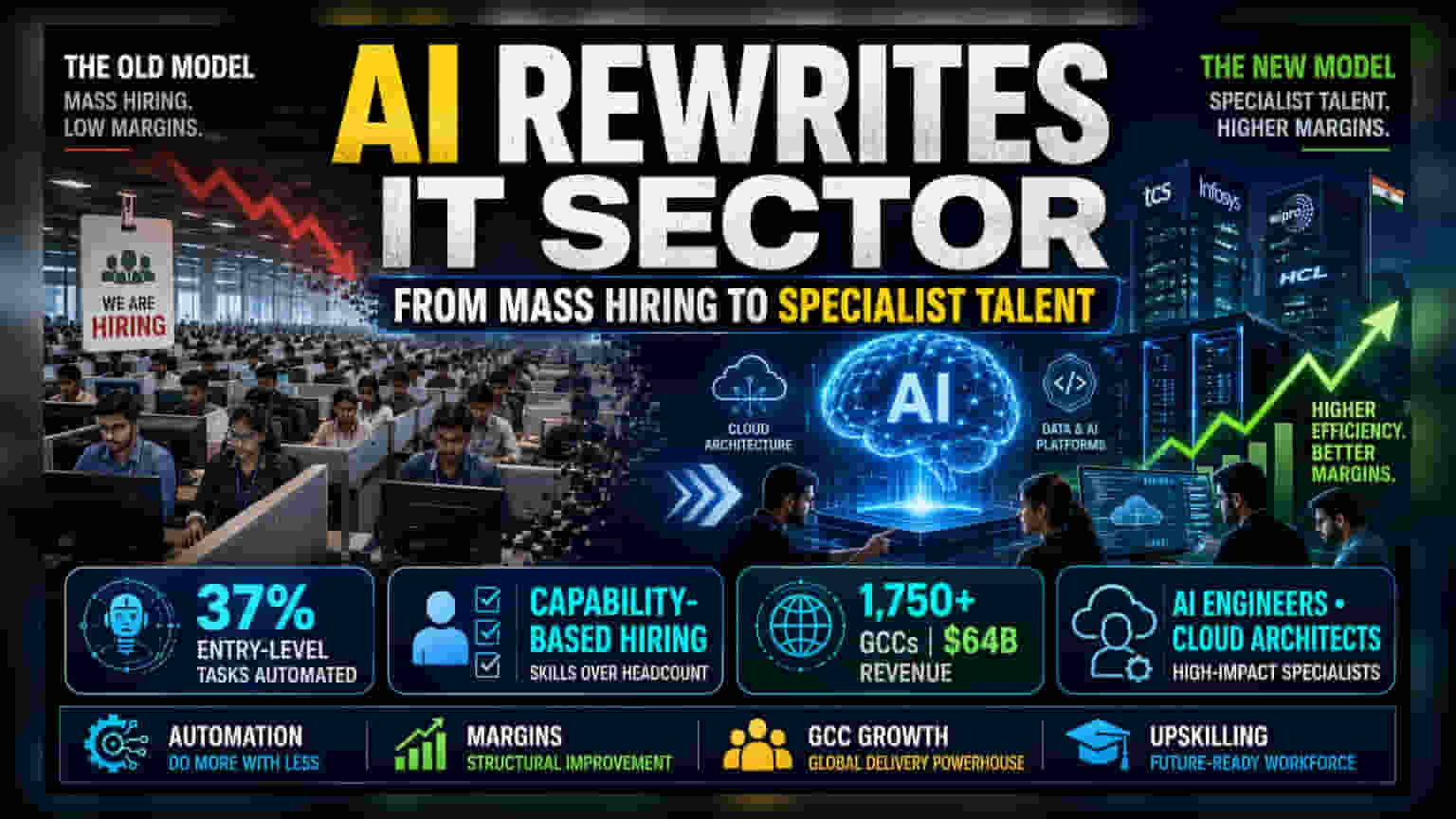
India's IT sector is undergoing a massive shift as artificial intelligence reduces the need for mass hiring while surging demand for high-skill roles. Companies are moving from traditional labor-reliant models to AI-driven efficiency. For investors, this marks a transition toward higher profit margins but poses challenges for the industry's historical headcount-based growth strategy.
What Happened
India's IT services sector is experiencing a fundamental structural shift as artificial intelligence reshapes its core business model. For years, companies grew by adding large numbers of employees to handle tasks at lower costs—a strategy known as labour arbitrage. In 2026, this model is being replaced. Data shows that IT firms are aggressively automating entry-level operational tasks, leading to a decline in mass hiring even as revenue growth remains a target. Studies indicate that nearly 37% of entry-level tasks are already being handled by AI, forcing firms to move away from volume-based recruitment toward capability-based hiring for specialized roles like AI engineers and cloud architects.
Why The Business Model Is Shifting
For investors, this change is significant because it alters how IT companies generate profit. Previously, revenue growth was directly tied to adding more people. Today, companies like TCS and Infosys are exploring ways to decouple revenue from headcount. By integrating AI into their workflows, these firms aim to improve operating margins. In recent quarterly results, some top-tier IT companies have reported record margins, partly attributed to this increased operational efficiency. However, this transition is not seamless. The shift to "outcome-based pricing," where clients pay for results rather than the number of hours worked, is moving slower than many industry analysts initially expected.
The Rise Of Global Capability Centers
While traditional IT service roles face pressure, a new growth engine has emerged: Global Capability Centers (GCCs). These are the India-based technology and innovation hubs of multinational corporations. As of 2026, India hosts over 1,750 GCCs, contributing more than $64 billion in annual services revenue. Unlike traditional IT service providers that focus on cost reduction, these GCCs are focusing on high-end innovation, product engineering, and AI development. For investors, GCCs represent a shift toward higher-value work being done within India, which helps stabilize the long-term outlook for the country's technology sector.
Risks To The Current Strategy
The move away from a headcount-heavy model comes with clear business risks. First, there is the risk of execution delay. If firms cannot train or hire specialized AI talent fast enough, they may lose out on high-value AI transformation projects. Second, pricing pressure is increasing. As AI makes services cheaper and faster, clients are demanding lower prices, which can squeeze margins if companies do not differentiate their offerings. Finally, the decline in entry-level hiring impacts the talent pipeline, potentially creating a gap in mid-level leadership in the future if firms do not successfully implement internal upskilling programs.
What Investors Should Track
Investors may want to monitor three key areas in upcoming quarterly reports: first, the trend in employee headcount versus revenue growth, as a wider gap between the two often signals successful AI adoption; second, the company's ability to win high-value "transformation" deals that prove they can deliver more than just basic coding; and third, the growth and expansion rate of their GCC engagements. These factors will help determine which companies are successfully navigating the transition from a 2010-era labor model to a 2026 AI-driven business strategy.