 Whalesbook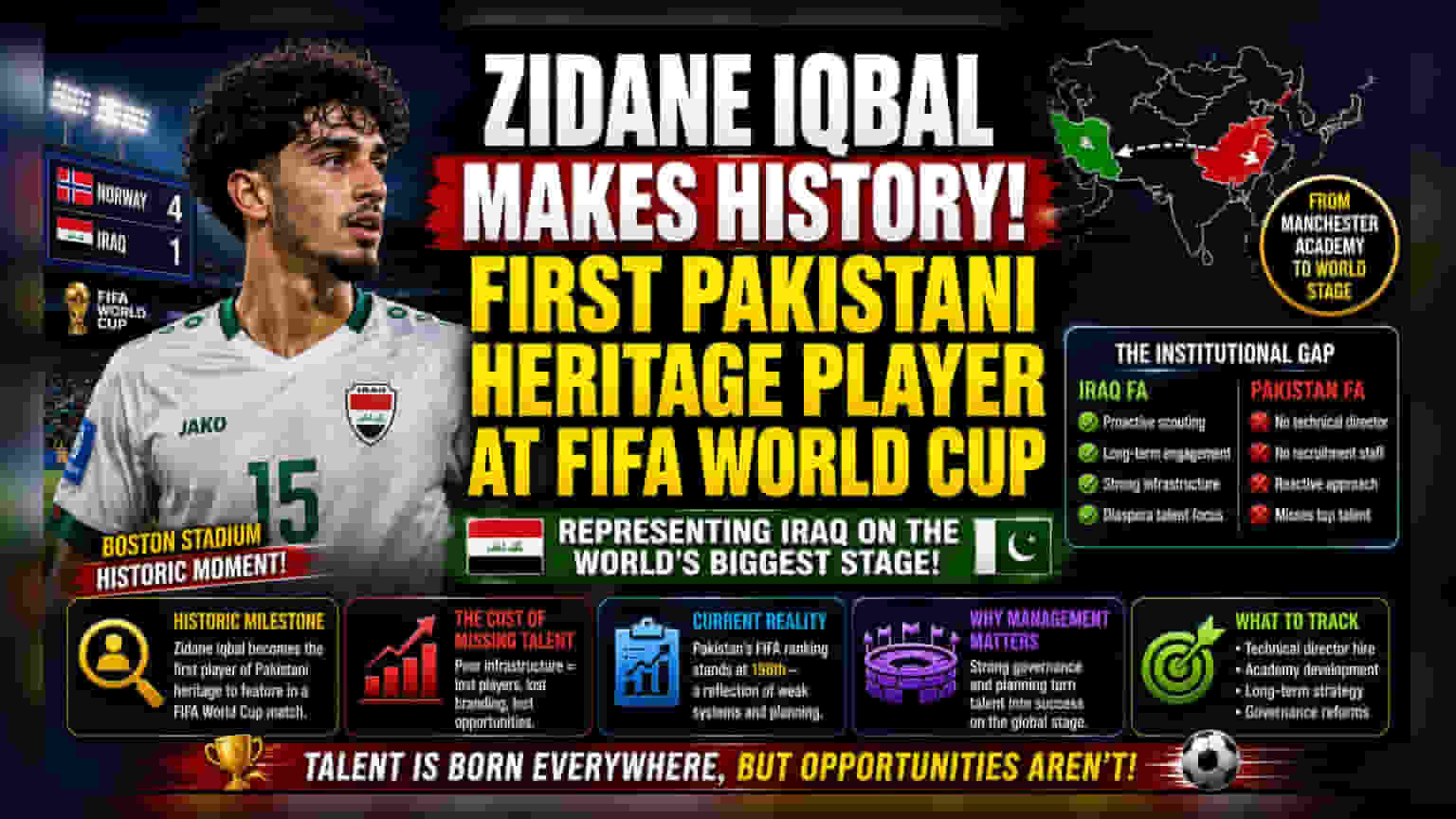


Zidane Iqbal, a player of Pakistani heritage, recently debuted at the FIFA World Cup for Iraq, highlighting structural failures in the South Asian sports ecosystem. While Iqbal’s development within European systems like Manchester United’s academy underscores the need for institutional training, the Pakistan Football Federation’s inability to leverage such talent points to critical management gaps. From a business perspective, this highlights how a lack of technical oversight and long-term planning in regional sports bodies leads to consistent capital and talent losses.
What Happened
Manchester-born midfielder Zidane Iqbal made history at the FIFA World Cup by representing Iraq in their match against Norway at Boston Stadium. Born to a Pakistani father and an Iraqi mother, Iqbal’s appearance marked the first time a player of Pakistani heritage has played in football’s premier global tournament. Iqbal, who previously trained at the Manchester United academy and moved to FC Utrecht, was eligible to represent Pakistan but chose to play for Iraq. The match ended in a 4-1 loss for Iraq, but the event has drawn significant attention to the state of football management and infrastructure in South Asia.
The Institutional Gap
From a structural and management perspective, Iqbal’s decision highlights a stark contrast in institutional capability. Reports indicate that the Pakistan Football Federation (PFF) monitored Iqbal’s progress but failed to secure his allegiance. Analysts point to a significant structural deficit within the federation, including the absence of a dedicated technical director and professional recruitment staff. In the business of professional sports, identifying and securing high-value talent requires a robust scouting and engagement ecosystem—elements currently missing from the PFF's operational framework. While Iqbal’s development was primarily funded by European club structures, the lack of a competing domestic pathway meant there was effectively no value proposition for him to represent Pakistan.
The Cost of Missing Infrastructure
The 198th global FIFA ranking of the Pakistan national team serves as a key performance indicator (KPI) for the country’s sports management sector. In a competitive global market, successful sports nations invest heavily in academies, coaching, and long-term developmental cycles. Without these, the local talent pool remains underdeveloped, and the commercial viability of the sport struggles to grow. Iqbal’s choice serves as a case study in opportunity cost; when federations fail to build the necessary technical foundations, they lose not only potential talent but also the branding, sponsorship interest, and grassroots inspiration that comes with World Cup participation.
Why Management Matters
The success of sports teams is increasingly treated as a product of institutional efficiency rather than raw talent alone. Iraq’s Football Association, which successfully courted Iqbal, demonstrated the value of active management and long-term engagement strategies. By creating an environment that feels like a home for diaspora talent, the Iraqi FA effectively expanded its human capital pool. Conversely, the PFF’s reliance on reactive measures rather than proactive planning illustrates a governance issue that is common in fragmented sports bodies across the region. For stakeholders in the sports industry, this highlights that without professionalised management and clear technical roles, even nations with high talent potential will fail to capture value.
What Investors and Analysts Should Track
For those observing the sports business landscape in South Asia, the key monitorables are not just on-field results, but the institutional reforms within national federations. Investors and policy watchers should look for evidence of structural changes, such as the hiring of professional technical directors, the establishment of sustainable academy systems, and the implementation of long-term strategic plans for recruitment. Until there is verifiable improvement in these governance areas, the region will likely continue to face a net outflow of top-tier talent, preventing the football industry from reaching its full commercial potential.