 Whalesbook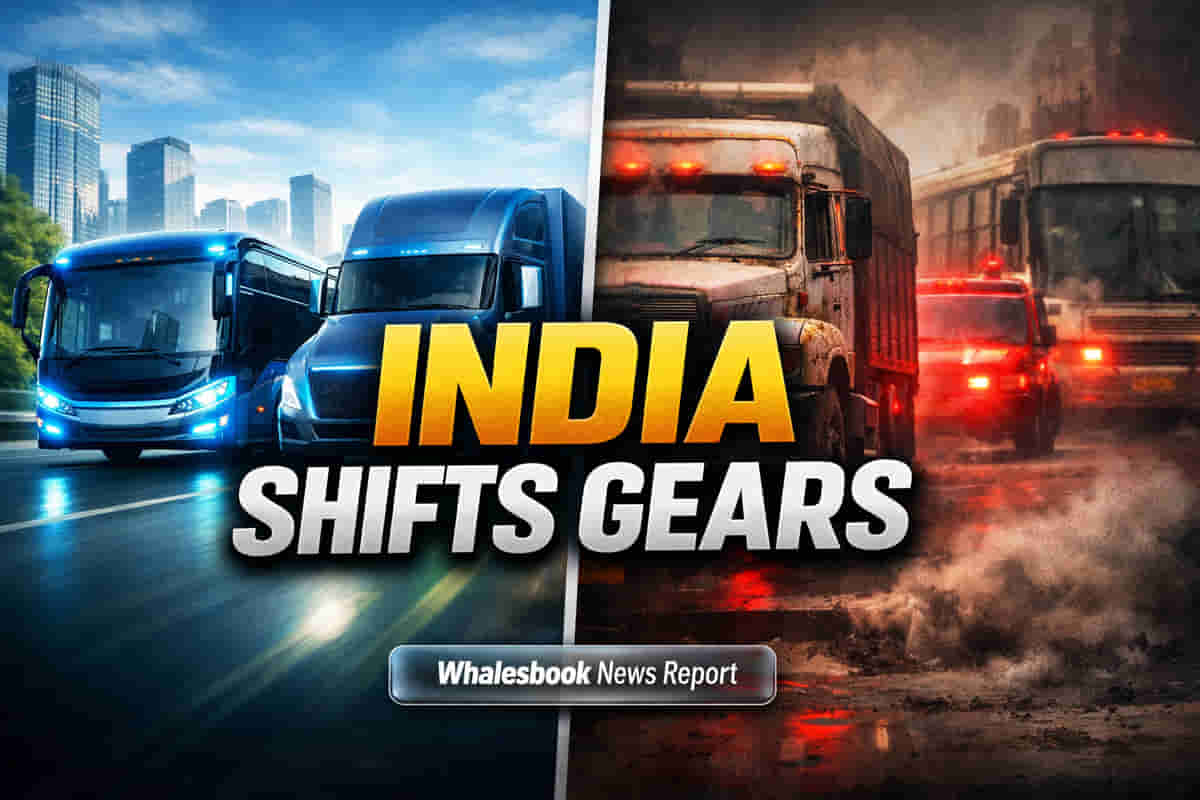
India Prioritizes Electric Buses and Trucks for 2026
India is strategically pivoting its electric vehicle (EV) policy for 2026, placing a significant emphasis on the adoption of electric buses and trucks, alongside the expansion of charging infrastructure. This redirection is crucial for achieving the nation's ambitious target of 30% electric mobility by 2030.
The Core Issue
The government's priority under the ₹10,900 crore PM E-Drive scheme will be on e-trucks and e-buses. This comes as incentives for electric two- and three-wheelers under the same scheme are scheduled to conclude in March 2026. A senior government official confirmed this strategic shift, signaling a move away from personal electric mobility towards commercial and public transport solutions.
Financial Implications
The overall adoption of EVs in India saw a rise in 2025, crossing 2 million units despite global supply chain disruptions linked to China's rare earth dominance. However, the government's decision to focus on larger vehicles is driven by their greater contribution to greenhouse gas emissions and air pollution compared to smaller vehicles. Sales of e-buses and e-trucks, while growing, still represent a small fraction of the market. In fiscal year 2025, approximately 4,000 electric buses were sold, dwarfed by around 63,000 diesel buses. Similarly, only 496 medium and heavy electric trucks were sold by December 2025, against over 291,000 diesel counterparts.
The primary hurdle remains cost; electric trucks and buses are roughly 2.5 times more expensive than their internal combustion engine (ICE) equivalents. The PM E-Drive scheme allocates ₹4,391 crore for e-bus incentives, aiming to support the deployment of 14,028 new buses procured by state transport undertakings.
Market Reaction
New-age manufacturers like PMI Electro Mobility, Eka Mobility, and Olectra Greentech recently secured nearly 80% of India's largest electric bus tender, indicating strong interest and capability in this segment. These companies are focusing on increasing localization and strengthening domestic supply chains to improve cost-competitiveness and resilience.
Official Statements and Responses
A spokesperson for PMI Electro Mobility Solutions Pvt. Ltd. stated their focus for 2026 is on accelerating localization of high-value components and co-developing with Indian suppliers to support the self-reliant EV ecosystem. They highlighted that their e-bus sales placed them second only to Olectra Greentech in 2025.
Historical Context
The PM E-Drive scheme is the first major incentive plan since FY15 to specifically target electric trucks. While the operational guidelines for e-truck incentives were clarified in July, the market remains nascent. Previous incentive programs like FAME (Faster Adoption and Manufacturing of Electric and Hybrid Vehicles) have faced challenges with patchy disbursal due to compliance and local supply chain requirements. Separate Production-Linked Incentive (PLI) schemes for zero-emission vehicles (PLI-Auto) and batteries (PLI-ACC) are also in place, though PLI-ACC disbursals for indigenous battery making are lagging.
Future Outlook
Experts believe India's 30% EV adoption goal by 2030 hinges on the rapid scaling of the commercial vehicle segment. While more e-truck pilot projects are expected in 2026, large-scale deployment may take time. Battery prices are declining, and financing models are maturing, making EVs more affordable. The total cost of ownership for electric buses is becoming competitive with ICE buses in urban settings. India's commercial EV financing market is projected to grow significantly to nearly $20 billion by 2030. Battery swapping is also emerging as a facilitator, particularly for heavy-duty vehicles.
Regulatory Scrutiny
The government's policy think tank, NITI Aayog, has advocated for a stricter 'carrot-and-stick' approach, suggesting increased registration fees, tougher emission standards, and higher input taxes on ICE vehicles to accelerate the transition. Dependence on Chinese components, particularly rare earth magnets, remains a concern, pushing Indian manufacturers towards greater localization.
Expert Analysis
Kunal Mundra, founder and chief executive of Astranova Mobility, emphasized that commercial segment scaling is key to India's EV goals. Shyamasis Das, fellow at the Centre for Social and Economic Progress, noted diesel's significant contribution to air pollution. The automotive industry is actively reducing dependency on Chinese suppliers amidst global geopolitical disruptions.
Impact
This policy shift could significantly boost the commercial EV manufacturing sector in India, potentially leading to growth for companies involved in electric bus and truck production, battery technology, and charging infrastructure. It may also impact traditional diesel vehicle manufacturers. The shift aims to improve urban air quality and reduce India's reliance on fossil fuels, contributing to national climate goals. However, challenges in cost, infrastructure, and supply chain management need to be addressed for successful mass adoption.
Impact Rating: 8/10
Difficult Terms Explained
- Electric Mobility: The use of vehicles powered by electricity, such as battery electric vehicles (BEVs) and plug-in hybrid electric vehicles (PHEVs).
- PM E-Drive Scheme: A government incentive scheme aimed at promoting the adoption of electric vehicles in India.
- Rare Earths: A group of 17 chemical elements with unique properties crucial for many modern technologies, including EV components, and often sourced from specific regions like China.
- Greenhouse Gases: Gases in Earth's atmosphere that trap heat, contributing to global warming and climate change.
- Particulate Matter: Tiny solid or liquid particles suspended in the air, often from combustion, which can harm respiratory and cardiovascular health.
- Internal Combustion Engine (ICE): A type of engine that burns fossil fuels (like petrol or diesel) to produce power, commonly found in traditional vehicles.
- State Transport Undertakings (STUs): Government-owned entities responsible for public road transport services in various Indian states.
- Localization: The process of increasing the domestic production of components and manufacturing within a country to reduce reliance on imports.
- Production-Linked Incentive (PLI) Schemes: Government initiatives that offer financial incentives to companies based on their incremental sales of manufactured goods.
- FAME: Faster Adoption and Manufacturing of Electric and Hybrid Vehicles, an earlier Indian government scheme to promote electric mobility.
- Battery Swapping: A technology that allows for the quick replacement of a depleted battery with a fully charged one, rather than waiting for it to recharge.
- NITI Aayog: The National Institution for Transforming India, a government think tank that advises on policy and programs.