 Whalesbook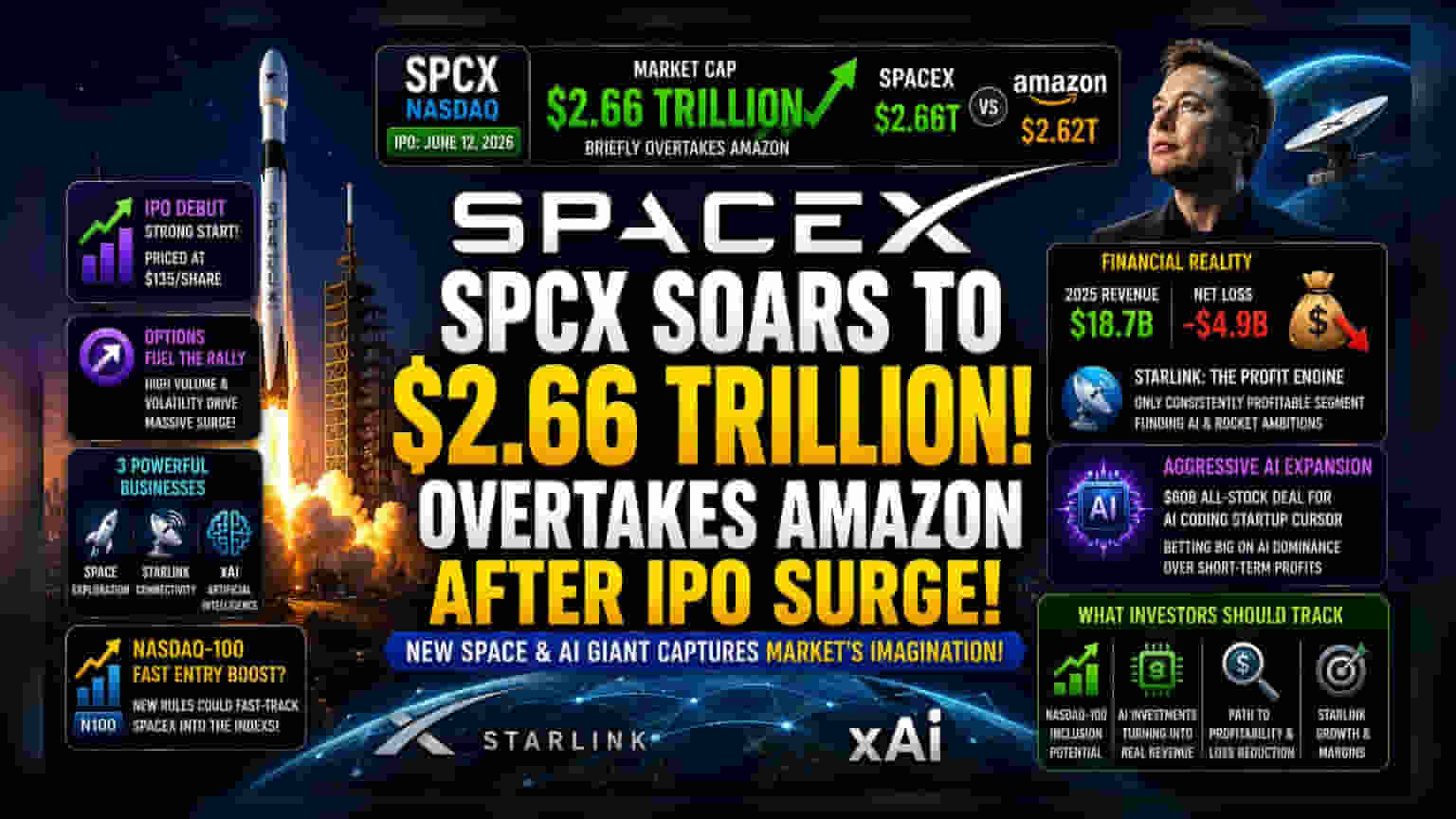


SpaceX, which debuted on the Nasdaq on June 12, 2026, has quickly become one of the world's most valuable companies, surpassing Amazon with a market cap of roughly $2.66 trillion. While the stock has seen a massive rally fueled by intense trading and investor confidence in Elon Musk's ventures, analysts remain divided due to the company's complex three-business structure and significant net losses.
What Happened
SpaceX (trading under the ticker symbol SPCX) has experienced a rapid rise in valuation shortly after its initial public offering (IPO) on the Nasdaq exchange on June 12, 2026. The rocket and technology company saw its market capitalization climb to approximately $2.66 trillion, briefly overtaking e-commerce giant Amazon in global rankings. This sharp increase follows an IPO pricing of $135 per share, with the stock seeing significant upward movement in the days following its debut.
Why This Matters For Investors
The market rally reflects high investor optimism regarding Elon Musk's combined business empire. Following a major corporate restructuring earlier this year, SpaceX is no longer just a rocket manufacturer. It now operates as a three-headed conglomerate encompassing space exploration, the Starlink broadband connectivity business, and an artificial intelligence (AI) division through its acquisition of xAI. Investors are currently betting that these combined units—supported by the massive infrastructure being built for AI and satellite internet—will dominate future technology markets.
The Role of Options Trading
Part of the intense stock volatility and price surge is tied to the launch of options trading on the newly listed shares. High volumes of options contracts injected extra momentum into the stock, a common phenomenon for highly anticipated new listings. This frenzied trading activity helped push the company's valuation to new highs, making it a central focus for both retail and institutional market participants.
Profitability and Financial Reality
While the market valuation has reached trillion-dollar levels, investors are scrutinizing the company's financial fundamentals. SpaceX reported revenue of approximately $18.7 billion in 2025, but it also posted a net loss of $4.9 billion. A significant portion of this is attributed to the high costs of building out its AI infrastructure and integrating the xAI business. Within the company, Starlink is currently the primary revenue generator and the only consistently profitable segment, effectively subsidizing the expensive capital spending required for the company's AI and rocket-testing ambitions.
The Business Strategy Question
The company’s recent aggressive moves, such as the reported $60 billion all-stock deal to acquire the AI coding startup Cursor, highlight a strategy of heavy expansion into AI. Critics and analysts have raised questions about this strategy, suggesting that the company is prioritizing rapid growth and AI dominance over immediate profitability. For shareholders, the core debate is whether the current high valuation is justified by the long-term potential of this integrated business model or if it is heavily influenced by speculative excitement.
What Investors Should Track
One of the most important factors for the stock in the coming months will be its potential inclusion in major market indices like the Nasdaq-100. Nasdaq has recently introduced "fast entry" rules that could allow newly listed, large-cap companies to join the index sooner than historically allowed. Inclusion in such indices would force index-tracking funds to buy the stock, potentially creating a new wave of demand. Beyond this, investors will likely monitor the company’s ability to turn its AI investments into actual revenue and whether it can narrow its net losses as the business scales.