

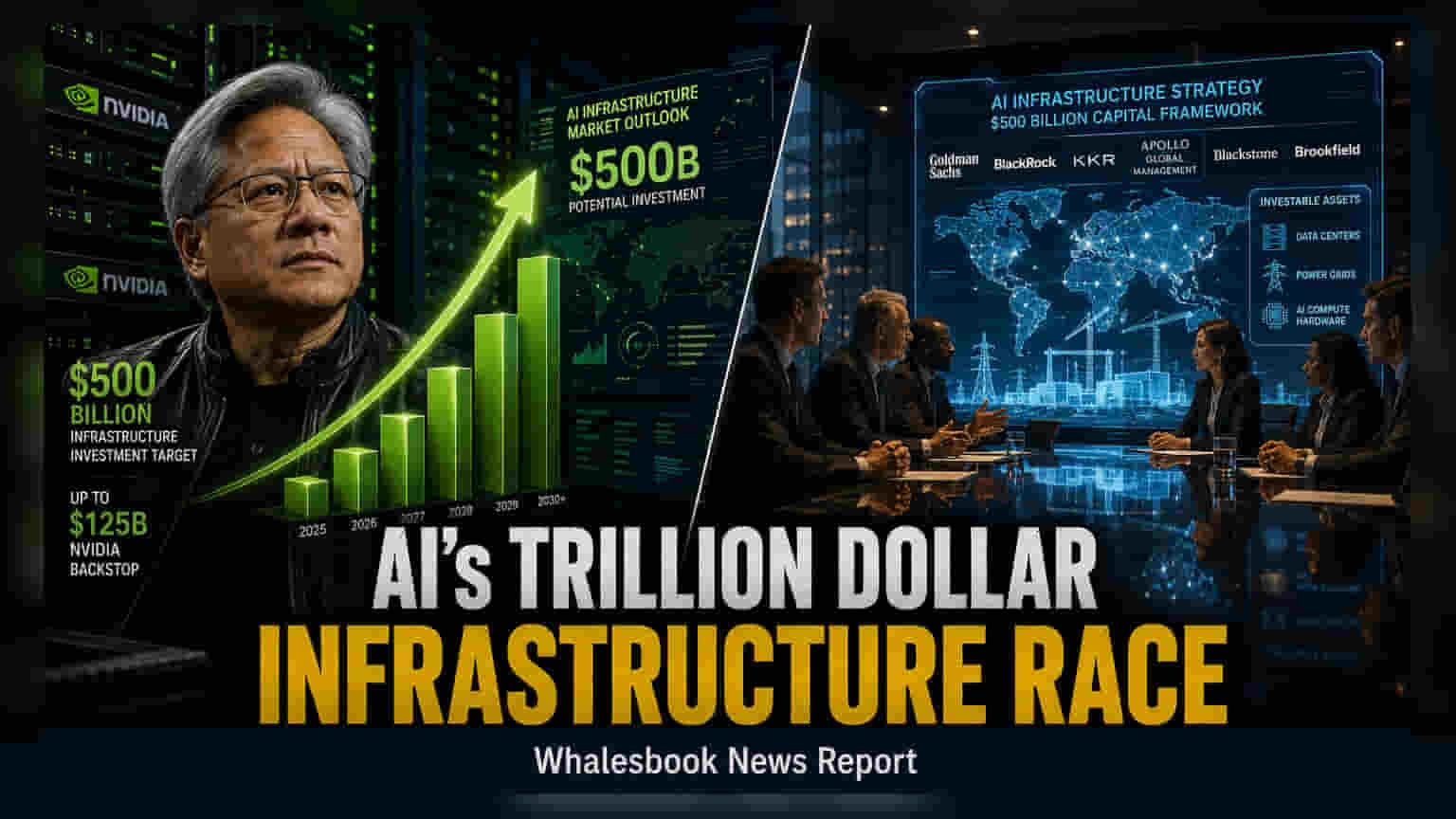
Nvidia is partnering with global financial firms like BlackRock and Goldman Sachs to create a $500 billion financing framework for AI infrastructure. The move aims to treat AI computing capacity as a long-term asset class, though the complexity and funding model have sparked caution among some market participants, leading to a recent dip in the company’s share price.
Nvidia has announced a collaborative framework with six major global financial institutions, including BlackRock, Goldman Sachs, KKR, Apollo Global Management, Blackstone, and Brookfield, to channel up to $500 billion into artificial intelligence infrastructure. The primary goal of this initiative is to reclassify data centers, power grids, and AI computing hardware from volatile technology products into stable, long-term investable assets. This strategy reflects a growing need for massive, sustained capital to support the global demand for AI processing power, which often exceeds the balance sheet capacity of individual technology companies.
It is important for investors to understand that this $500 billion figure is an ambitious capital-raising target for future infrastructure projects, rather than a single, immediately available fund. Under the proposed framework, Nvidia may optionally backstop up to $125 billion, or 25% of the potential deal volume, to encourage third-party investment. The structure is designed to create new financing platforms, allowing institutional investors to gain exposure to the AI ecosystem without necessarily funding technology projects directly.
Following the announcement, Nvidia’s share price experienced volatility, with a decline of approximately 2-3% on the day. Market participants have reacted with caution, raising questions about the complexity and long-term implications of this financial model. A key concern frequently cited by analysts involves the risk of circular financing, where Nvidia might effectively provide the capital that enables customers to purchase its own products. Investors are weighing whether the potential for sustained demand outweighs these structural risks.
Another significant risk factor for this asset class is the speed of technological change. Traditional infrastructure, such as power plants or real estate, often has a useful life spanning several decades. In contrast, AI hardware like GPUs faces rapid obsolescence. There is a potential mismatch between the long-term nature of the debt or financing terms being proposed and the shorter economic life of the actual technology assets. If the demand for AI does not grow at the projected rate, or if the hardware becomes outdated faster than expected, the returns on these large-scale infrastructure investments could come under pressure.
Moving forward, the primary factor for investors to track will be the actual deployment of capital and the structure of individual deals. The success of this initiative will depend on whether these projects can generate stable, long-term returns independent of the current AI hype cycle. Observers will also be looking for further management commentary regarding how Nvidia plans to balance its role as a technology provider with its new, deeper involvement in the financial engineering of its own sector’s expansion.