

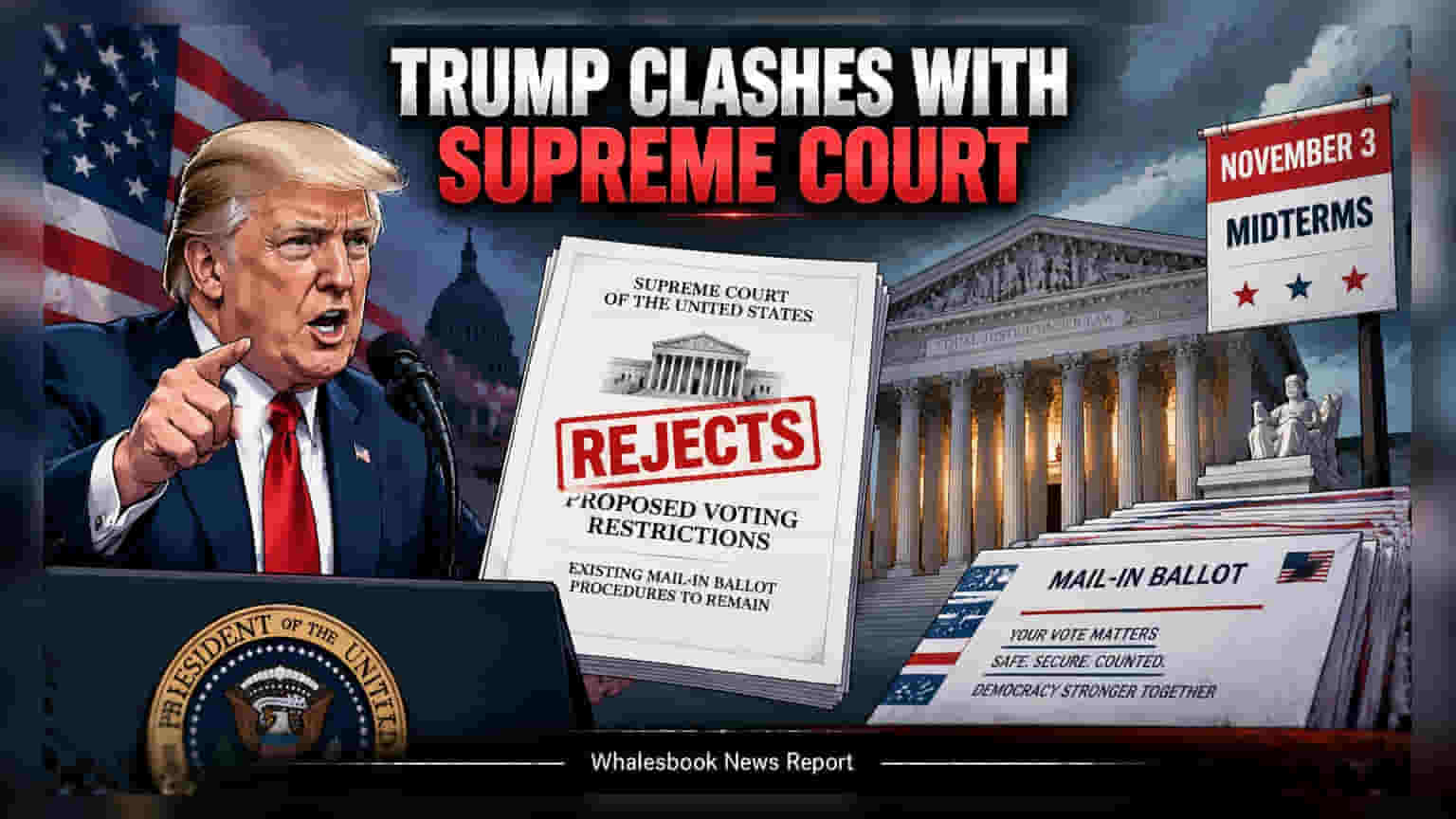
The U.S. Supreme Court has blocked a move to restrict mail-in voting for the November 3, 2026, midterms, citing a lack of time for implementation. President Donald Trump publicly criticized the decision, marking another instance of friction between the administration and the judiciary. While the ruling lacks direct corporate impact, it adds to political uncertainty ahead of the U.S. elections.
The U.S. Supreme Court issued an unsigned order on September 14, 2026, effectively maintaining existing mail-in ballot procedures for the November 3 midterm elections. The Court’s decision upholds a lower court's preliminary ruling, which had prevented the U.S. Postal Service from implementing new restrictions on how mail ballots are handled. The Court based its decision on the practical assessment that state and local election officials did not have sufficient time to reasonably adapt to these changes before voting takes place.
Following the announcement, President Donald Trump publicly condemned the Supreme Court, labeling the ruling as highly political and claiming the institution had failed the country. This reaction highlights the ongoing tension between the current administration and the judiciary. Within the Court, Justices Samuel Alito and Clarence Thomas dissented from the majority opinion, while Justice Brett Kavanaugh concurred, specifically emphasizing the logistical inability to implement changes in the short time remaining before the elections.
From an investor perspective, this specific ruling does not have a direct financial, corporate, or stock market impact. It is a procedural election matter and does not involve specific listed companies, order books, or regulatory approvals that would change business fundamentals. However, for those tracking global markets, political developments in the United States are often watched for their potential to influence broader economic policy over the long term.
Institutional friction and election-related uncertainty are often monitored by global market participants because they can eventually influence trade policy, tariff discussions, and fiscal spending plans. While this specific ruling regarding mail-in ballots is procedural and avoids an abrupt change to voting systems, the primary focus for investors remains on how the upcoming November 3 elections might shape future U.S. policy decisions. Market analysts generally look for signals regarding potential changes in international trade relations or domestic fiscal measures, which have a more significant indirect influence on global financial conditions than procedural election rules. There are no immediate monitorables for investors beyond observing the general political environment in the lead-up to the midterms.