 Whalesbook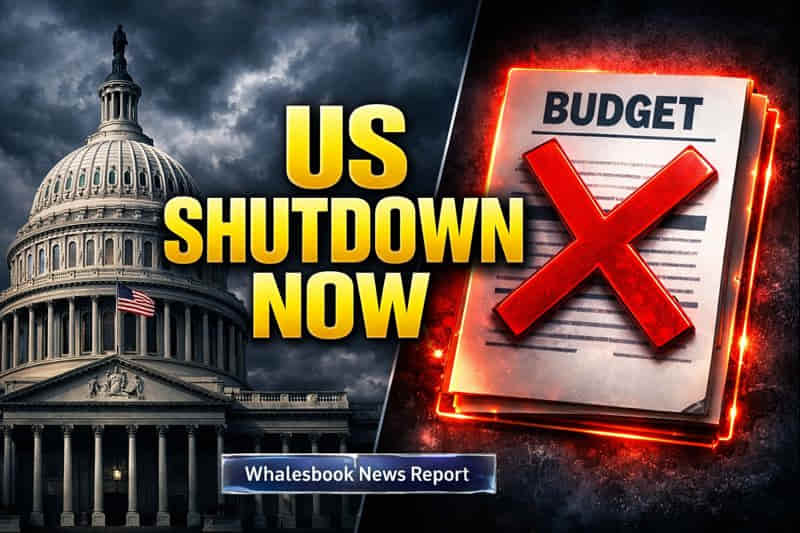
THE SEAMLESS LINK
This fiscal disruption halts essential government functions, impacting critical sectors and federal workers. Historically, market indicators show resilience to such political gridlock, suggesting minimal long-term economic consequences if resolved promptly.
Market Resilience Amid Shutdown
The U.S. government's partial shutdown on January 31, 2026, marks another instance of fiscal brinkmanship. Approximately 75% of federal operations have ceased, affecting key areas such as education, health, housing, and defense sectors. Federal employees may face unpaid leave or continue working without immediate compensation. Historically, such disruptions have had a muted impact on broader market performance. Data shows the S&P 500 has averaged near flat performance during government closures, with gains occurring in over half of such instances. Since 1990, the index has consistently risen during shutdowns, averaging a slight uptick of 0.3%. Significant market drawdowns are rare, with the maximum recorded since 1980 being just 2.2%. Post-resolution, markets typically strengthen, with the S&P 500 showing average gains of 1.2% one month and 2.9% three months later. This historical trend suggests that while volatility may occur, long-term market trajectories are primarily dictated by corporate earnings and global economic factors rather than legislative stalemates.
Political Standoff and Economic Ripples
The current shutdown stems from a failure to agree on the 2026 budget, specifically stalling Department of Homeland Security (DHS) funding due to Democratic opposition. This opposition is linked to recent actions by federal immigration agents, including the fatal shootings of two protesters in Minneapolis, prompting demands for reforms. The Senate addressed the immediate crisis by passing a funding package to sustain most federal agencies through September, coupled with a temporary two-week extension for DHS operations. This allows lawmakers time to negotiate immigration enforcement details. Economically, shutdowns trim GDP growth by an estimated 0.2% to 0.6% per week. A prolonged shutdown could reduce real GDP by billions, though this is a small fraction of the overall economy. Beyond direct GDP impact, these events cause disruptions, delaying applications for passports, small business loans, and government benefits, and can affect private-sector investment decisions if uncertainty persists. While government agencies like HHS will maintain minimal readiness for health hazards and continue support for Medicare and Medicaid, some functions like data collection and grant oversight will be suspended. Contingency plans and back pay for furloughed workers, along with contractor premiums for uncertainty, tend to offset potential cost savings from shutdowns.
Path to Resolution
The immediate outlook points toward a swift end to the current lapse. The Senate's approval of a funding package, which President Trump has endorsed, sets the stage for rapid action. The House of Representatives is expected to convene and vote on the legislation early in the upcoming week. This process is anticipated to restore federal funding within days, thereby limiting the practical impact on government services, contractors, and employees. The two-week extension for DHS funding signifies that negotiations over immigration policy will continue even as other agencies resume operations.