 Whalesbook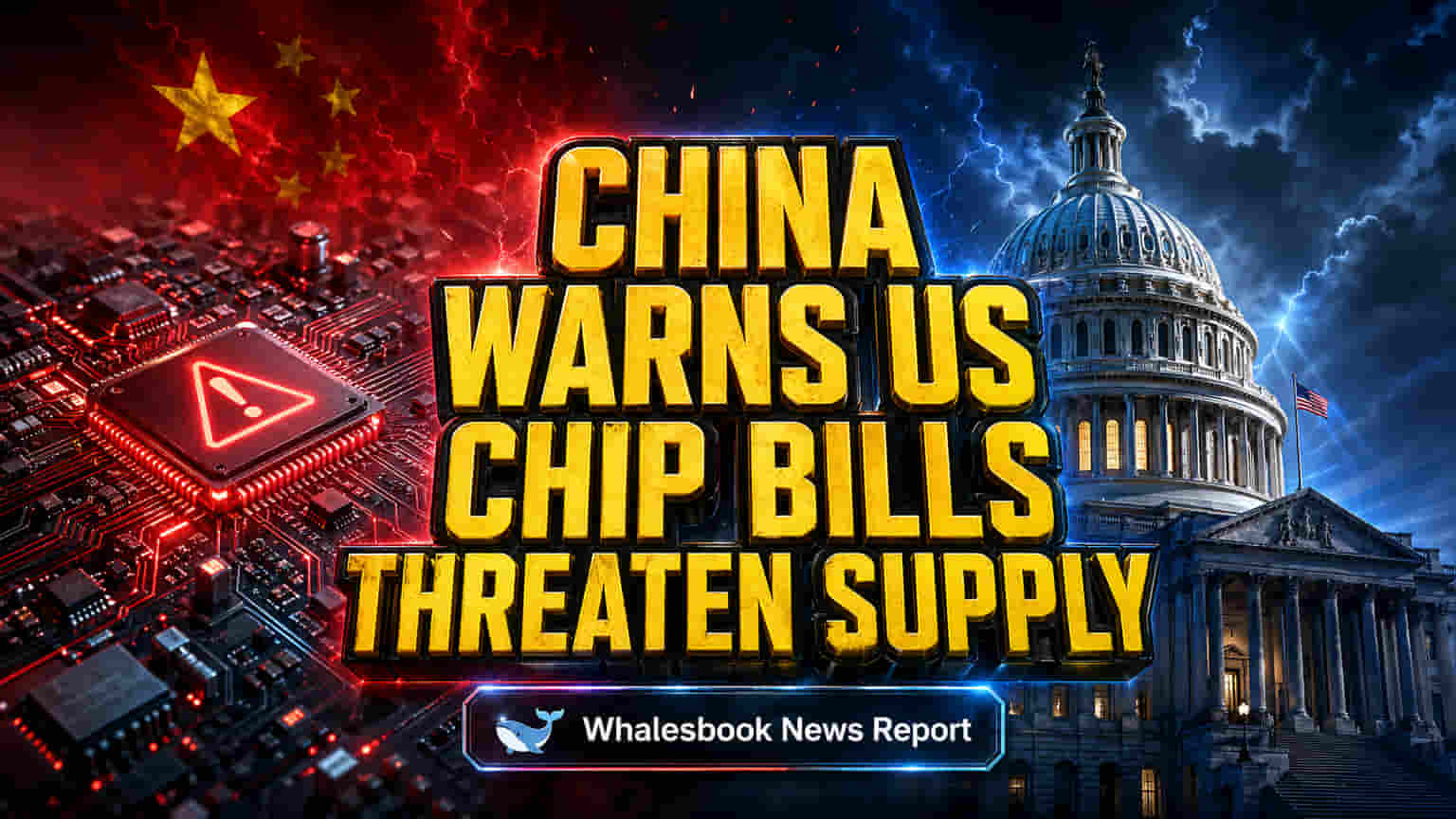


US Tightens Chip Export Controls
Legislative actions by U.S. lawmakers, including the Multilateral Alignment of Technology Controls on Hardware Act (MATCH Act), aim to restrict advanced semiconductor technology exports to China. These measures specifically target semiconductor manufacturing equipment and seek to align allied nations' controls. China's Ministry of Commerce has criticized these actions as an overreach of national security justifications for trade curbs, warning of disruptions to the global chip industry. Beijing has stated it will assess the impact on its national interests and take necessary steps to protect domestic companies, without specifying countermeasures.
Global Chip Market Braces for Growth and Risk
The global semiconductor industry is expected to see significant growth, with Gartner projecting revenues to exceed $1.3 trillion in 2026, largely driven by demand for AI processing power. AI semiconductors are anticipated to account for 30% of total revenue, and memory segments are experiencing record price increases, referred to as 'memflation.' Leading AI chip supplier TSMC reported a 58% profit increase in the first quarter, with AI and high-performance computing making up 61% of its revenue. ASML, a vital maker of lithography equipment, also posted strong Q1 results. However, this positive outlook is shadowed by rising geopolitical risks. Tariffs and trade policy are top worries for industry leaders, and supply chain flexibility is a key priority. The MATCH Act itself introduces uncertainty, potentially creating difficulties with compliance and market access for key equipment suppliers.
China's Accelerated Push for Self-Sufficiency
In direct response to U.S. export controls, China is pushing hard for chip self-sufficiency. Beijing is reportedly considering a substantial $70 billion injection into its domestic chip industry, aiming to strengthen chip making and design capabilities. Key players like SMIC, China's largest foundry, are reportedly finalizing a 5nm-equivalent process. However, they rely on older Deep Ultraviolet (DUV) lithography instead of the more advanced EUV machines used by global leaders, a key limitation. Memory manufacturers like YMTC and CXMT are also advancing, with YMTC mass-producing 270-layer 3D NAND chips. Despite significant progress and investment, China faces major challenges reaching the level of global leaders, especially in advanced chip production, due to limited access to critical equipment.
Key Suppliers Caught in the Middle
Major equipment and foundry players are dealing with this complex situation. TSMC's stock has performed well, boosted by AI demand, and analysts largely rate it a 'Strong Buy.' Applied Materials, another key equipment provider, has also seen stock momentum, although some see its valuation as very high, and insider selling has been observed. ASML, vital for advanced chip making, continues to report strong financials but faces scrutiny from the MATCH Act, which could impact its revenue. ASML's sales geography has already shifted, with revenue from China decreasing in Q1 2026.
Risks: Fragmentation, Retaliation, and Valuation
The U.S. actions and China's drive for self-sufficiency risk creating two separate global tech systems. This split could cause inefficiency, duplicated development, and a less integrated global market, slowing innovation and raising costs. China has retaliated before, restricting exports of critical minerals like gallium and germanium. Geopolitical instability, like conflicts in the Middle East, pressures supply chains and puts companies, especially South Korean memory producers Samsung and SK Hynix, at risk for energy and materials security. Valuations for some key equipment makers, like Applied Materials which trades at a much higher P/E ratio than usual, seem high, making them vulnerable to market sentiment shifts or new regulations. The MATCH Act directly targets equipment like ASML's DUV lithography machines, posing a regulatory risk to its revenue.
Outlook: Balancing Demand and Geopolitics
The chip industry's path in 2026 will be shaped by strong AI demand and growing geopolitical pressures. While growth forecasts remain positive, companies must navigate potential supply chain splits, strategic decoupling, and tougher regulations. Balancing AI demand with geopolitical risks and compliance challenges will be key to staying a market leader and remaining profitable.