

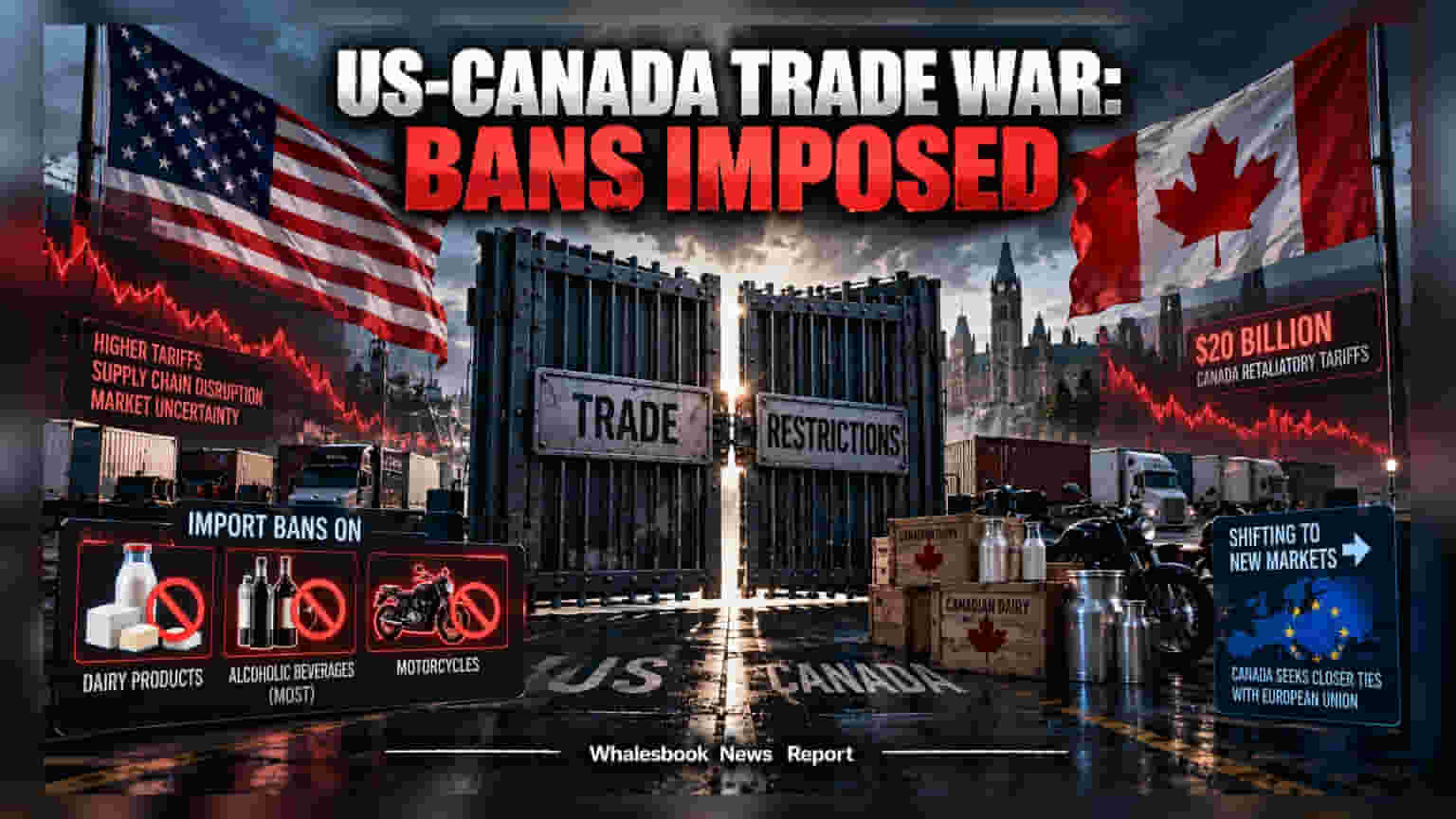
The United States has announced an import ban on Canadian dairy, alcohol, and motorcycles, effective September 29, 2026. This follows Canada’s decision to impose $20 billion in retaliatory tariffs on American goods. The ongoing trade conflict creates supply chain uncertainty and potential cost pressures for businesses operating across the border.
The United States has announced a new set of trade restrictions targeting Canadian imports, marking a significant escalation in the ongoing economic conflict between the two nations. Starting September 29, 2026, the US will ban the import of Canadian dairy products, most alcoholic beverages, and motorcycles. This move follows Canada's implementation of $20 billion in retaliatory tariffs on American goods, which officially came into force earlier today.
In addition to the import bans, the US government has taken steps to restrict Canadian access to domestic business opportunities. President Donald Trump has directed the General Services Administration to block Canadian firms from competing for large-scale US federal government procurement contracts. This policy aims to limit Canadian companies' ability to bid for significant public projects, citing a lack of reciprocal market access for American exporters.
Impact on Business and Trade
These trade barriers create substantial uncertainty for industries that rely on deep integration between the two economies. Sectors ranging from agriculture and automotive manufacturing to beverage production are now facing complex logistical challenges. Businesses that rely on cross-border supply chains may encounter increased costs, shipment delays, and the need to restructure operations to comply with the new rules.
For investors and corporate leadership, the primary concern is the potential destabilization of the existing trade environment. The sudden imposition of tariffs and trade bans complicates long-term planning for companies with significant assets or market share in both countries. Additionally, the broader diplomatic tension and the collapse of bilateral trade negotiations from last month raise concerns about the stability of the US-Canada trade relationship and the future of the North American trade framework.
Strategic Shifts and Future Outlook
In response to the deteriorating trade relationship, Canadian Prime Minister Mark Carney has outlined a plan to reorient the country’s economic strategy. The government is now actively looking to deepen economic ties with the European Union, aiming to reduce Canada's long-standing reliance on the American market. Canadian officials are currently in discussions to explore new treaty frameworks and cooperation models that could buffer the domestic economy against future US protectionist measures.
Investors and market participants are now tracking how these trade barriers will influence operational costs and corporate earnings for cross-border firms in the coming quarters. The next significant development to monitor will be whether there are any diplomatic efforts to cool tensions or if the trade conflict continues to deepen, potentially affecting a wider range of industries.