

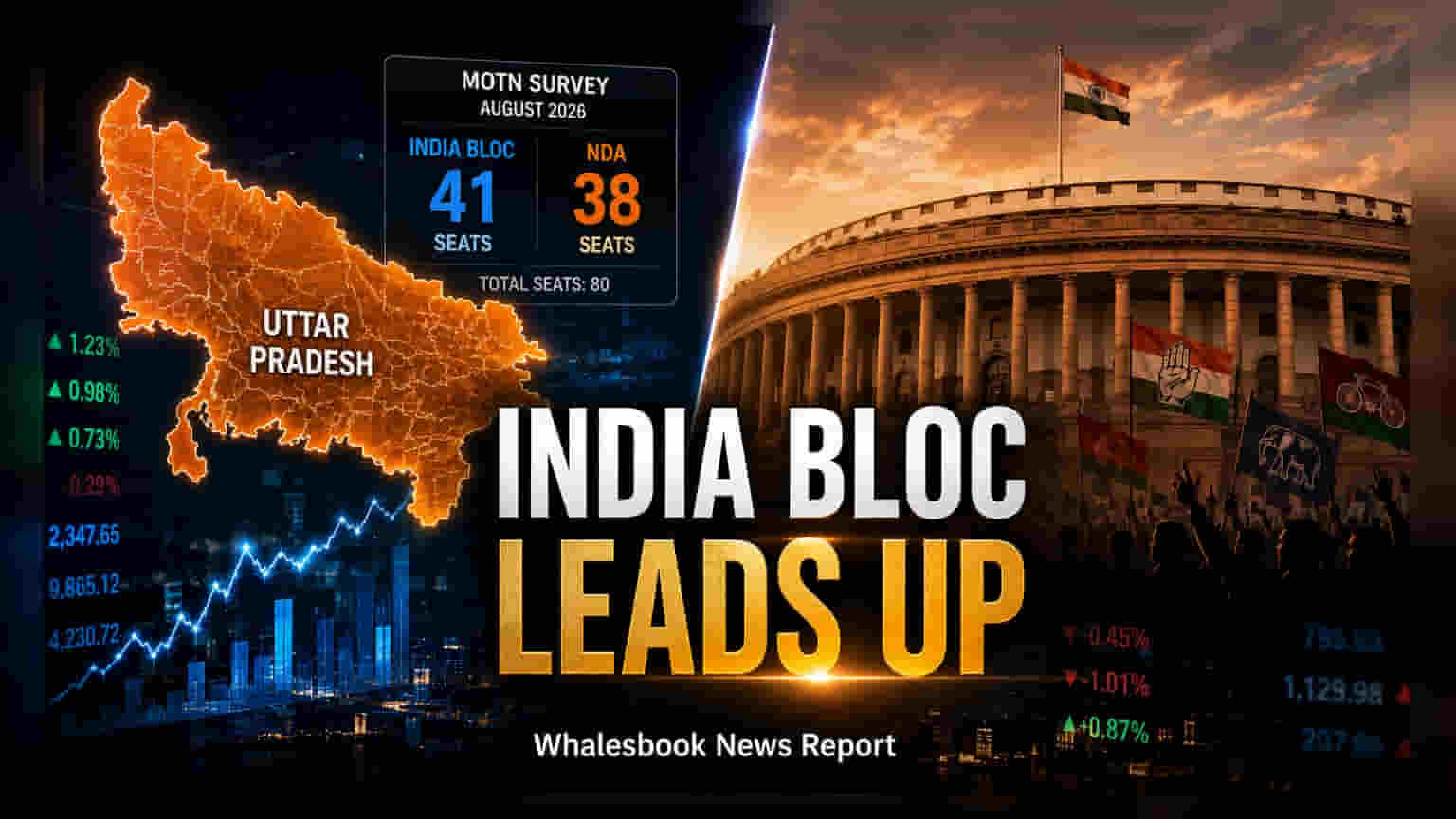
The August 2026 Mood of the Nation survey indicates a shift in Uttar Pradesh, projecting 41 Lok Sabha seats for the INDIA bloc against 38 for the NDA. This result marks a reversal from January 2026 projections, which previously favored the NDA. Investors often review such data to assess the stability of future policy environments and reform continuity, though political surveys do not impact short-term corporate earnings or fundamentals.
The latest Mood of the Nation (MOTN) survey, conducted in August 2026, highlights a shift in political sentiment within Uttar Pradesh, a state critical to national governance. Data from the survey, carried out by CVoter for the India Today Group, projects that the INDIA bloc could secure 41 of the 80 Lok Sabha seats, with the NDA projected to win 38 seats. This is a notable change from the January 2026 projections, which had anticipated 48 seats for the NDA and 31 for the opposition alliance.
For investors, the primary interest in such data lies in its potential influence on policy predictability and the pace of economic reforms. Financial markets generally prefer stable legislative environments that allow for consistent long-term planning, infrastructure spending, and taxation policy. When polling data suggests a more competitive political environment, investors often assess the potential impact on future legislative outcomes, as these can influence sectors heavily dependent on government spending, such as infrastructure, manufacturing, and state-backed banking.
However, it is essential to distinguish between political sentiment and corporate fundamentals. While shifts in polling can lead to short-term market volatility due to sentiment changes, they do not alter the underlying financial health of businesses. A company’s revenue, profit margins, and debt levels are driven by operational efficiency, demand trends, and global macroeconomic factors rather than political survey results. Corporate earnings remain fundamentally dependent on factors like consumer spending, raw material costs, and interest rate cycles, which operate independently of electoral projections.
Macroeconomic risks remain constant regardless of political polling. The Indian economy faces ongoing challenges, including managing public debt, maintaining fiscal deficit targets, and navigating global trade fluctuations. Analysts often point out that these economic variables, along with the Reserve Bank of India’s monetary policy, have a far more direct and lasting impact on stock market performance and investor returns than periodic opinion polls. The methodology of the latest survey, which included over 25,000 direct respondents and nearly 92,000 interviews over six months, illustrates the scale of the effort but also highlights that voter sentiment remains a fluid and evolving metric.
Investors typically look for clarity rather than directional bias in such data. The next phase for the market will involve observing how these sentiment trends translate into actual government policy and whether the focus remains on economic growth initiatives. For shareholders, the most relevant information continues to be company-specific announcements, quarterly financial results, and management commentary, which provide a clearer picture of growth potential than political projections.