

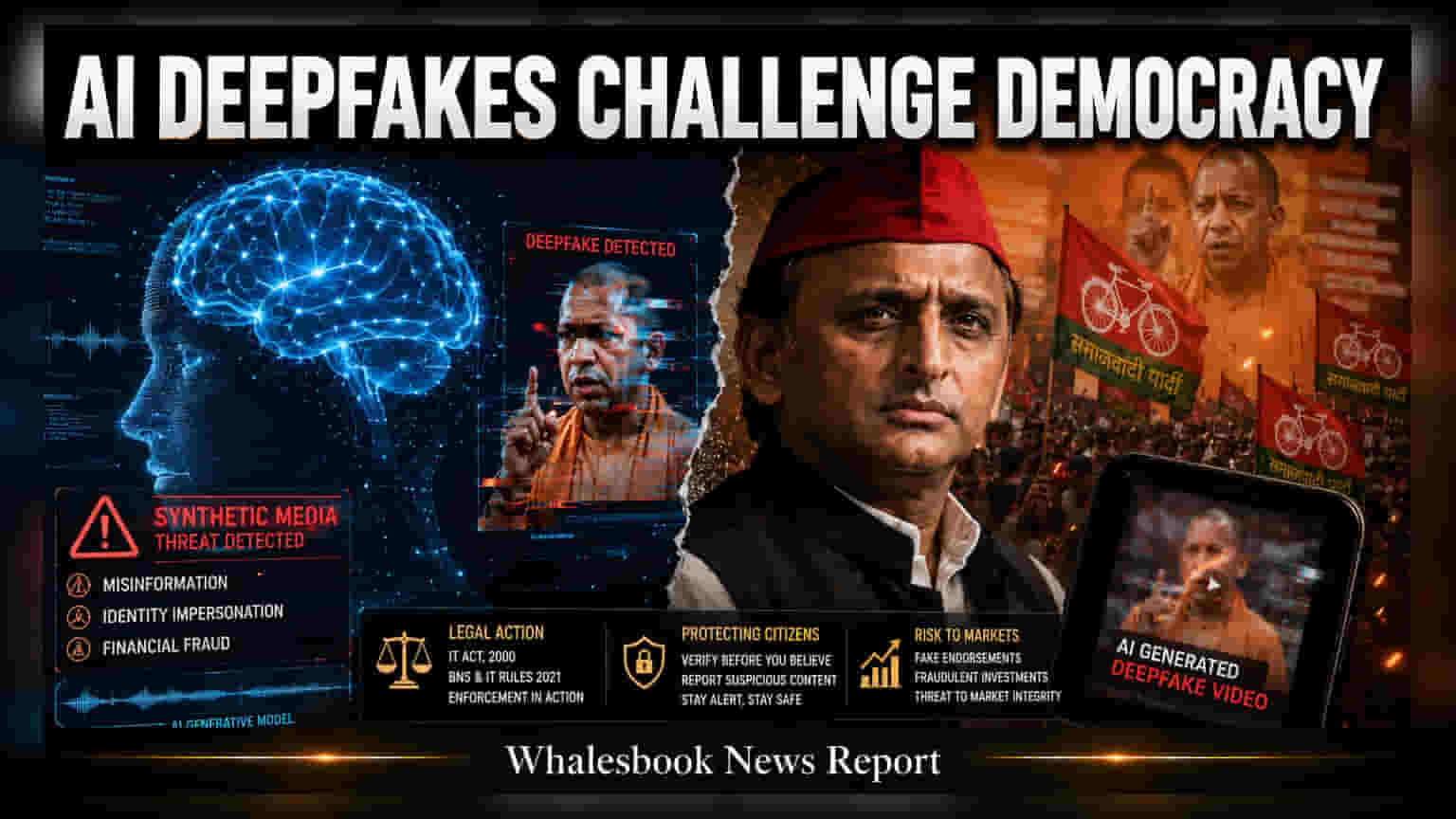
A controversy involving an AI-generated video in Uttar Pradesh politics has raised alarms about the misuse of synthetic media. This incident highlights a growing trend where AI is being weaponized for political narratives and, more critically, for financial fraud targeting the public. As authorities strengthen legal frameworks, the impact on institutional trust and digital security has become a major concern for all sectors.
A heated political debate has emerged in Uttar Pradesh following the use of an AI-generated video by Samajwadi Party president Akhilesh Yadav during a press conference. The content, which targeted Chief Minister Yogi Adityanath, has sparked sharp criticism regarding the erosion of political decorum. While this event highlights a change in campaign strategies, it also underscores a dangerous and broader trend where generative artificial intelligence is being used to manipulate public perception and spread misinformation across the country.
This incident is not an isolated case but part of a wider challenge facing both the public and private sectors in India. The risk of synthetic media has moved well beyond political campaigning. In recent months, malicious actors have increasingly used sophisticated deepfake technology to impersonate senior government officials and key financial leaders. Earlier this year, for instance, Union Minister Piyush Goyal had to file a police complaint after a doctored video containing false remarks about student protests was circulated online.
For investors and the general public, the financial risks are even more direct. There have been several verified instances where deepfake videos were used to impersonate high-ranking executives from the National Stock Exchange (NSE) and the Bombay Stock Exchange (BSE) to solicit fraudulent investments. These scams use synthetic audio and video to create a sense of legitimacy, often tricking individuals into transferring money into illicit schemes. This misuse of technology poses a significant threat to market integrity and individual financial safety.
In response to these developments, the Government of India is actively reinforcing regulatory frameworks to curb the spread of malicious AI content. Authorities are utilizing the existing Information Technology Act, 2000, and the more recent Bharatiya Nyaya Sanhita, alongside the IT Rules 2021, to crack down on the creation and distribution of illegal deepfakes. These regulations aim to place a greater burden on digital platforms and content creators to verify the authenticity of media shared online.
As AI tools become more accessible, the capacity for disinformation campaigns to influence voter perception and facilitate financial crime increases. The critical monitorable for citizens and market participants moving forward will be the effectiveness of these government-led enforcement measures and the ability of digital platforms to identify and block manipulated content in real-time. Until comprehensive safety guardrails are firmly established, the potential for synthetic media to damage public trust and institutional credibility remains a significant risk factor.