

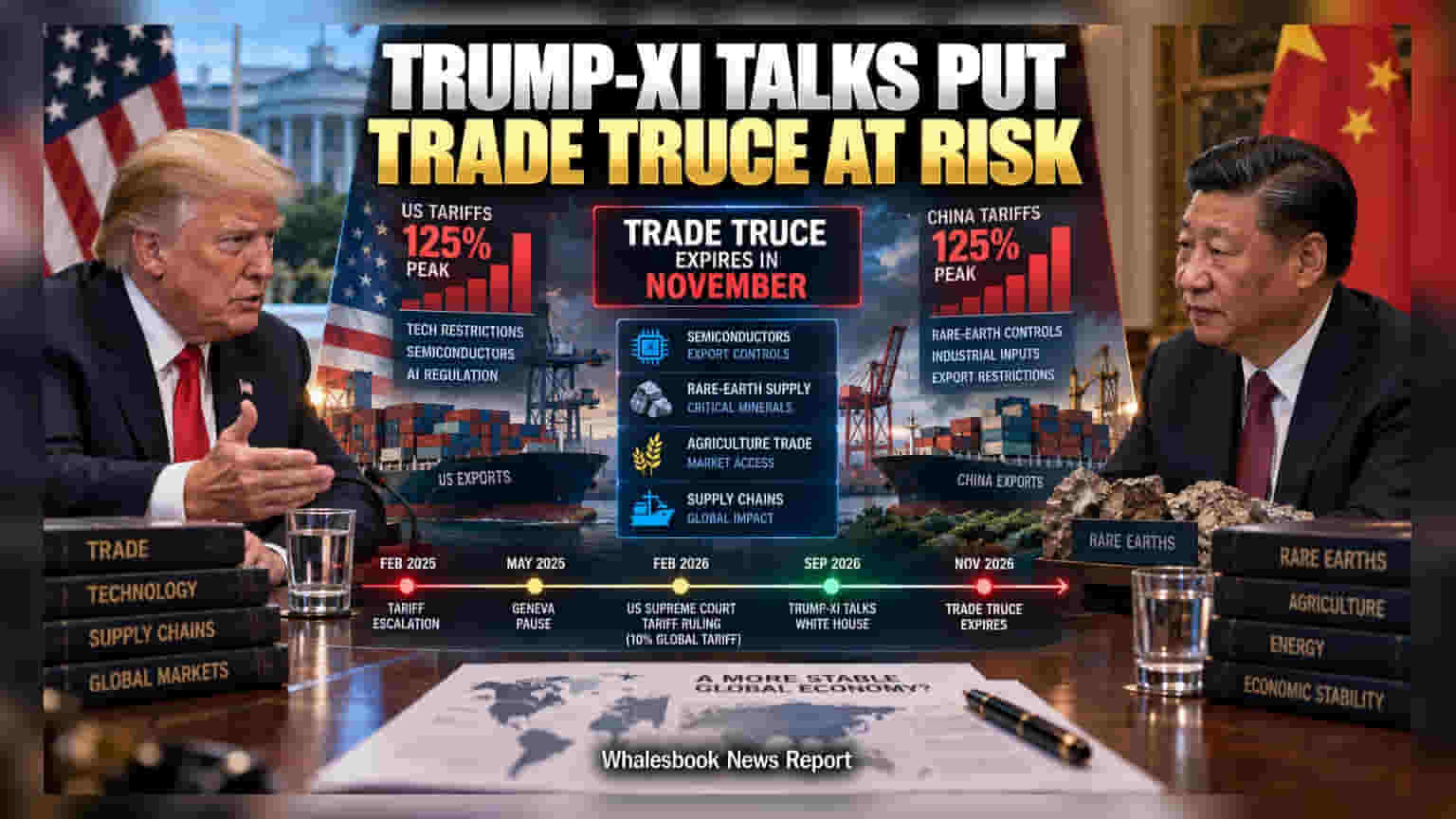
US President Donald Trump and Chinese President Xi Jinping are scheduled to meet on September 24 to address a trade truce expiring in November. For Indian investors, the summit carries significance as global trade tensions can influence commodity prices, foreign fund flows into emerging markets, and potential shifts in global manufacturing supply chains.
US President Donald Trump and Chinese President Xi Jinping are scheduled to meet at the White House on September 24, with the global markets closely watching for updates on a trade truce set to expire this November. While the meeting aims to find common ground, investor expectations remain measured given the volatile history of trade relations between the two largest economies.
History of Trade Friction
The trade relationship has experienced significant fluctuations since early 2025. Following a series of escalations that saw tariffs reaching as high as 125% on both sides, the two nations entered a temporary cooling-off period after negotiations in Geneva. The situation evolved further in February 2026, when the US Supreme Court ruled on the administration's emergency tariff powers, leading to the introduction of a broad, temporary 10% global tariff. Despite various meetings and proposed agreements on agricultural and aviation trade, several issues including rare-earth export controls, advanced technology restrictions, and AI regulation remain unresolved.
Impact on Indian Markets
For Indian investors, the outcomes of this summit carry indirect but important implications. Trade wars and protectionist measures often create volatility in global markets, which can influence foreign institutional investor sentiment toward emerging markets. When global risk increases, capital flows can become unpredictable, occasionally impacting liquidity in the Indian stock market.
Another critical angle for Indian investors is the global supply chain. As the US and China navigate trade restrictions, many multinational companies have accelerated efforts to diversify their manufacturing bases, a strategy often referred to as China+1. India has been positioning itself as a key alternative hub for manufacturing, particularly in electronics and components. Any cooling of tensions might slow this diversification, while a renewal of strict trade barriers could reinforce the need for companies to accelerate their move toward alternative manufacturing locations like India.
Commodities and Cost Pressures
Trade dynamics between the US and China also play a significant role in determining global commodity prices, including crude oil, metals, and agricultural goods. China is a major consumer of raw materials; therefore, any trade-related slowdown or shift in Chinese demand often impacts global commodity price trends. As India is a net importer of many of these commodities, fluctuations in global prices directly affect input costs for domestic manufacturers and can influence domestic inflation trends.
Investors should monitor the outcome of the summit for clear signals regarding the extension of the trade truce. Any move toward de-escalation could bring stability to global trade flows and commodity prices, whereas a breakdown in talks could lead to renewed uncertainty across manufacturing and technology sectors globally.