

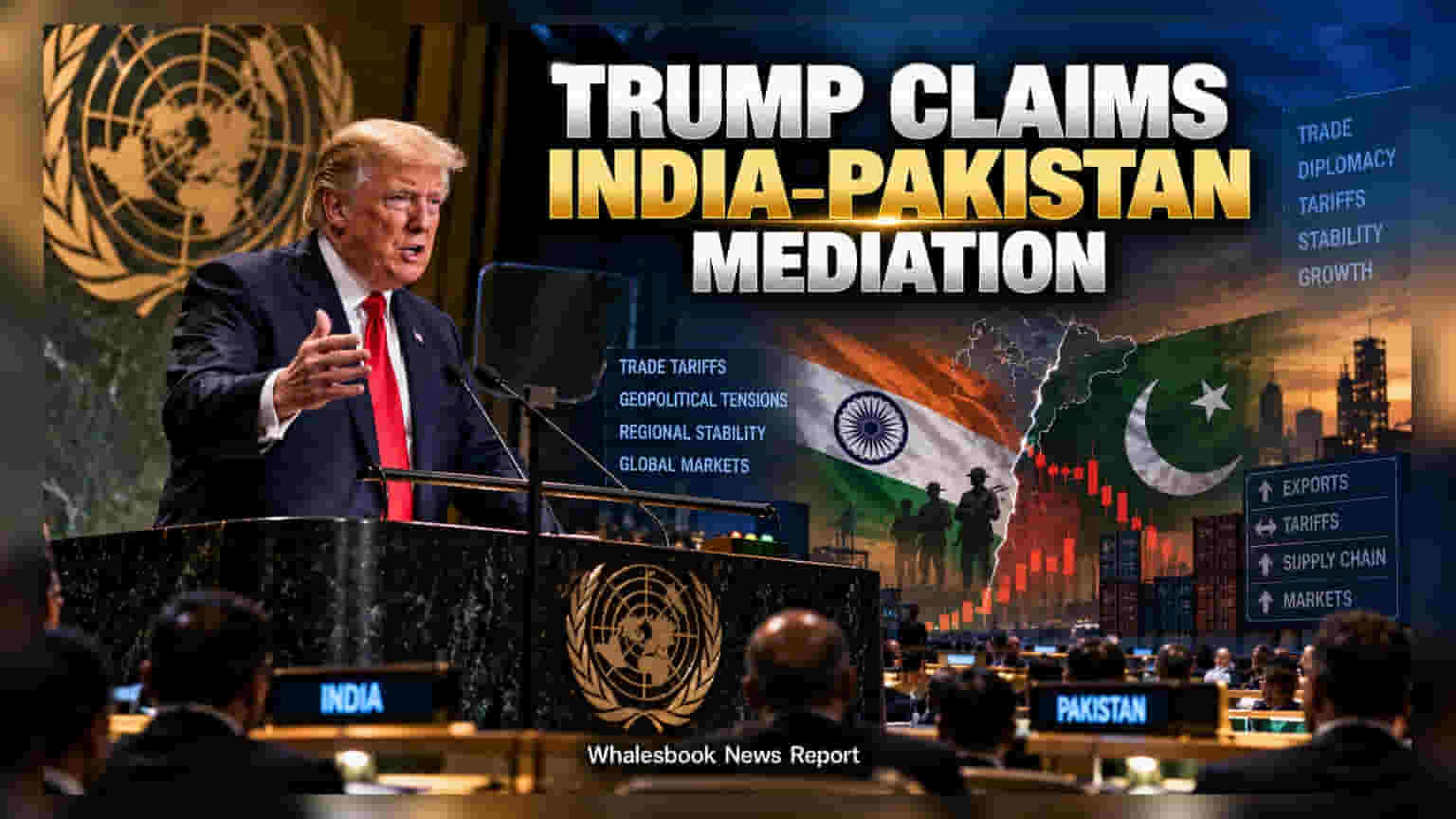
Former President Donald Trump highlighted trade tariffs as a key tool for foreign policy during his UNGA address. While his claims regarding India-Pakistan mediation were noted, investors are focusing on his emphasis on aggressive tariff enforcement, which could influence future trade relations, global supply chains, and market volatility for export-sensitive sectors.
Former US President Donald Trump’s address at the 81st United Nations General Assembly in New York has brought future trade strategy to the forefront of market discussion. While his remarks concerning past mediation efforts in South Asia captured headlines, the primary takeaway for global investors lies in his explicit focus on using trade tariffs as a core lever for future foreign policy.
The former president highlighted new legislative powers granted by Congress regarding tariff enforcement, indicating that trade-related pressure is likely to remain a central pillar of his international agenda. For Indian investors, this signals the need to monitor shifts in US trade policies closely. Sectors heavily reliant on exports—such as information technology, pharmaceuticals, engineering, and textiles—are often sensitive to changes in trade barriers and customs duties, which can impact profitability and supply chain dynamics.
Trump’s assertion that his personal intervention resolved military tensions between India and Pakistan contrasts with the official stance held by New Delhi. The Indian government has consistently maintained that ceasefire agreements along the Line of Control were achieved through direct communication between the respective Directors General of Military Operations. India’s long-standing policy of resolving bilateral matters without third-party mediation remains a cornerstone of its foreign policy framework. For investors, this official clarity is meaningful, as it reaffirms the stability and predictability of India’s diplomatic stance despite varying external narratives.
The speech also outlined a binary, high-stakes approach toward global conflicts and trade negotiations. This rhetoric suggests a preference for direct bilateral pressure, a strategy that can introduce volatility into global markets. As global trade dynamics evolve, investors are keeping track of how such policies might influence customs costs, regional stability, and overall sentiment toward emerging economies. The potential for revised tariff enforcement remains a key monitorable for those tracking long-term risks to trade-linked businesses.