

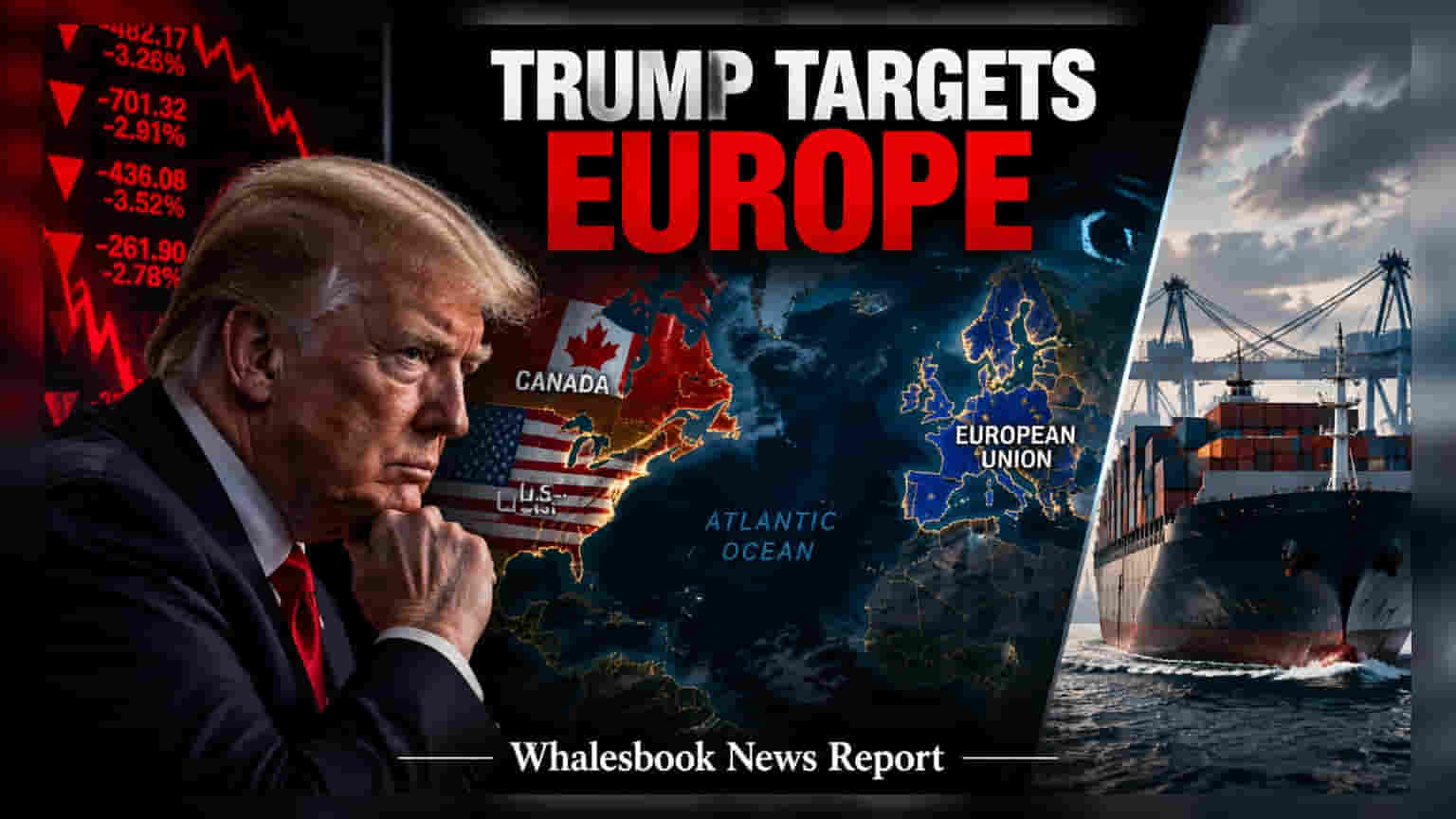
President Donald Trump has warned of 'very heavy' retaliatory tariffs against the European Union, labeling a proposed associate membership for Canada a 'hostile act.' The escalation adds uncertainty for global markets, potentially impacting multinational firms that rely on integrated supply chains across the U.S., Europe, and Canada.
President Donald Trump has escalated trade tensions with a fresh warning against the European Union, declaring that any move to grant Canada 'associate membership' in the bloc could be viewed as a hostile act. The U.S. President stated that such a partnership, if formed with bad intentions toward Washington, would trigger significant retaliatory tariffs or potentially lead to a cut-off in trade.
The rhetoric follows a proposal by European Commission President Ursula von der Leyen to deepen economic and strategic ties with Canada. For the Canadian government, led by Prime Minister Mark Carney, this pivot represents a move to diversify trade relationships amid worsening ties with the U.S. and recent American trade actions. Simultaneously, the U.S. has tightened pressure on Canada by signing a memorandum to exclude Canadian-origin goods from U.S. federal civilian procurement.
For investors and global corporations, this rhetoric signals a period of heightened geopolitical risk. The primary concern is the potential for a renewed cycle of protectionist policies that could disrupt supply chains. Companies that operate in both North American and European markets may face higher compliance costs, potential tariff barriers, and the need to restructure logistics to account for these shifting trade dynamics.
Multinational firms with significant exposure to these regions will likely face increased scrutiny regarding their cross-border dependencies. If the U.S. proceeds with the threatened tariffs, it could lead to increased inflationary pressure on goods traded between these blocks. Investors are now assessing whether this is a precursor to a wider trade conflict or a negotiation tactic to pressure the EU and Canada into revised economic terms. The lack of specific details regarding which sectors would be targeted creates further uncertainty, making it difficult for businesses to adjust their operational plans in the short term.
The most important factor for markets to track next is the formal reaction from European leadership and whether the proposed EU-Canada alliance proceeds despite the threats. Further, any specific exchange filings or company announcements regarding changes in procurement policy, supply chain adjustments, or direct impact on business operations in the affected regions will be crucial for shareholders to monitor.