

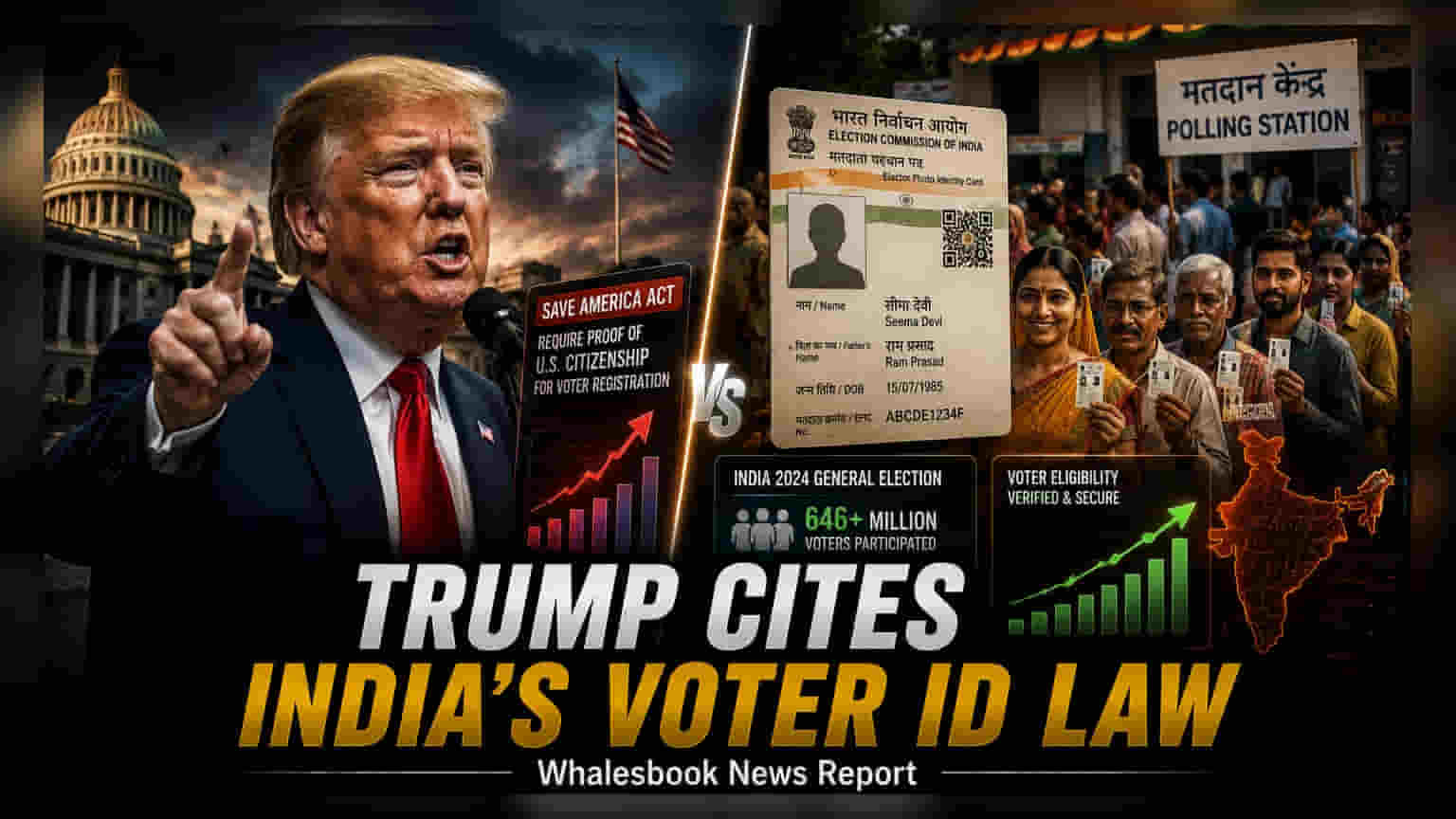
Former U.S. President Donald Trump is using India’s voter identification model to advocate for the 'Safeguard American Voter Eligibility (SAVE) America Act'. The proposal seeks to mandate proof of citizenship for U.S. voter registration. This political debate highlights the ongoing legislative challenges in the U.S. regarding electoral requirements and has no direct impact on Indian equity markets.
Former U.S. President Donald Trump has increasingly pointed to India’s election system as a potential model for enhancing electoral security in the United States. His remarks are part of an ongoing campaign to pass the 'Safeguard American Voter Eligibility (SAVE) America Act,' a piece of legislation that seeks to require proof of U.S. citizenship for voter registration.
Trump’s focus on India’s electoral processes centers on the country's reliance on mandatory, in-person voting with photo identification and the minimal use of mail-in ballots. By citing India’s 2024 general election, which successfully managed the participation of over 646 million voters, supporters of the act aim to argue that large-scale, secure elections can be conducted without the electoral practices currently common in the U.S.
The discussion has gained attention following reports that Indian election officials, including Chief Election Commissioner Gyanesh Kumar, have discussed these identification standards with counterparts, noting the structural differences in how the two democracies conduct their polls. While the U.S. system relies on state-led processes, India operates under the central authority of the Election Commission, which manages a unified, digitized voter database.
Despite the legislative push, the SAVE America Act faces significant hurdles. In the U.S. Senate, the bill has stalled due to deep political divisions over the balance between election security and voter accessibility. Critics of the legislation argue that federal mandates for voter identification could create significant barriers for vulnerable, minority, and elderly populations, potentially leading to disenfranchisement. There are also ongoing legal debates regarding the constitutionality of federal government intervention in state-run election procedures, suggesting that any passage of such laws would likely face intense judicial scrutiny.
For observers in India, this discourse underscores the global attention on the country's ability to maintain a robust and scalable democratic process. However, investors and market participants should note that this remains a matter of political and policy debate within the United States. There is no corporate or financial event connected to this news, and it has no direct or indirect impact on Indian stocks, corporate valuations, or financial markets. The primary monitorable for this issue is the legislative progress of the bill in the U.S. Congress and the subsequent legal discussions that may follow.