

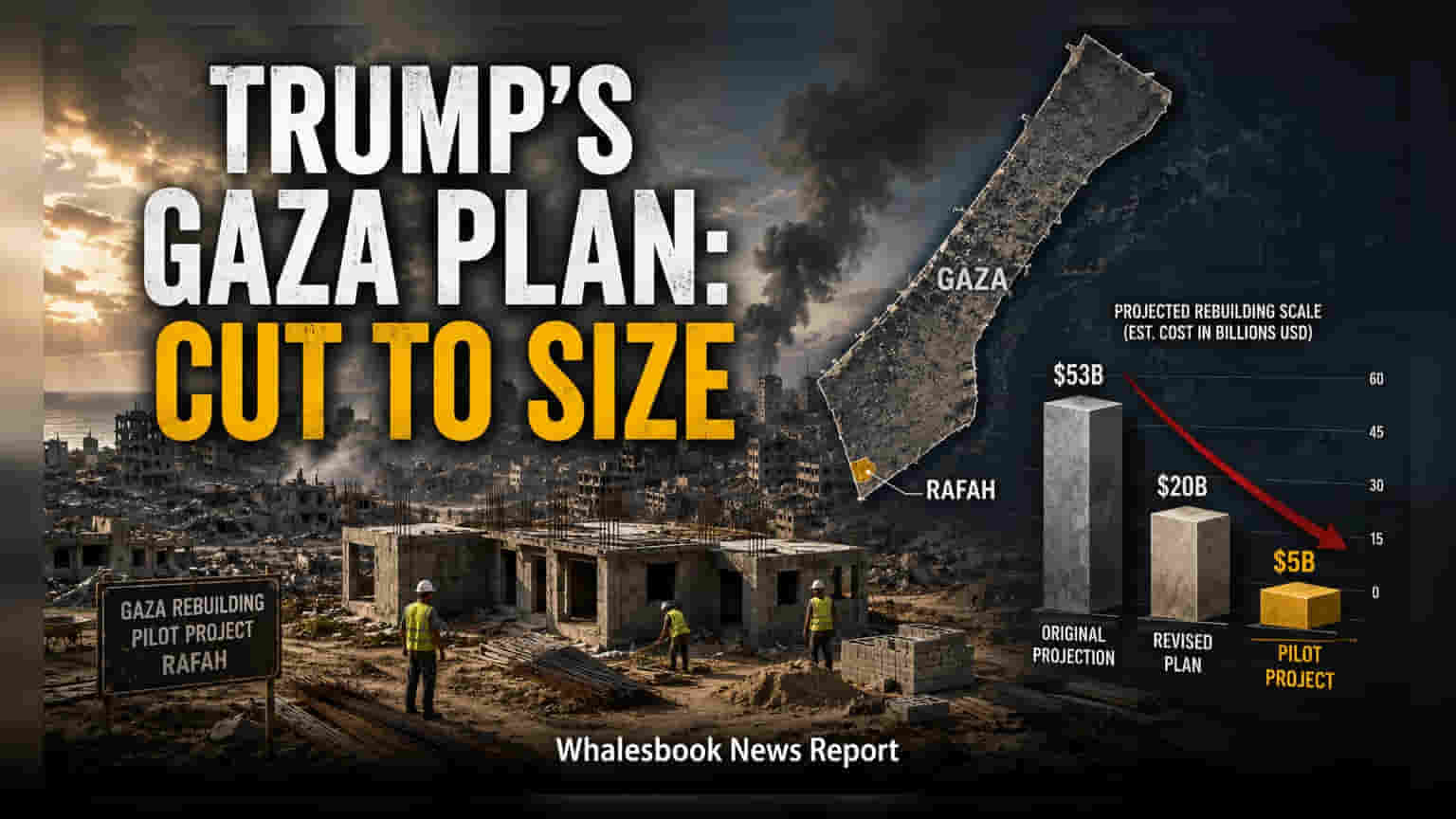
The Gaza reconstruction plan led by the Trump Board of Peace has been reduced from a massive infrastructure effort to a limited pilot project near Rafah. The project, which aims to house tens of thousands of displaced people, faces significant delays and is now not expected to be operational until late 2026 due to ongoing conflict and political instability.
The ambitious reconstruction framework for the Gaza Strip, originally spearheaded by the Trump Board of Peace (BoP), has undergone a major shift in scope. What was once pitched as a comprehensive 100-day plan to restore critical infrastructure, hospitals, and essential utilities across the region has now been condensed into a localized pilot project centered near Rafah.
Project Scope and Revised Timeline
The current proposal moves away from large-scale regional development and instead focuses on establishing a managed settlement designed to house a fraction of Gaza’s displaced population in portable units. While initial projections were optimistic, officials currently anticipate that the pilot may not reach completion before late 2026. This extended timeline underscores the severe difficulties involved in executing post-war planning in an environment marked by persistent military operations and political uncertainty.
The revised framework includes a Palestinian civil administration, a vetted police force, and an International Stabilization Force (ISF). Recent developments indicate that initial logistics efforts are underway, with a base being established near the Kerem Shalom crossing and the arrival of a small contingent of officers from Morocco and Kosovo. Despite these minor logistical steps, the core construction of the settlement and the training of the proposed local police force remain effectively stalled.
Geopolitical and Financial Challenges
The project’s feasibility remains tightly linked to the status of the conflict. Although a ceasefire was brokered last October, ongoing military activity continues to act as a barrier to large-scale humanitarian and reconstruction efforts. Western diplomatic observers have noted that meaningful rebuilding is difficult to achieve without a broader political resolution following the upcoming Israeli elections.
Financing and administration have also emerged as significant hurdles. The Palestinian Authority has formally objected to the use of withheld Palestinian tax revenues for these temporary measures, with Foreign Minister Varsen Aghabekian emphasizing that such funds should be released unconditionally rather than diverted to localized projects. Furthermore, the proposed reliance on an International Stabilization Force has faced downsizing, with the target size reduced to approximately 5,000 personnel. Given the volatile security environment and the lack of consensus on regional governance, the primary monitorable for this project will be the actual start of construction on the Rafah camp and any shifts in the diplomatic stance toward using withheld tax revenues for funding.