 Whalesbook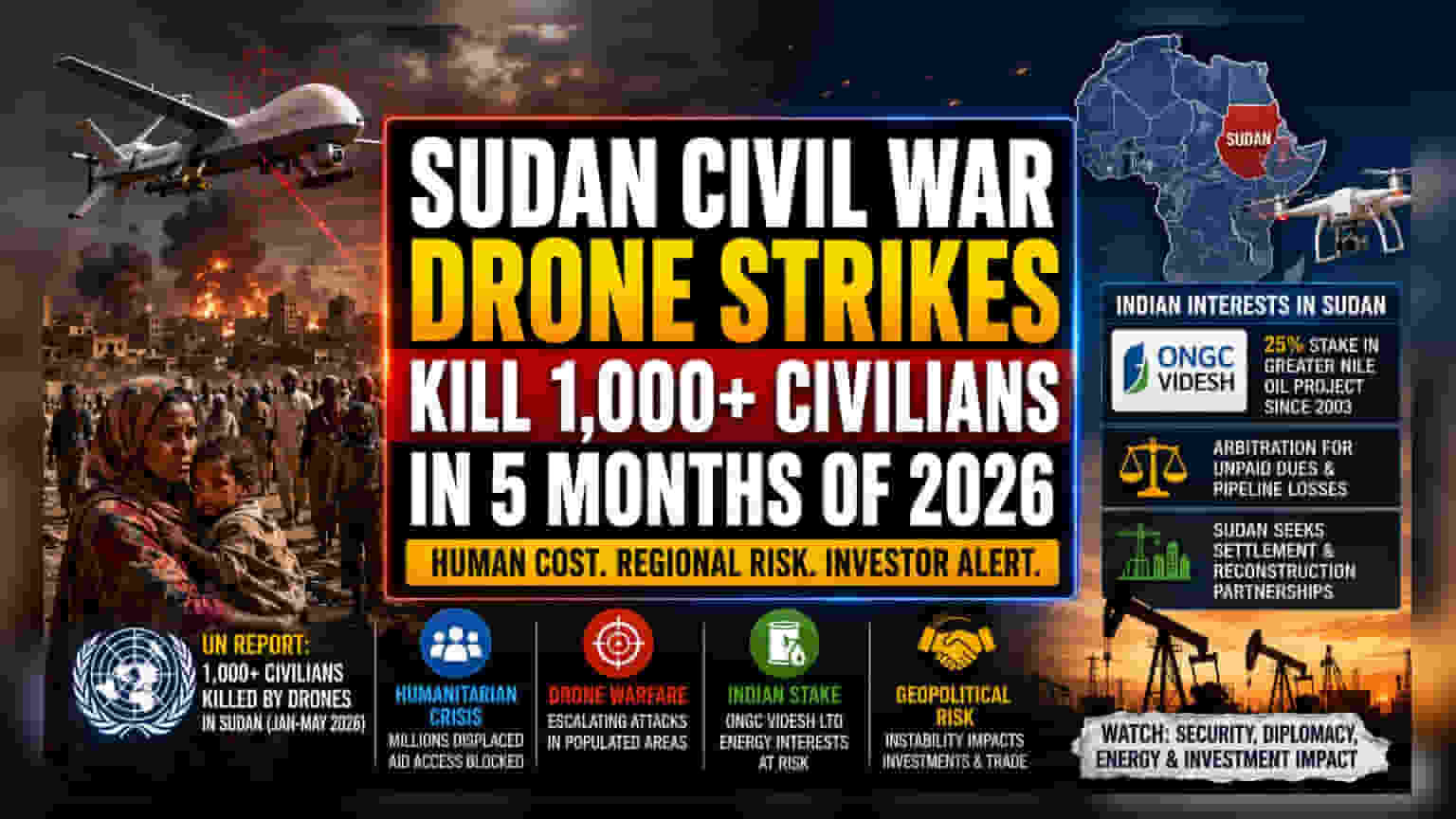


A new UN report highlights a surge in drone warfare in Sudan, resulting in over 1,000 civilian deaths in the first five months of 2026. This escalation deepens the humanitarian crisis and complicates the long-term outlook for Indian companies with legacy energy assets in the region.
What Happened
A new report by the United Nations has highlighted a significant escalation in the use of drone technology in the ongoing civil war in Sudan. UN High Commissioner for Human Rights, Volker Türk, informed the Human Rights Council in Geneva on Monday that drone strikes in Sudan have killed over 1,000 civilians in the first five months of 2026. This development marks a shift in the conflict, which has been ongoing since April 2023, as both warring parties increasingly rely on aerial technology to conduct operations. The report emphasizes that drone warfare is now a central, and deadly, feature of the fighting, contributing to widespread humanitarian suffering in a nation already struggling with millions of displaced people.
The Human and Tactical Cost
The use of drones in the Sudanese conflict has evolved rapidly. Reports indicate that these strikes are frequently occurring in populated areas, leading to significant civilian casualties and destruction of infrastructure. Beyond the immediate fatalities, the humanitarian situation remains critical. Millions of citizens are displaced, and the conflict has severely disrupted essential supply chains, making the delivery of food and medical aid increasingly difficult. The UN has called for the immediate protection of civilians and the facilitation of humanitarian access, warning that the intensification of these attacks—especially during the rainy season—threatens to isolate further regions and worsen the displacement crisis.
Impact on Indian Business Interests
For Indian market participants, the conflict in Sudan represents a complex geopolitical risk. Several Indian companies, most notably ONGC Videsh Ltd (OVL), have long-standing energy interests in the region. OVL has held a 25% stake in the Greater Nile Oil Project since 2003. However, these investments have faced significant hurdles due to the country's instability, with OVL having pursued arbitration proceedings in international courts to recover substantial unpaid dues related to oil and pipeline operations.
While Sudan has recently signaled an interest in settling these obligations and pursuing reconstruction partnerships with India, the continued violence and the escalation of drone-related hostilities create a challenging environment for any near-term business recovery. The destruction of energy infrastructure and the overall economic instability mean that the realization of dues and the resumption of major energy projects remain uncertain.
Geopolitical Risk and Market Sentiment
Investors typically view such prolonged geopolitical crises as 'tail risks'—events that, while often operating outside of direct financial markets, carry significant potential for disruption. Continued instability in the Horn of Africa can impact broader global commodity markets and increase the risk premium for international projects in the region. As Sudan faces a prolonged period of potential stagnation, Indian policy-makers and companies continue to monitor the situation, balancing humanitarian concerns with the need to protect national and corporate interests in the region.
What Investors Should Track
Moving forward, the primary monitorables include the diplomatic and security situation on the ground, which will dictate the feasibility of reconstruction efforts. Investors watching the energy sector may monitor updates regarding ONGC Videsh's arbitration proceedings and any official government statements concerning the settlement of legacy dues. Additionally, the broader impact of the conflict on regional logistics and energy supply routes remains an important indicator for tracking geopolitical risk in the wider African market.