

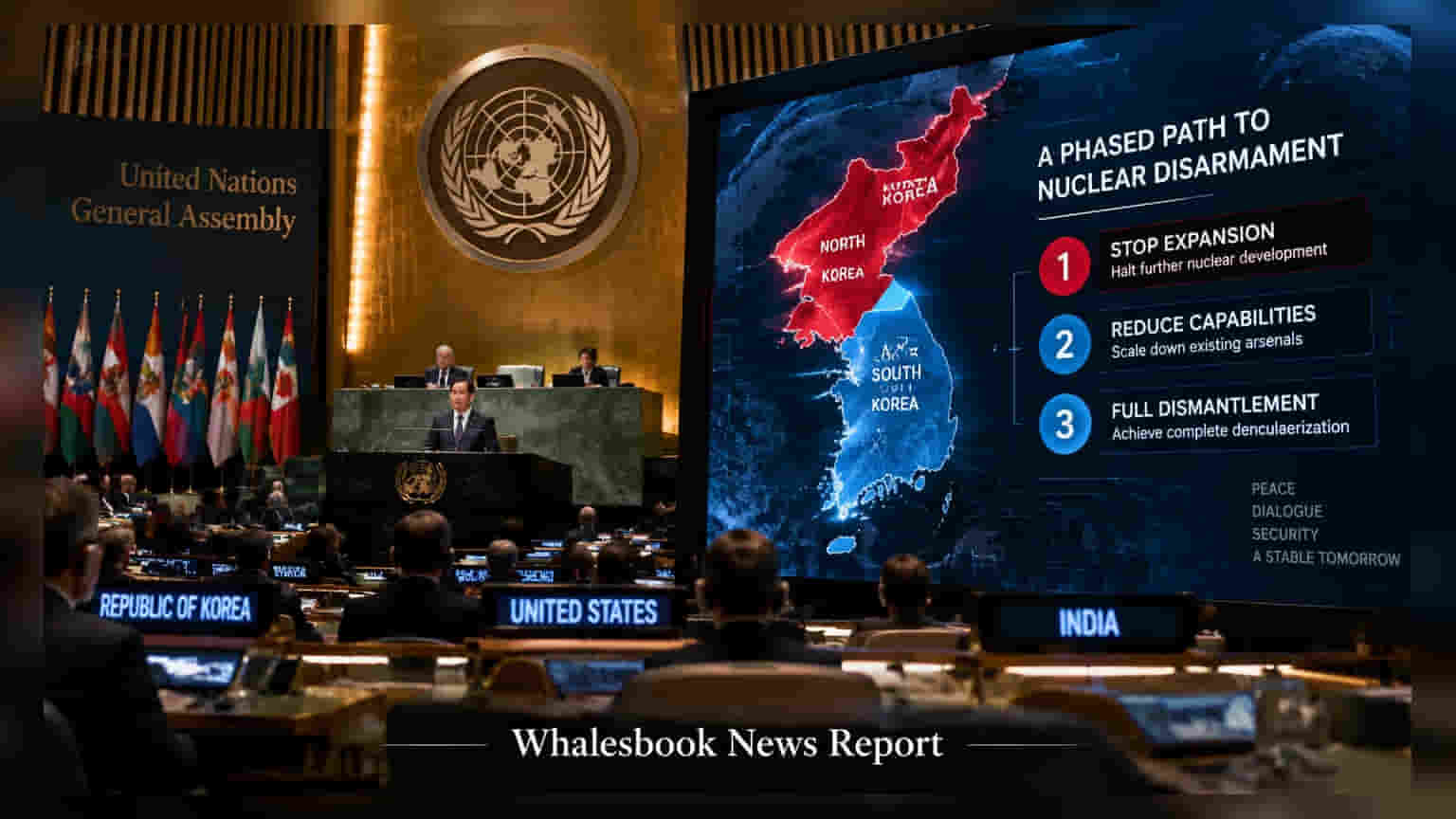
South Korean President Lee Jae Myung will propose a phased approach to North Korean denuclearization at the UN General Assembly. This strategy change, alongside new plans for maritime security and AI regulation, has implications for global supply chain stability and energy shipping routes that international investors should track.
South Korean President Lee Jae Myung is set to propose a significant shift in diplomatic strategy regarding North Korea at the upcoming United Nations General Assembly. Moving away from expectations of immediate disarmament, the administration is focusing on a new doctrine defined by three stages: stopping the expansion of nuclear programs, reducing existing capabilities, and finally, working toward full dismantlement. This phased approach acknowledges that immediate total denuclearization has proven difficult to achieve and aims to prevent further military advancement by Pyongyang during the negotiation process.
Impact on Global Trade and Security
For investors monitoring global markets, this development carries weight beyond simple geopolitics. The Korean Peninsula remains a critical hub in the global semiconductor and electronics manufacturing ecosystem. Any fluctuation in security dynamics in this region can impact the stability of global tech supply chains. Indian companies that rely on global semiconductor components for electronics manufacturing often monitor regional stability in East Asia to gauge potential risks to their supply lines.
Additionally, the South Korean administration has signaled an interest in increasing naval cooperation in the Gulf of Aden to protect energy shipping lanes. For India, which is highly dependent on crude oil imports, maritime security in these passages is essential. A more active international approach to securing these routes is generally viewed as a positive factor for maintaining stability in freight costs and energy supply.
Diplomatic Adjustments and Future Policy
The proposal also reflects an evolving relationship within the Seoul-Washington alliance. Following adjustments to the Ulchi Freedom Shield military exercises, the South Korean administration is aiming to balance regional security requirements with diplomatic flexibility. Furthermore, President Lee is calling for structural reforms within the United Nations to better address modern challenges, specifically the rapid development of artificial intelligence. The administration is pushing for greater international cooperation to manage the benefits and regulations of AI, which is becoming a priority for global tech markets.
Investors looking for the next updates will need to watch how major international stakeholders, particularly the United States, respond to this phased proposal. Future developments regarding the implementation of this doctrine, as well as any official updates on maritime cooperation or AI governance frameworks, will be key monitorables for those tracking the stability of global trade and regional security.