

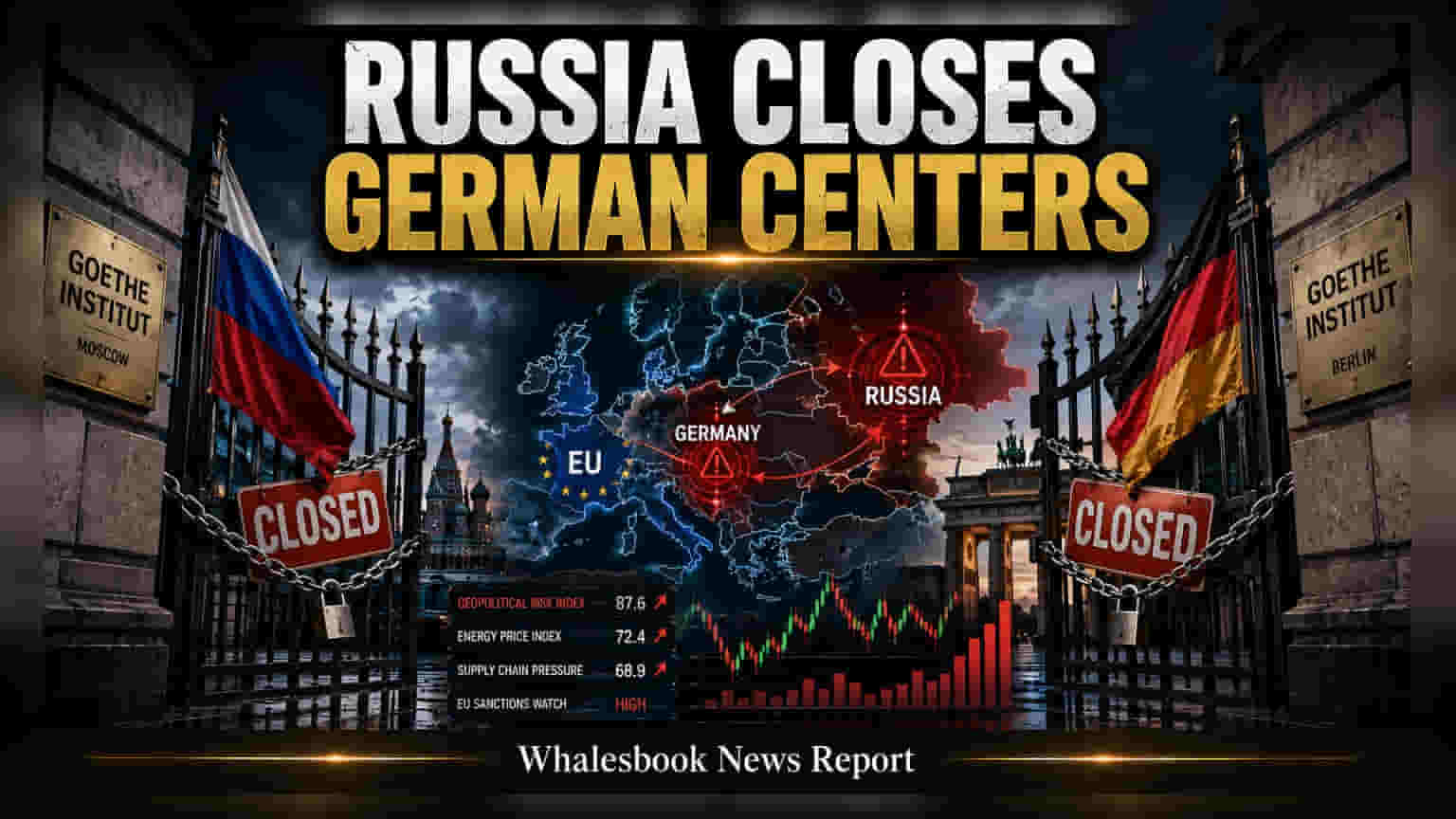
Russia has ordered the shutdown of all Goethe-Institut cultural centers, a retaliatory step following Germany's closure of Russian diplomatic facilities. The diplomatic friction stems from a security incident at Germany’s Leipzig/Halle Airport, with investors monitoring the move for potential impacts on broader EU-Russia geopolitical stability.
Russia has officially ordered the closure of all Goethe-Institut cultural centers across its territory, specifically targeting facilities in Moscow, St. Petersburg, and Yekaterinburg. This directive serves as a retaliatory measure following the German government’s decision to shut down the 'Russian House' in Berlin and terminate operations at the Russian Consulate in Bonn.
The diplomatic breakdown is linked to a high-stakes security incident that occurred on August 4, 2026, at Germany’s Leipzig/Halle Airport. German authorities discovered explosives-laden hardware near a Ukrainian transport aircraft, subsequently categorizing the event as an act of state-sponsored sabotage. Moscow has firmly rejected these claims, accusing German officials of planting evidence and orchestrating a hostile campaign.
For investors and global market observers, this escalation represents a notable deepening of the diplomatic rift between Russia and Western nations. The European Union is currently evaluating the situation, with discussions underway regarding the possibility of further sanctions, travel restrictions, and additional measures targeting Russian entities. The EU has previously imposed widespread restrictions on thousands of individuals and entities, and the potential for a fresh round of sanctions remains a primary concern for companies with exposure to European industrial and logistics supply chains.
While this development primarily affects diplomatic and cultural relations, the broader impact on the geopolitical landscape continues to generate uncertainty in global markets. Heightened tensions often lead to increased volatility in sectors linked to international trade and European infrastructure. As the situation evolves, the key monitorable for market participants will be whether this tit-for-tat escalation leads to broader economic policy shifts or further trade barriers between Russia and the European bloc. Future updates from both the Kremlin and the European Commission regarding potential sanctions or retaliatory economic policies will be the next important events to track.