

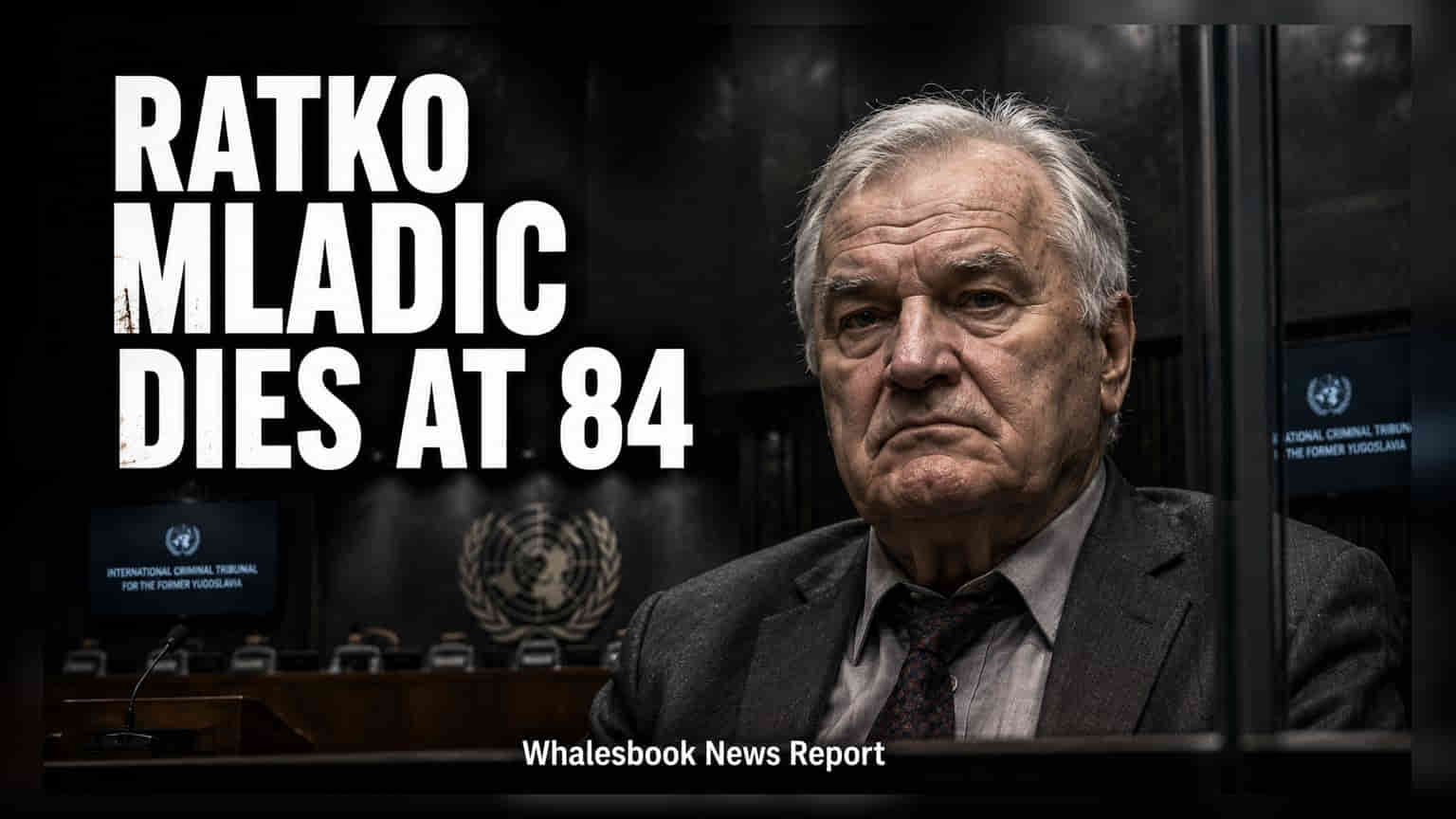
Ratko Mladić, the former Bosnian Serb military commander convicted of genocide and crimes against humanity, has died in a UN prison facility in The Hague at 84. He was serving a life sentence for his central role in the Srebrenica massacre and the siege of Sarajevo. His passing concludes a decades-long legal case that set a major precedent for international criminal law.
Ratko Mladić, the former Bosnian Serb military commander convicted of genocide and crimes against humanity, has died while serving a life sentence in a United Nations prison facility in The Hague. He was 84 years old. His death follows a lengthy legal process that began after the Bosnian War and concluded with a final judgment by international courts.
Mladić was a central figure during the 1992-1995 Bosnian War. In 2017, the International Criminal Tribunal for the former Yugoslavia (ICTY) sentenced him to life imprisonment. The court found him guilty of orchestrating the 1995 Srebrenica massacre, where more than 8,000 Bosniak men and boys were killed, and for overseeing the brutal siege of Sarajevo, which lasted for nearly four years. These events are recognized as some of the most violent chapters in post-World War II European history.
Following the conclusion of the war, Mladić evaded capture for 16 years, remaining in hiding until his arrest in 2011 in Serbia. His subsequent trial at the ICTY served as a landmark case for international justice. Prosecutors presented extensive evidence linking Mladić directly to the military strategies that led to widespread displacement and mass killings. Throughout the proceedings, Mladić frequently challenged the legitimacy of the court and maintained his innocence regarding the charges.
The court upheld his life sentence in 2021, rejecting appeals from his legal team, who had previously sought his release on medical grounds due to declining health. His passing closes one of the most high-profile trials in the history of international criminal law. Legal experts often cite the proceedings as a critical precedent in establishing accountability for military leaders involved in wartime atrocities. The case remains a significant historical reference point regarding the international effort to prosecute war crimes.