

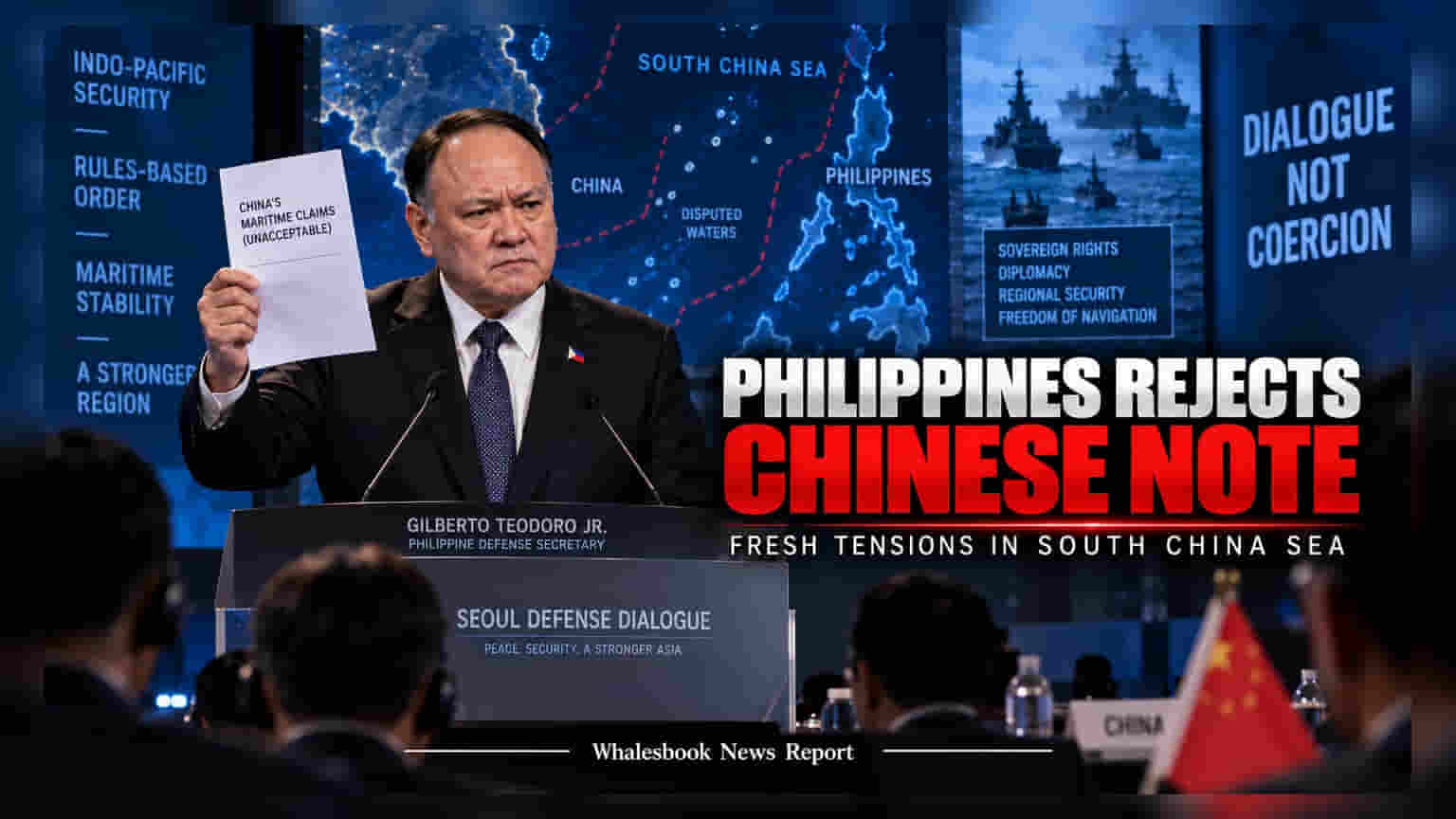
Philippine Defense Secretary Gilberto Teodoro Jr. publicly dismissed an unsolicited note from a Chinese military attache during the Seoul Defense Dialogue on September 8, 2026. He criticized the delivery method as coercive and disrespectful to the host nation. The incident highlights the persistent maritime tensions in the South China Sea that remain a focus for regional security stability.
Philippine Defense Secretary Gilberto Teodoro Jr. publicly rejected a diplomatic note delivered by the Chinese delegation during a panel discussion at the 15th annual Seoul Defense Dialogue on September 8, 2026. The incident occurred when a Chinese military attache attempted to provide an unsolicited document to the Secretary while he was on stage.
The note contained Beijing’s standard assertion that the 2016 international arbitration ruling regarding maritime claims in the South China Sea is invalid. In a departure from typical closed-door diplomatic protocols, Teodoro read the contents of the note aloud to the audience. He condemned the act, labeling it a display of coercion and bullying. He further noted that the attempt to interrupt his presentation was disrespectful to the host nation, South Korea, and bypassed established international diplomatic channels.
This event is part of the ongoing friction between Manila and Beijing over the South China Sea, a region where the Philippines has increasingly leveraged the 2016 tribunal ruling to challenge expansive maritime claims. China maintains that the ruling lacks jurisdiction, while the Philippines continues to assert its sovereign rights within its exclusive economic zone. Teodoro described the incident as a reflection of the challenges Manila faces in asserting its position against persistent pressure.
From a business and investor perspective, the incident is a purely diplomatic development and has not triggered direct volatility in Indian or global stock market indices. However, the event underscores the rising security friction in the South China Sea. This region serves as a vital artery for global trade, and ongoing instability remains a long-term monitorable for logistics and energy shipping lanes. The incident highlights the complex geopolitical environment currently influencing defense and security policies across the Asia-Pacific region. Investors typically track these developments for potential impacts on regional trade flow and shipping security, though no direct financial or corporate consequences have emerged from this specific diplomatic exchange.