

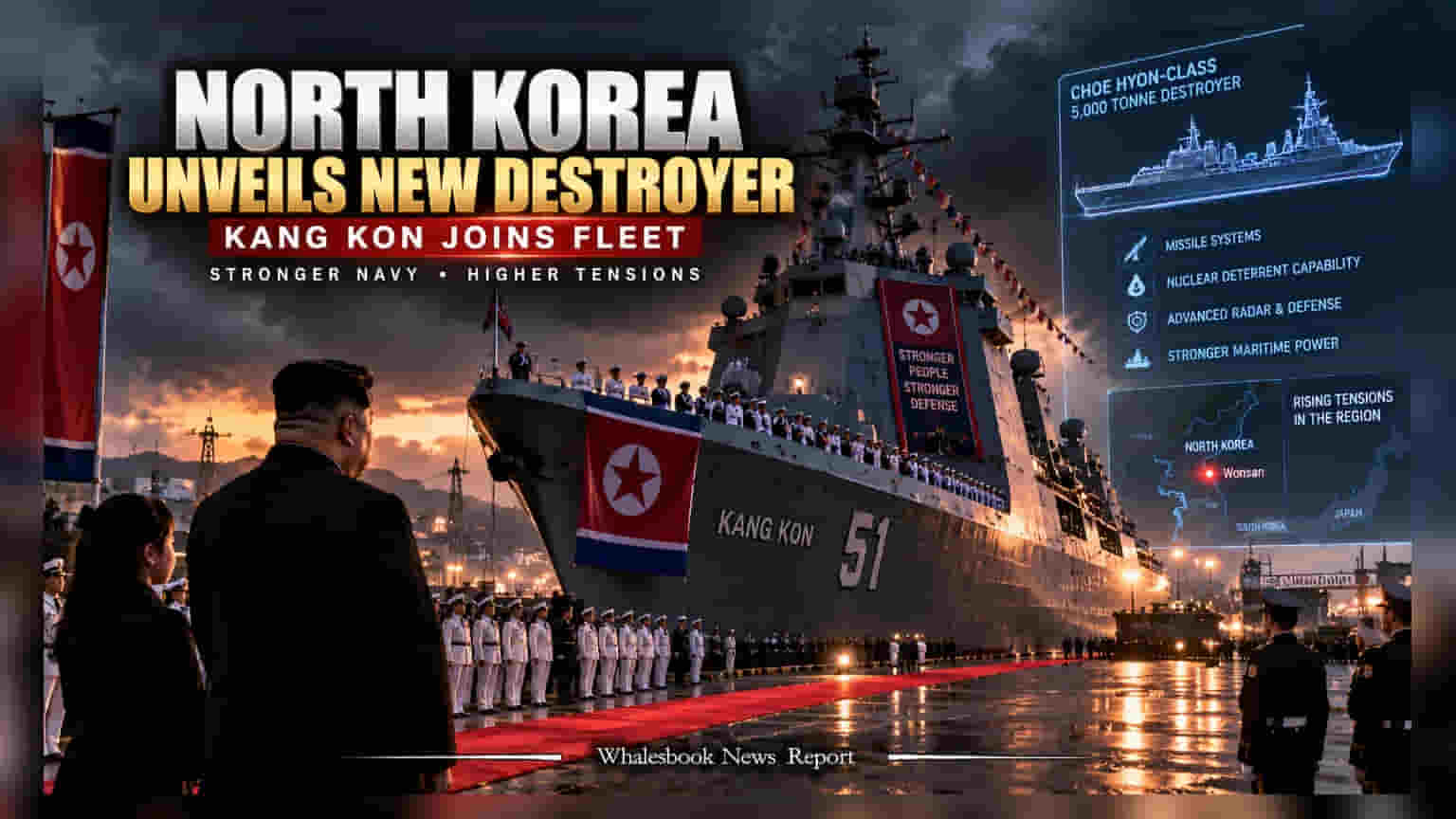
North Korea has commissioned its second 5,000-tonne destroyer, the Kang Kon, as leader Kim Jong Un boosts naval nuclear strike capabilities. This military expansion coincides with ongoing trilateral exercises by the US, South Korea, and Japan, intensifying geopolitical friction in the Pacific that investors are watching for global sentiment impact.
North Korea has officially commissioned its second 5,000-tonne destroyer, named the Kang Kon, during a ceremony held in the port city of Wonsan. Leader Kim Jong Un attended the event, accompanied by his daughter, Kim Ju Ae. This vessel is the second of the Choe Hyon-class, with the first ship of the same series having entered service earlier in June 2026. The move marks a significant update in North Korea’s maritime military strategy as the nation continues to expand its defense infrastructure.
The destroyer is designed as a core component of the country's state nuclear counteraction system. According to official statements, the vessel is equipped with missile systems capable of delivering nuclear-armed retaliatory strikes. By building these capabilities, Pyongyang aims to create a more diversified nuclear deterrent, which it argues is necessary to protect itself from perceived hostile policies of regional neighbors and their international allies.
This naval expansion occurs against a backdrop of increasing regional friction. The commissioning took place alongside the Freedom Edge military exercise, a five-day series of drills involving the United States, South Korea, and Japan near Jeju Island. While the participating nations describe these maneuvers as defensive efforts to maintain regional stability and counter nuclear proliferation, Pyongyang views them as direct rehearsals for a potential invasion. The North Korean government has criticized the exercises, labeling them as a deliberate escalation of confrontational policy from Washington.
For investors and global market observers, this geopolitical activity serves as a reminder of the persistent tensions in the Pacific region. Escalating military posturing often creates uncertainty in global markets, particularly concerning energy security and maritime trade routes. While immediate economic impacts are indirect, continued friction in this vital trade corridor can influence investor sentiment and impact the risk premium applied to Asian equity markets during periods of heightened volatility.
Diplomatic efforts between North Korea and the US have remained stalled since high-level talks collapsed in 2019. Pyongyang has rejected recent diplomatic overtures from the US, demanding formal recognition as a nuclear-armed state as a prerequisite for any further negotiations. As the cycle of military exercises and counter-displays continues, market participants will likely monitor the diplomatic situation for any signs of de-escalation, as a prolonged period of tension may continue to weigh on the stability of the region.