

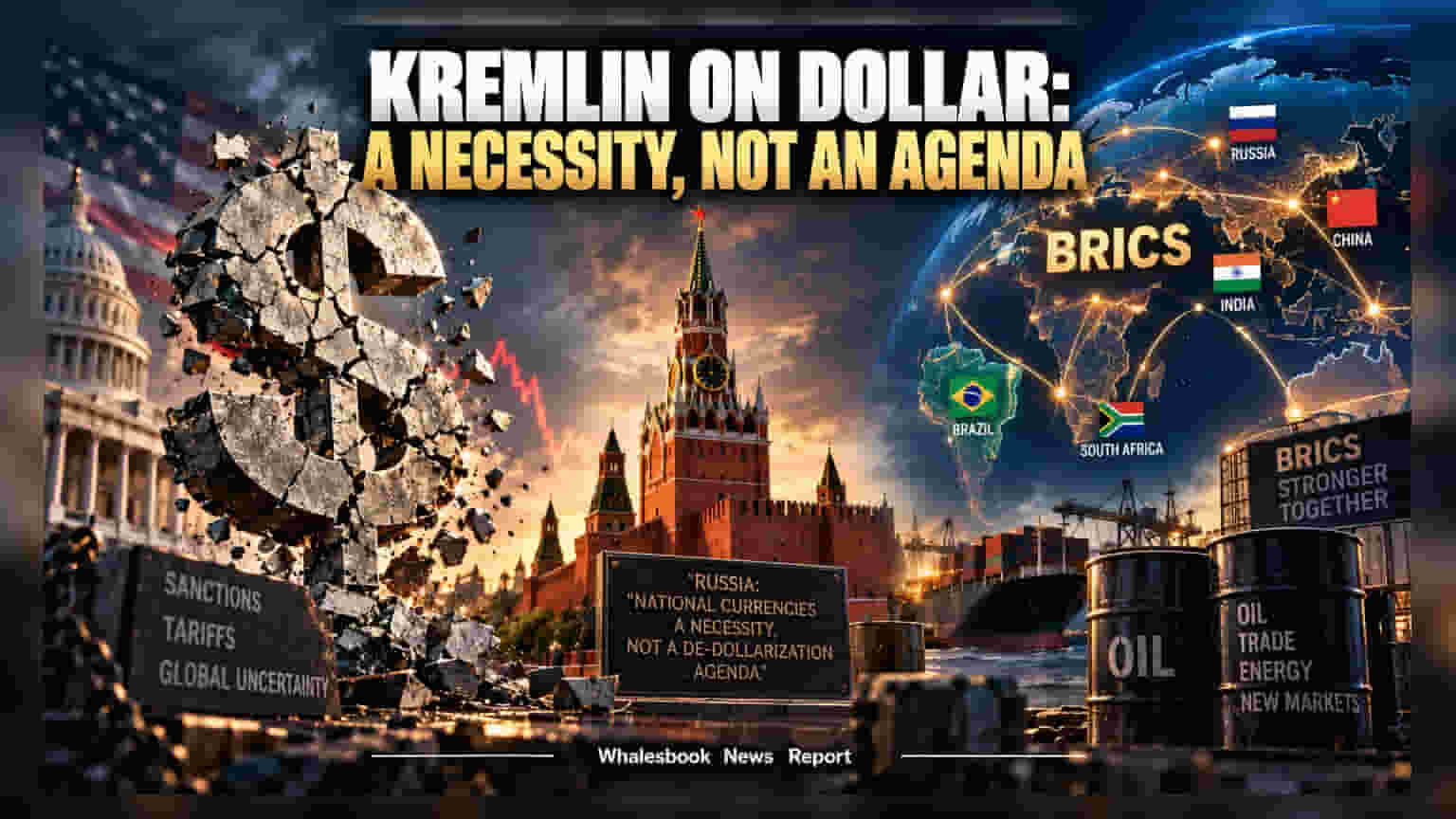
Russia has denied an intentional campaign to replace the US dollar, citing national currency use as a defensive reaction to sanctions. As the BRICS summit approaches in New Delhi on September 12, the US threat of 100% tariffs on Russian oil buyers creates economic uncertainty. This situation poses diplomatic and operational challenges for Indian firms engaged in energy and defense trade with Moscow.
The Kremlin has officially responded to rising concerns regarding the global financial system, with spokesperson Dmitry Peskov stating that Russia has no formal agenda to de-dollarize. Instead, Moscow has labeled its shift toward national currencies a practical necessity, driven by its exclusion from Western financial networks. This clarification comes at a tense time as the United States Senate has passed a bill proposing potential tariffs of up to 100% on nations that continue to import Russian oil and gas.
Impact of US Sanctions on Energy Trade
The legislative move by the US to impose heavy tariffs on buyers of Russian energy has created a difficult environment for emerging market economies. These proposed tariffs are designed to discourage third-party nations from facilitating Russian trade. For global energy markets, this creates a risk of supply chain disruptions and higher costs. Indian companies, particularly those involved in importing crude oil or managing defense contracts, face the challenge of navigating these secondary sanction threats while maintaining their essential energy and strategic requirements.
Focus on the BRICS Summit in New Delhi
Geopolitical tensions will likely dominate discussions at the 18th BRICS summit, scheduled for September 12-13, 2026, in New Delhi. Russian President Vladimir Putin is set to attend the event, with a planned bilateral meeting with Prime Minister Narendra Modi. The agenda is expected to cover critical areas, including the exploration of rare earth minerals and the potential sale of the Sukhoi Su-57 fighter jet. However, the logistical friction caused by current financial sanctions remains a major hurdle.
Currently, approximately 90% of trade transactions between Russia and BRICS nations are settled in local currencies. While this system has allowed trade to continue, it has created new difficulties. A significant concern for Indian companies is the accumulation of excess Indian rupees by Russian firms, which they cannot easily convert or repatriate. This buildup of local currency creates a mismatch in trade balances and limits the speed at which new transactions can be settled.
What Investors Should Monitor
The economic implications of this dispute extend beyond government-to-government relations. Investors should track how Indian companies manage their payment settlements with Russian counterparts as the threat of secondary sanctions looms. The key monitorable is whether the upcoming summit leads to a more stable framework for currency conversion or if the US tariff threat forces a change in the procurement strategies of energy-importing nations. Any shift in payment systems or reliance on alternative settlement mechanisms will be critical in determining the operational costs and financial stability for firms with deep exposure to Russian trade.