

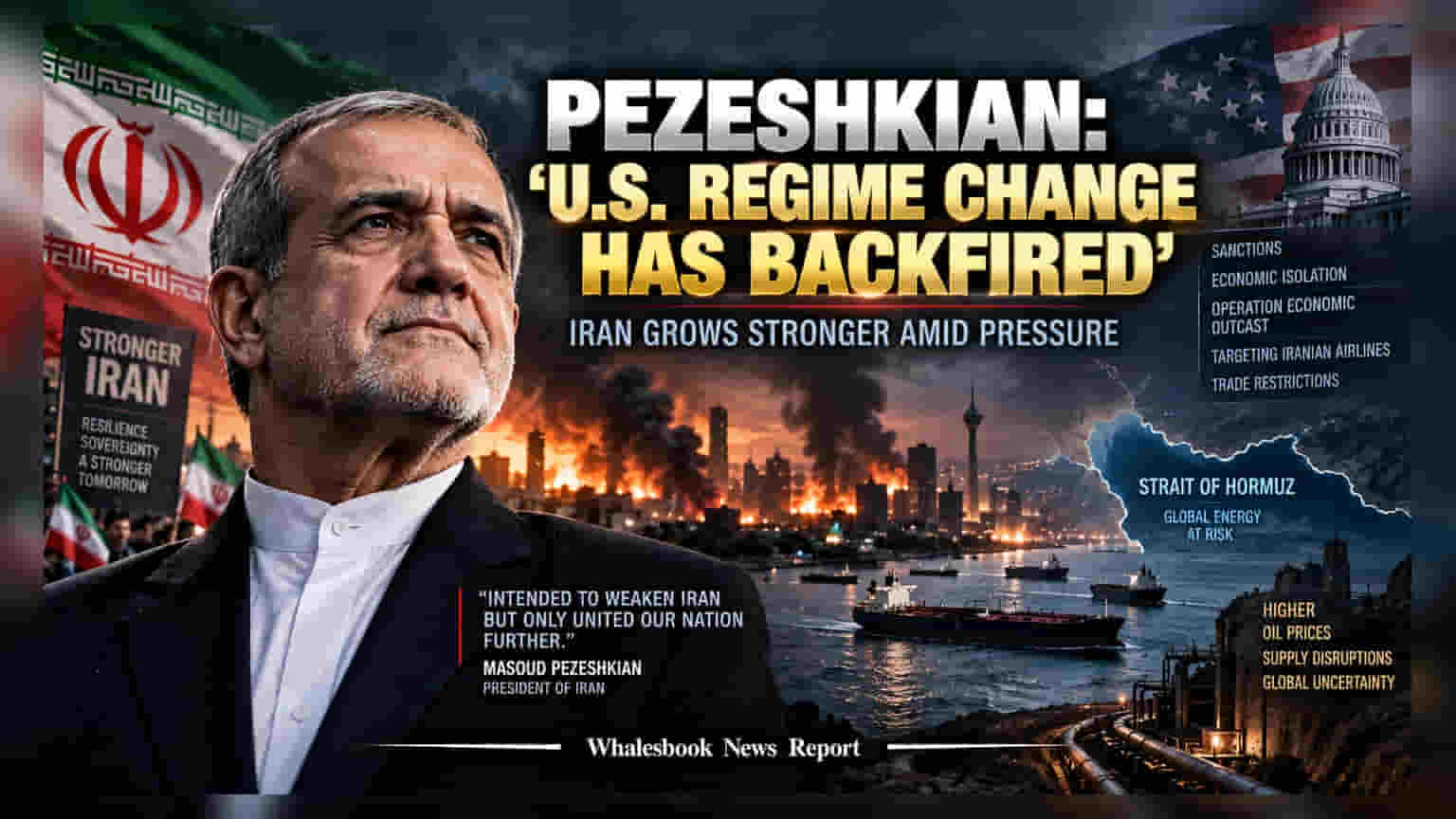
During his visit to India for the BRICS summit, Iranian President Masoud Pezeshkian alleged that U.S.-led attempts to orchestrate regime change have failed. Investors are monitoring the situation as rising geopolitical tensions and the U.S. 'Operation Economic Outcast' policy disrupt energy markets and global supply chains, potentially impacting energy costs in India.
Iranian President Masoud Pezeshkian has publicly asserted that United States-led efforts to force a regime change in Tehran have backfired, consolidating domestic support instead of destabilizing the government. Speaking during his visit to India for the BRICS summit, Pezeshkian drew comparisons to political transitions in Venezuela and Syria, claiming that Washington anticipated a rapid collapse following targeted military and infrastructure actions. According to the Iranian administration, these interventions failed to achieve their stated objectives and instead resulted in increased internal cohesion.
Tensions Rise Over 'Operation Economic Outcast'
The U.S. government has intensified its stance through a policy referred to as 'Operation Economic Outcast.' This initiative is specifically targeting Iranian airlines and established trade routes in an effort to isolate the country economically. The Iranian administration reports that these measures, combined with ongoing sanctions, have caused a 25-35% decline in trade volumes. The President described these restrictions as a form of economic strangulation that is currently limiting the flow of essential food and medical supplies to the civilian population.
Impact on Energy Markets and Global Trade
For investors and global markets, the ongoing friction between the U.S. and Iran creates significant uncertainty regarding energy security. A critical monitorable for the markets is the situation in the Strait of Hormuz, a vital chokepoint for global oil transit. Any disruption in this region directly impacts global crude oil prices, which influences the operating costs for energy-dependent sectors in India, including oil marketing companies, aviation, and logistics.
While the administration in Tehran insists that its domestic position remains stable, the risk of further military escalation between the U.S., Iran, and other regional forces remains elevated. Financial analysts are tracking whether these supply chain disruptions will persist, as persistent instability in the Middle East often leads to higher input costs for manufacturers and potential inflationary pressure.
Investors may continue to watch for updates on trade flow data and any changes in regional military activity. The primary concern for the broader market remains the potential for volatility in energy prices and the effect of restricted transit routes on global logistics costs.