 Whalesbook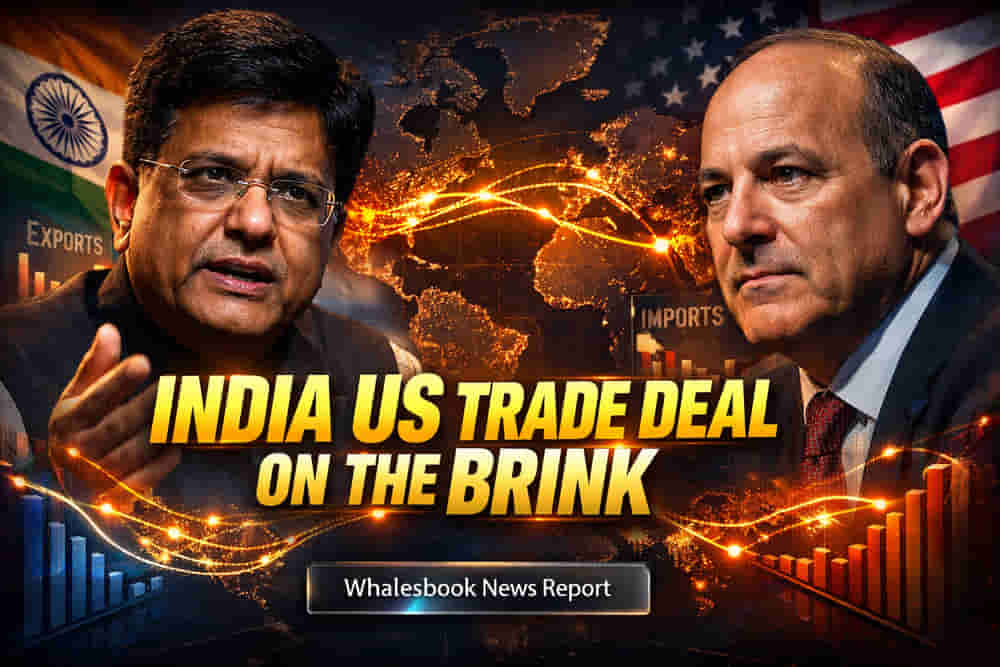


India-US Trade Dialogue Navigates Shifting Tariff Landscape
On Thursday, February 26, 2026, Indian Commerce and Industry Minister Piyush Goyal engaged in significant discussions with US Secretary of Commerce Howard Lutnick and US Ambassador to India Sergio Gor. The meeting, described as "fruitful" and "productive," centered on advancing the trade and economic partnership between the two nations, with a key focus on finalizing the legal text for the first phase of a bilateral trade agreement [7, 8, 12, 18]. This high-level exchange occurred against a backdrop of considerable flux in US trade policy, following a landmark Supreme Court decision and subsequent tariff adjustments [2, 3, 6, 14].
The Alpha Angle: Navigating Policy Crosscurrents
The primary analytical lens on this development is the inherent tension between a formally agreed-upon framework for tariff reduction and the immediate, albeit temporary, imposition of new broad-based US tariffs. While India and the US had established a framework in early February 2026, envisioning a reduction of US tariffs on Indian goods from a high of 50% down to 18% [20, 25, 33, 35], the US Supreme Court's ruling on February 20, 2026, fundamentally altered the landscape [2, 3, 5]. The Court invalidated President Donald Trump's prior emergency tariffs imposed under the International Emergency Economic Powers Act (IEEPA), citing a lack of clear congressional authorization [2, 3, 4, 5]. In response, the US administration invoked Section 122 of the Trade Act of 1974, implementing a temporary 10% global tariff effective February 24, 2026, with indications of a potential increase to 15% [9, 21, 22, 23]. This swift policy shift has created a dual environment: one of strategic cooperation towards a trade deal and another of immediate, short-term trade friction, necessitating a careful reassessment of trade implications before final agreements are inked [14, 16, 30].
Sectoral Impact and Competitive Positioning
Key Indian export sectors, such as information technology, pharmaceuticals, textiles, and automotive components, stand to benefit from the proposed 18% tariff rate under the Phase 1 agreement [25, 33, 35]. This reduction is anticipated to restore competitiveness for Indian exporters, potentially allowing them to gain an edge over regional rivals like Vietnam, Bangladesh, and China, which face higher tariffs [33]. Historically, Indian equity markets have shown sensitivity to shifts in India-US trade policy; significant trade pacts have often been followed by sector-specific rallies, while tariff disputes have historically introduced volatility [28, 30]. The current global trade sentiment, characterized by cautious optimism and a focus on supply chain resilience, further amplifies the importance of predictable trade agreements. However, the immediate imposition of temporary tariffs introduces an element of operational uncertainty, potentially affecting planning and margins for businesses dependent on US market access.
The Forensic Bear Case
The market's enthusiasm for the Phase 1 trade deal framework must be tempered by substantial risks. The Supreme Court's invalidation of IEEPA tariffs and the subsequent implementation of temporary tariffs under Section 122 create a scenario of policy unpredictability [6, 21, 22, 30]. While the framework targets an 18% tariff rate, the immediate 10%-15% global surcharges introduce a layer of complexity and potential for unexpected costs. This regulatory flux could lead to further delays in formalizing the Phase 1 agreement, which was already postponed from its initial late February 2026 schedule due to the need for reassessment [14, 30]. The Trump administration's trade policy has historically been characterized by abrupt changes and reliance on broad executive authority, raising concerns about the long-term stability and definitive nature of any agreements [24, 28, 36]. Furthermore, the potential for tariffs to be reinstated or altered under different legal provisions underscores the persistent risk for businesses engaged in bilateral trade. The reliance on Section 122, a statute designed for balance of payments crises and limited to 150 days, also introduces an inherent expiration date to current US tariff measures, necessitating congressional action for extension and adding another layer of uncertainty [21, 23].
Future Outlook
Despite the immediate trade policy turbulence, both nations remain committed to finalizing their interim trade agreement. Negotiators are expected to reconvene in Washington D.C. after reassessing the implications of recent developments, with the aim of signing the pact in March 2026 and operationalizing it by April [25, 29, 35]. The framework signifies a strategic de-escalation, positioning India as a key US ally and a counterbalance to China in the Indo-Pacific [33]. However, the efficacy and stability of this agreement will be significantly influenced by the resolution of ongoing tariff uncertainties and the evolution of US trade policy.