 Whalesbook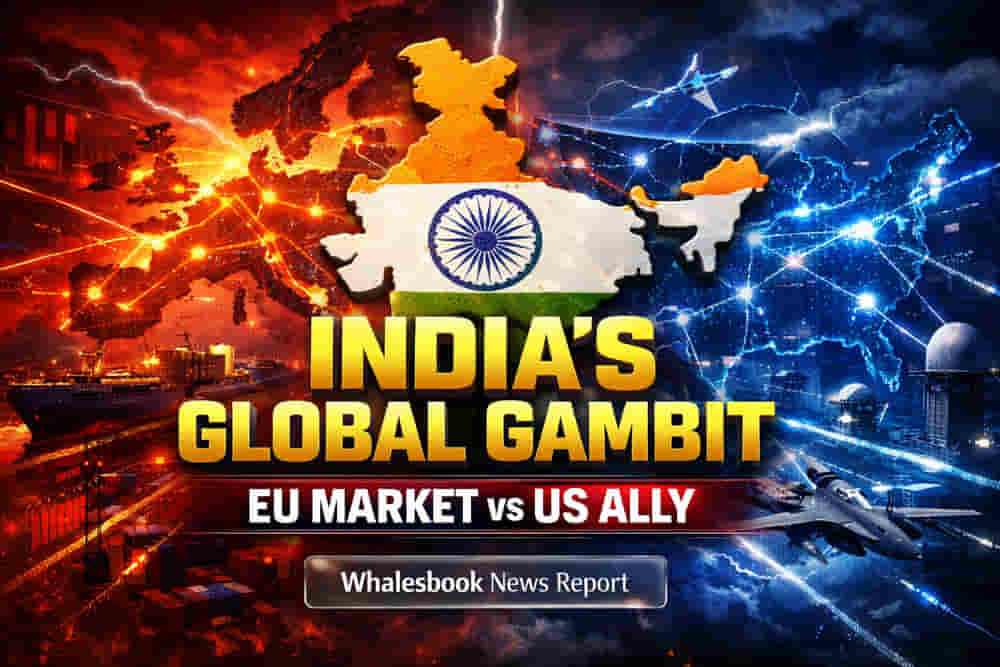
The Bifurcated Western Approach to India
The recent Munich Security Conference underscored a significant divergence in how Western powers envision India's role in the global architecture. The European Union, particularly Germany, sees India primarily as a crucial market to absorb its industrial exports, seeking a deep trade relationship. Conversely, the United States views India as an indispensable strategic ally, essential for bolstering its Indo-Pacific security framework and countering China's ascendancy. This distinction highlights a fundamental difference in objectives: Europe pursues economic integration, while America aims for geopolitical alignment.
EU's Economic Imperative and India's Market Access
The European Union, driven by Germany's export-reliant economy and seeking alternatives to a less predictable China, is prioritizing a comprehensive free trade agreement with India. This pact, finalized in January 2026 after nearly two decades of negotiations, aims to significantly reduce tariffs, particularly on automobiles, which historically reached up to 110%. The agreement is designed to open India's economy further to European firms, providing European automakers like Volkswagen, BMW, and Mercedes-Benz with expanded export opportunities without necessitating production relocation. This economic necessity for Germany stems from its need to secure large external markets to sustain its industrial base, especially as China becomes a less dependable trade partner. India's market, with its burgeoning middle class, presents a vital avenue for German industry to offset declining exports to China.
US Strategic Alignment and Geopolitical Counterbalancing
The United States' engagement with India is less about trade volumes and more about strategic depth. Washington's approach centers on deepening defense and technology ties, integrating India into a broader Indo-Pacific security architecture aimed at balancing China's growing regional and global influence. This involves expanding joint military exercises, fostering deeper defense industrial cooperation, and collaborating on critical technologies such as semiconductors and artificial intelligence. Initiatives like the U.S.-India TRUST (Transforming the Relationship Utilizing Strategic Technology) initiative underscore this focus, building on existing frameworks to enhance collaboration in defense, AI, and critical minerals. The U.S. designates India as a Major Defense Partner, granting it enhanced access to sensitive technologies and military equipment, with defense trade significantly increasing over the past decade. This aligns with the broader U.S. Indo-Pacific strategy, which views India as a key partner in maintaining regional stability and a democratic counterweight to Beijing.
India's Strategic Autonomy and Navigational Leverage
India, acutely aware of its enhanced geopolitical leverage, is skillfully navigating these competing Western overtures. New Delhi has consistently demonstrated its commitment to strategic autonomy, a policy rooted in its Cold War-era non-alignment. This approach allows India to pursue its national interests pragmatically, balancing engagements with major powers without aligning exclusively with any bloc. The finalized EU-India FTA exemplifies this, providing market access benefits while India retains policy autonomy in sensitive sectors and continues to bolster domestic manufacturing through tariffs and industrial policies. Despite U.S. pressure to deepen strategic alignment against China, India maintains relationships with Russia, particularly in defense, where Russia remains a major supplier. Senator Mark Warner has voiced concerns that U.S. trade policies, such as tariffs, risk alienating India and pushing it closer to China and Russia, undercutting years of U.S. efforts to anchor India in its orbit. This highlights the fragility of solely pursuing geopolitical alignment without acknowledging India's unique position and traditional non-alignment stance.
The Analytical Deep Dive: Market Dynamics and Sectoral Impact
India's economic trajectory provides a strong foundation for its amplified geopolitical role. The country is projected to be the fastest-growing major economy, with the IMF forecasting 6.5% growth in 2025 and 2026, and the World Bank projecting similar robust figures. The Indian stock market, as of February 2026, shows a P/E ratio around 22.38 for the Nifty 50, which is considered fairly valued to slightly overvalued historically, suggesting investor confidence in its growth prospects. Total market capitalization for the Bombay Stock Exchange stood at approximately $5.001 trillion in January 2026, underscoring the scale of its financial markets.
The EU-India FTA is expected to significantly boost bilateral trade, projected to reach €180 billion annually, with tariff reductions saving European exporters around €4 billion per year. India's automotive sector, a significant contributor to its GDP and manufacturing output, stands to benefit from greater access to European markets while simultaneously being protected by domestic tariffs on imports. The EU's offer of tariff reductions on cars, from as high as 110% down to 10% over time, is a key concession. Meanwhile, the U.S.-India partnership focuses on technology sectors, with initiatives like the U.S.-India TRUST program driving cooperation in AI, semiconductors, and critical minerals, areas vital for future economic and military competitiveness.
The Forensic Bear Case: Risks and Structural Weaknesses
Despite India's strategic maneuvering, significant risks persist. The country’s historical commitment to non-alignment complicates the U.S. objective of firm geopolitical alignment. Senator Mark Warner's strong criticisms highlight the U.S. administration's frustration, suggesting that punitive trade actions, driven by perceived personal grievances such as President Trump's Nobel nomination aspirations, risk alienating India and potentially pushing it towards closer ties with Russia and China. This transactional approach by the U.S. contrasts with the more enduring, albeit economically focused, engagement from the EU.
Furthermore, India’s own reliance on Chinese intermediary goods, particularly in manufacturing and renewable energy sectors, presents a vulnerability, despite ongoing border tensions and efforts to diversify trade. While India's industrial policies aim to boost domestic manufacturing, its manufacturing share of GDP has remained stagnant around 17% in recent years. The success of the EU-India FTA, though finalized, will depend on ratification by the European Parliament and Union Council of Ministers in India, a process that could introduce delays. For European economies, the failure to secure favorable market access could exacerbate economic vulnerabilities, particularly for export-dependent nations like Germany. The U.S. strategy of building a "coalition of democracies" faces hurdles in integrating countries like India, which often prioritize their own strategic calculus over bloc alignment, especially when faced with protectionist measures from Washington.
Future Outlook: India's Ascending Global Role
India's ability to successfully negotiate terms with both the EU and the US, while maintaining relationships with other major powers, demonstrates its growing agency on the world stage. The country is expected to contribute significantly to global economic growth, with projections placing it as a key engine of expansion. Its strategic autonomy, evolved from non-alignment to a "multi-alignment" strategy, allows it to engage with competing powers, diversify partnerships, and act as a constructive player in multilateral forums. This approach positions India not merely as a participant but as a shaper of the emerging multipolar world order, where its economic and geopolitical weight grants it considerable influence over the terms of its international integration.