
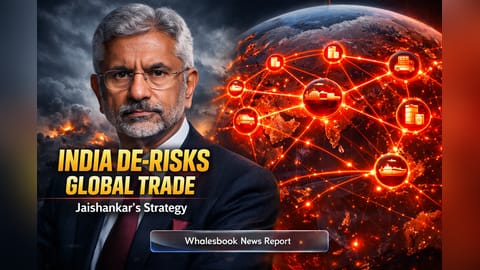
India Responds to 'Weaponized' World: De-risking Strategy Takes Shape
External Affairs Minister S. Jaishankar's recent comments highlight a significant shift in global economics and foreign policy. India has weathered shocks from events like the West Asian conflict and the Russia-Ukraine war well, a result of its decade of growth and strong domestic optimism. The focus now is on a strategic adjustment, as global resources and interdependencies are increasingly used as geopolitical tools. Jaishankar's call to 'hedge, de-risk, and diversify' directly addresses this 'weaponization' of economic power, which is speeding up the breakup of global trade and supply chains. This strategy is timely, with India's Nifty 50 trading around a P/E of 20.0 and Sensex at 20.15, indicating moderate market valuations.
Global Tensions Fuel India's Strategic Shift
Indian equity markets have faced headwinds, with six straight weeks of losses despite a slight gain on April 2, 2026 (Nifty 50 +0.15%, Sensex +0.25%), due to ongoing FII selling and global uncertainty. The driving force behind India's strategic response, as explained by the EAM, is the growing 'weaponization of interdependence' and nations using economic leverage. This includes trade policies, export controls, and supply chain maneuvers that frame competition around control of key resources like energy. The West Asia conflict has pushed crude oil prices over $100 per barrel, threatening India's import-heavy economy. Analysts now forecast higher inflation and lowered GDP growth, showing how global tensions directly affect India's economic outlook.
India's Evolving Strategy: From Resilience to Proactive Capability Building
India's response to global shocks has changed. Previously, geopolitical events often caused immediate market drops and currency devaluation, with past policies focused on strategic oil reserves and currency hedging. Although markets have shown resilience, recent positive openings on April 2, 2026, hint at easing tensions, underlying structural issues remain. Today's climate demands a stronger national strategy to build capabilities, moving beyond economic diplomacy to secure vital resources, technology, and market access. Embracing digital advancements and a positive outlook are key, but building domestic strength is crucial for future goals. Government reforms like the Income Tax Act 2025 and improved banking security (effective April 1, 2026) aim to simplify processes and strengthen the financial system. Meanwhile, global rivals are also adjusting, with many prioritizing 'friend-shoring' and creating new trade routes, signaling a wider fracturing of the global economy.
Risks Remain: High Oil Prices and Global Fragmentation Threaten India
While India has shown resilience, the global situation still carries major risks. Persistent high oil prices from geopolitical conflicts threaten to widen India's current account deficit to about 2% of GDP. This imported inflation could push CPI inflation to the RBI's upper limit, possibly requiring interest rate hikes that slow economic growth, which ICRA forecasts to slow to around 6.5% in FY2027. India's manufacturing sector is already slowing, with the PMI hitting a 45-month low in March 2026, and is facing higher costs and supply issues. The rupee's fall against the dollar also increases import expenses. Foreign institutional investor selling continues to pressure Indian stocks, indicating cautious global investor sentiment due to geopolitical uncertainty and the possible breakdown of global trade and financial systems.
India's Path Forward: Diversification and Global Standing
Building national capabilities and diversifying supply sources are top priorities. When direct control isn't feasible, relying on 'trusted partnerships' and varied suppliers will be vital for reducing risk and gaining advantage. The Reserve Bank of India (RBI) is expected to stay cautious, likely moving toward a stricter, data-driven policy stance to counter inflation, while trying not to hinder economic growth. Efforts to expand market access for Indian businesses and promote 'Brand India' worldwide are key parts of the country's economic strategy. These moves aim to use India's growing strengths in a tough global market. This approach is crucial for India's goal of 'Viksit Bharat 2047', demanding consistent work to protect its economic and strategic interests amid major global changes.