 Whalesbook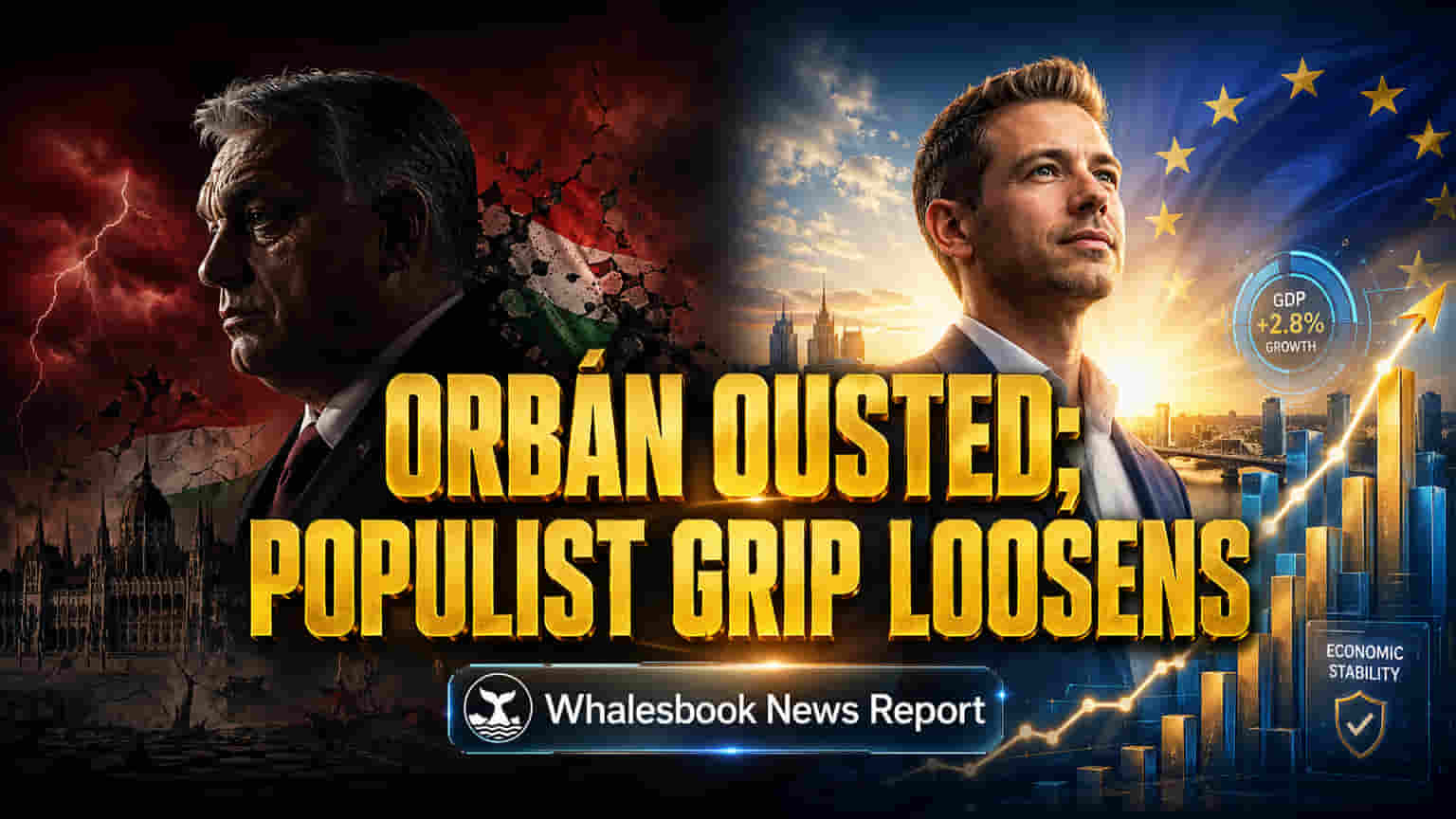


New Political Chapter Opens EU Doors
Hungary's political transition marks a significant economic turning point, moving the nation from isolation toward renewed engagement with the European Union. Hungary's recent election has shifted the focus to unlocking substantial EU financial aid, around €18 billion, which was previously withheld due to rule-of-law concerns. This influx is poised to stimulate the economy, with analysts projecting a 1-1.5 percentage point boost to GDP growth, contingent on swift institutional reforms and adherence to EU fiscal targets. A more cooperative approach toward Brussels and strengthened governance have revitalized investor sentiment, marking a departure from the 'stable stagnation' of the Orbán era.
The Economic Pivot
Financial markets have responded enthusiastically to Hungary's election results. The Hungarian Forint (HUF) rallied significantly, appreciating about 3% against the Euro to a four-year peak, showing a sharp rise in investor confidence. The benchmark BUX equity index also climbed nearly 4%, outperforming regional peers. This surge is linked to anticipated EU fund releases, which had previously weighed on the economy, estimated to be worth about 9% of Hungary's annual GDP. Analysts at Morgan Stanley suggest the release of these funds, alongside a more predictable policy environment, could add considerable momentum to economic growth. The potential for Hungary to meet EU fiscal targets could pave the way for euro adoption discussions in the early 2030s, offering a long-term positive outlook for investors. However, Hungary's debt-to-GDP ratio, exceeding 70%, and a budget deficit above 5%, still present fiscal challenges that credit rating agencies monitor closely.
Geopolitics and Energy Strategy Shift
The election has immediate implications for Hungary's geopolitical standing and its energy relationship with Russia. Orbán's government often used its position to block EU decisions, particularly on energy supplies, causing friction within the bloc and with Ukraine. The new government's commitment to normalizing EU ties suggests a pivot away from this obstructionist approach. Hungary historically relies heavily on Russian energy, supplying around 75% of its natural gas and 60-80% of its oil in 2024. The EU's push to phase out Russian energy sources by 2027 requires Hungary to realign its strategy. Though the new administration is unlikely to sever ties abruptly due to economic dependence and potential price volatility, a gradual transition is anticipated, potentially extending to 2035. This recalibration could bolster EU cohesion and strengthen Eastern Europe's energy security, though balancing domestic needs with geopolitical pressures adds complexity. Eastern European markets, in general, remain sensitive to geopolitical shocks, with recent conflicts in the Middle East exacerbating uncertainty and impacting foreign direct investment.
Persistent Economic Challenges Remain
Despite market optimism, significant economic challenges persist. The country inherits fiscal imbalances and structural weaknesses from the Orbán era, including a large budget deficit and national debt over 70% of GDP. Deep entanglement with Russian energy infrastructure and supply chains presents a formidable challenge for diversifying. While the new government champions EU alignment, the practicalities of reducing dependence on Russian oil and gas, which sustain key industries and utility price reductions, are complex and politically sensitive. Critics point to the decade-long policies that fostered 'stable stagnation' and reduced domestic enterprise productivity, suggesting that genuine economic modernization will require more than just a change in political leadership. The previous regime's dismantling of institutional checks and balances has damaged trust and requires sustained effort to rebuild transparent governance.
Future Outlook
Analysts project a period of cautious optimism for Hungary. The release of frozen EU funds and a return to constructive dialogue with Brussels are expected to provide a significant economic uplift. However, achieving sustained, high-growth trajectories (3-4% GDP) will require addressing underlying competitiveness issues and managing fiscal consolidation effectively. The commitment to EU rule-of-law standards and anti-corruption measures will be critical for maintaining investor confidence and securing long-term financial stability. Hungary's geopolitical standing and evolving energy strategy will be key to its economic performance and its role in Europe.