 Whalesbook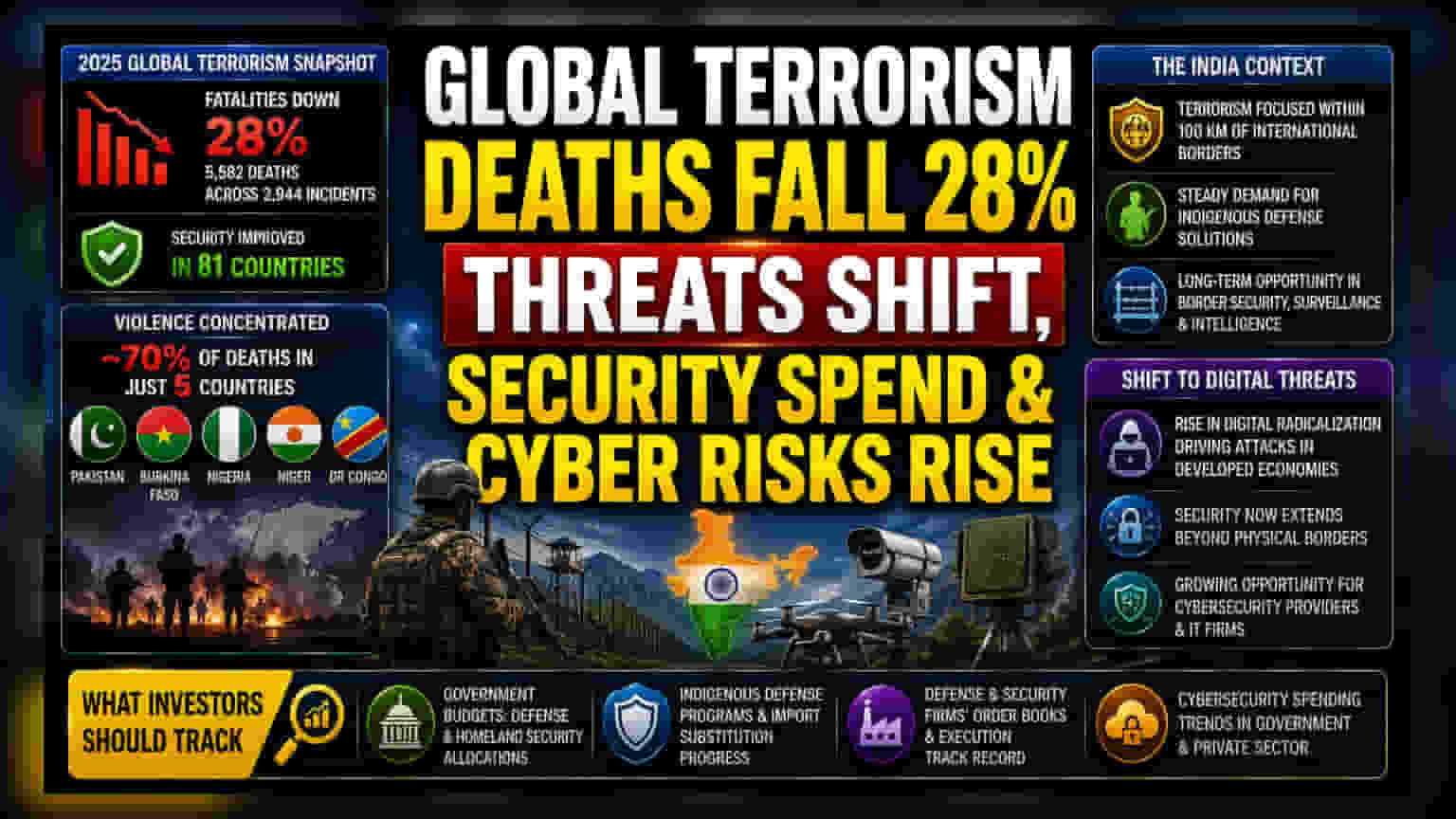


What Happened
Global terrorism trends in 2025 showed a notable shift, with total fatalities falling by 28% to 5,582 across 2,944 incidents. Data indicates that security conditions improved in 81 countries, contributing to this broad-based decline. However, the data also highlights a reorganization of threats rather than a total retreat. Violence is becoming increasingly concentrated, with approximately 70% of all terrorism-related deaths occurring in just five nations: Pakistan, Burkina Faso, Nigeria, Niger, and the Democratic Republic of the Congo.
The Security and Economic Implication
For investors, tracking global and regional security trends is important because national security remains a massive component of government budgets. When security threats become more localized and complex, governments often increase capital allocation toward defense, border management, and surveillance technologies. In India, this translates to a consistent focus on modernizing defense equipment. Companies involved in border security, drone manufacturing, and advanced surveillance systems often see sustained demand as the government prioritizes the protection of its borders, particularly in sensitive regions.
The India Context
India remains in a region where cross-border security challenges are persistent. The data underscores that terrorism is increasingly occurring within 100 kilometers of international borders, turning these areas into focal points for security infrastructure. For Indian investors, this suggests that the demand for indigenous defense solutions is likely to remain steady. Businesses that supply the Ministry of Defence or provide critical infrastructure security—such as those involved in perimeter fencing, intelligence gathering, and regional logistics—often operate with a long-term revenue visibility, provided they can execute on government contracts efficiently.
The Shift to Digital Threats
One of the most significant trends noted is the rise of digital radicalization, which has contributed to an increase in attacks in developed economies. This shift confirms that security is no longer just about physical borders but also about digital domains. As the nature of threats evolves, the corporate and public sector demand for cybersecurity solutions is expected to grow. Indian IT firms and specialized cybersecurity providers are increasingly finding opportunities to offer services that protect both critical national infrastructure and corporate data from digitally enabled threats.
What Investors Should Track
Investors may track several factors that link security trends to the business environment. First, keep an eye on government budget announcements, specifically the allocation for defense and homeland security. Higher allocations often indicate a strong pipeline for defense contractors and surveillance technology providers. Second, monitor the progress of indigenous defense programs, as government policy continues to favor domestic manufacturing to reduce import reliance. Finally, observe the cybersecurity spending patterns of both the government and private sector. As digital threats move from being fringe issues to mainstream risks, the companies that provide robust security architecture are likely to remain central to the evolving security landscape. The long-term performance of these businesses will depend on their ability to adapt to technological changes and maintain reliable execution of complex security contracts.