

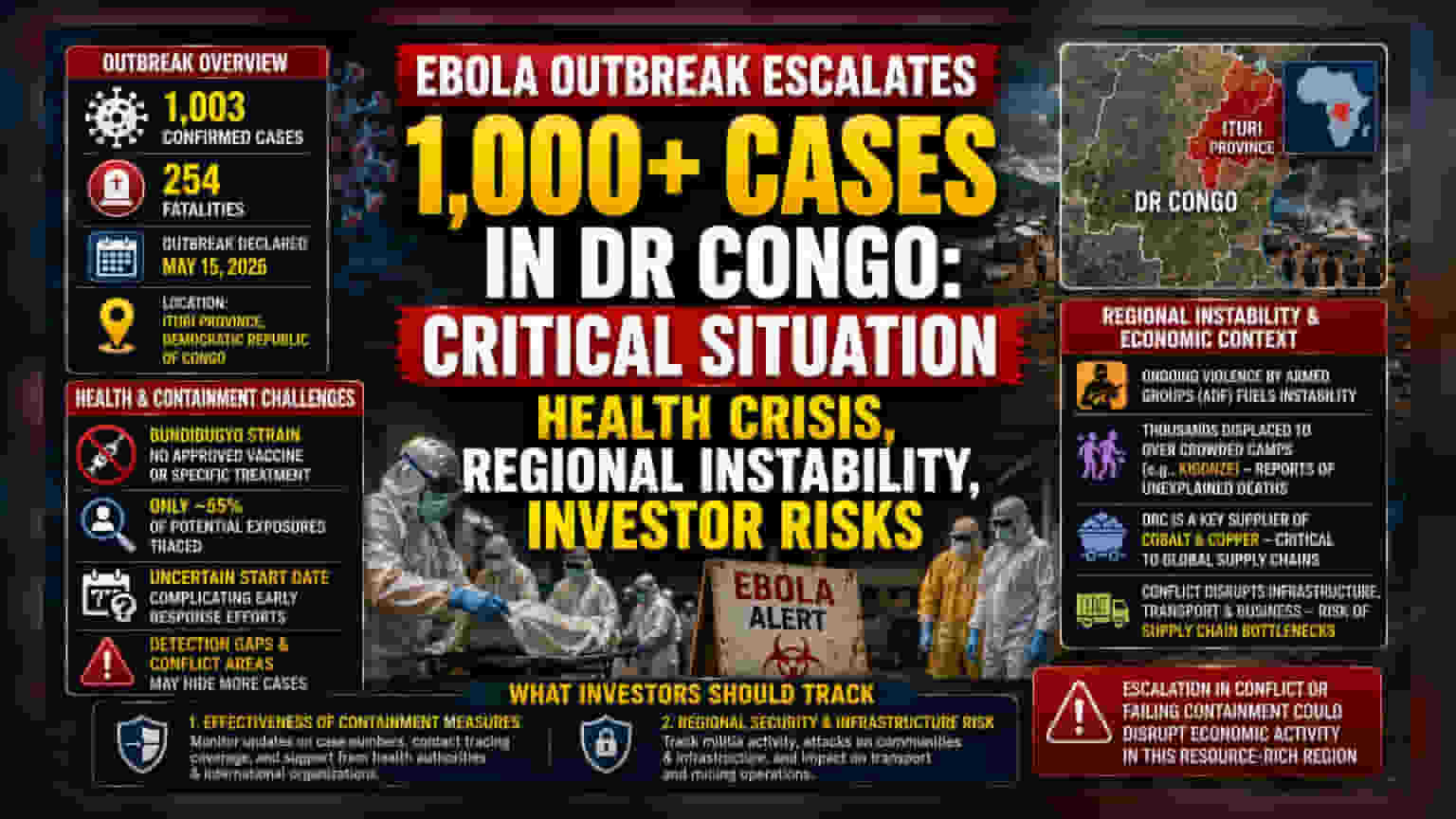
The Ebola outbreak in the Democratic Republic of Congo’s Ituri province has reached 1,003 confirmed cases with 254 deaths. The spread of the rare Bundibugyo strain, coupled with ongoing militia violence and mass displacement, poses significant containment challenges. This humanitarian crisis creates instability in a region critical to global mineral supply chains.
What Happened
The Ebola outbreak in the Democratic Republic of Congo (DRC) has escalated, with confirmed infections surpassing the 1,000 mark. Health officials report 1,003 cases and 254 fatalities in the northeastern Ituri province since the outbreak was declared on May 15. The situation is considered critical, with experts noting that the true number of infections could be higher due to gaps in detection and the difficulty of tracking potential exposures in conflict-affected areas.
The Health And Containment Challenge
Containment efforts are struggling against the unique characteristics of this outbreak. The virus involved is the Bundibugyo strain, for which there is currently no widely approved vaccine or specific treatment available. This lack of medical countermeasures makes the situation particularly difficult for health authorities. Furthermore, contact tracing efforts have only reached approximately 55 percent of people who may have been exposed, leaving a significant portion of the transmission chain unidentified. Dr. Jean Kaseya, director general of the Africa Centres for Disease Control and Prevention, has flagged concerns about uncertainty regarding the outbreak’s exact start date, which complicates early-response efforts.
Regional Instability And Economic Context
For investors and global observers, the situation in Ituri is significant due to the region's broader economic context. The DRC is a key player in the global supply chain for critical minerals, including cobalt and copper. Ongoing violence by armed groups, such as the Allied Democratic Forces (ADF), has fueled a climate of instability that disrupts local infrastructure and business operations.
The conflict has led to thousands of people fleeing their homes, creating overcrowded displacement camps, such as the one in Kigonze, where reports of unexplained deaths have surfaced. This mass displacement not only creates a humanitarian crisis but also hinders the movement of goods, labor, and services, potentially causing supply chain bottlenecks. The inability to ensure safety in these areas creates a risk of prolonged disruption to regional economic activity.
What Investors Should Track
Investors monitoring the situation should focus on two key areas: the effectiveness of containment measures led by health authorities and the level of regional security. The ability of the government and international aid organizations to control the virus’s spread in conflict-prone areas will be a primary monitorable. Additionally, any escalation in militia activity that affects transport or mining infrastructure in the broader North Kivu and Ituri provinces would be a significant development, as such instability could impact the cost and reliability of logistics in this resource-rich region.