 Whalesbook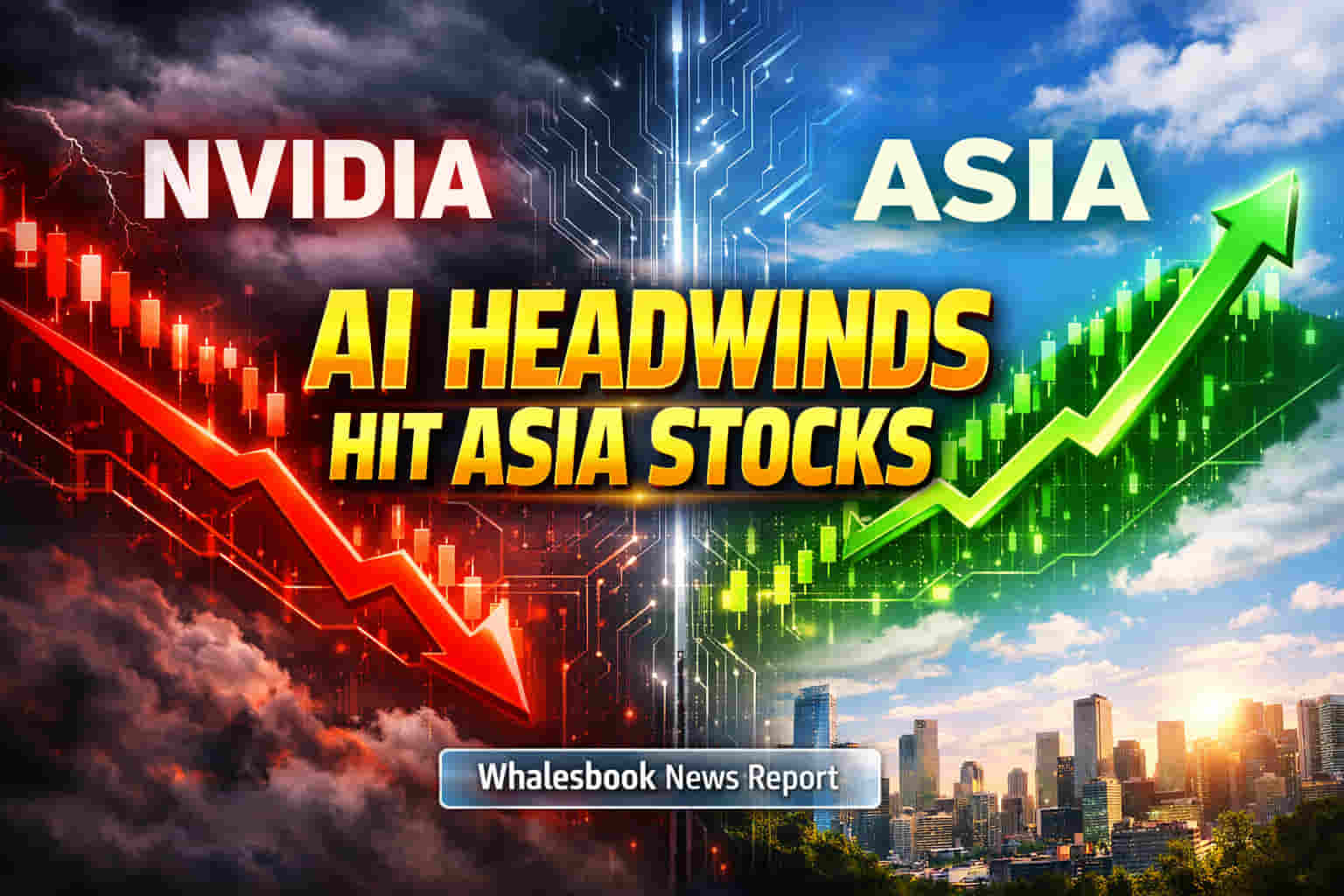


THE SEAMLESS LINK
The recent market pullback, triggered by heightened volatility in mega-cap technology stocks, has cast a shadow over Asian equities approaching record highs. While Wall Street benchmarks experienced a significant decline, the MSCI Asia Pacific Index held flat early Friday, reflecting underlying resilience driven by regional companies perceived as essential 'picks and shovels' for the burgeoning artificial intelligence revolution. This divergence highlights a market increasingly bifurcated between thematic AI plays and broader sentiment reacting to the performance of tech giants, whose stock movements are now inextricably linked to AI headlines and regulatory scrutiny.
THE STRUCTURE
AI's Double-Edged Sword Hits Tech Giants
Nvidia's substantial 5.5% slump on Wednesday, its worst session since April 2025, served as a potent reminder of the market's sensitivity to artificial intelligence narratives. This decline rippled through the 'Magnificent Seven' mega-cap stocks, signaling that even strong earnings beats from AI leaders are no longer guaranteed to sustain upward momentum when investor expectations are exceedingly high. The market's vulnerability to AI-related news was further underscored by after-hours trading activity. Block Inc. shares surged over 20% following its announcement of nearly 4,000 workforce reductions as part of a strategic pivot to AI. Similarly, Dell Technologies saw its stock jump on a better-than-expected outlook for AI server sales, a segment where it has accumulated a significant backlog. However, Dell faces headwinds from margin compression on these lower-margin AI servers and rising memory component costs.
Asia's AI Infrastructure Advantage and Valuation Dynamics
Amidst the tech sector turmoil, Asian equities have demonstrated notable outperformance, with the MSCI Asia Pacific Index achieving a 15% year-to-date gain, significantly outpacing the S&P 500's modest 0.9% rise [cite: Source A]. This strength is attributed to investor confidence in regional companies as key suppliers for the AI build-out. However, valuations warrant scrutiny. ASML, a critical supplier of chipmaking equipment, commands a high P/E ratio, ranging from 53.2 to 57.88, significantly exceeding the technology sector average of approximately 28.95. Taiwan Semiconductor Manufacturing Company (TSMC) trades at a P/E around 29.66 to 37.21, which, while below its industry average of 43.33x, is still historically high and above its sector median. Samsung Electronics' P/E ratio hovers around 38.0 to 32.77, placing it above Asian tech averages. SK Hynix shows a more moderate P/E around 17.5 to 19.02, with a strong forward P/E of 5.85, reflecting its robust return on equity.
THE FORENSIC BEAR CASE
Despite the enthusiasm for AI, significant risks persist. For Dell, the structural challenge of lower margins on AI servers, coupled with memory component cost pressures and intense competition, particularly from vertically integrated players like Nvidia and AMD, poses a threat to profitability. Block faces operational risks from its aggressive cost-cutting and mandatory AI integration strategy, which employees report is deteriorating company culture and may disrupt ongoing projects. On a broader scale, the semiconductor industry is increasingly subject to geopolitical risks and stringent regulatory controls. US export restrictions on advanced AI chips are forcing companies to design compliant, potentially less capable, versions, thereby impacting innovation and creating a complex compliance environment. The threat of a bifurcated global supply chain due to US-China tensions and other geopolitical rivalries adds another layer of uncertainty, potentially slowing innovation and increasing costs. Analyst sentiment, while generally positive for individual AI leaders, has shown caution regarding the broader US-branded server market, with some firms lowering price targets due to margin and competition concerns.
Future Outlook
Treasury yields have stabilized around 4%, offering a degree of calm in fixed income markets, though the US dollar remains volatile. The narrative in Japan saw core inflation ease, aided by utility subsidies, while the yen strengthened slightly. Investors will be closely watching upcoming earnings reports and the continued impact of AI adoption on operational efficiency and margin dynamics across the tech sector. The sustained demand for AI infrastructure in Asia, contrasted with the performance of US tech giants, suggests a complex investment environment shaped by technological advancement, regulatory landscapes, and macroeconomic factors.