

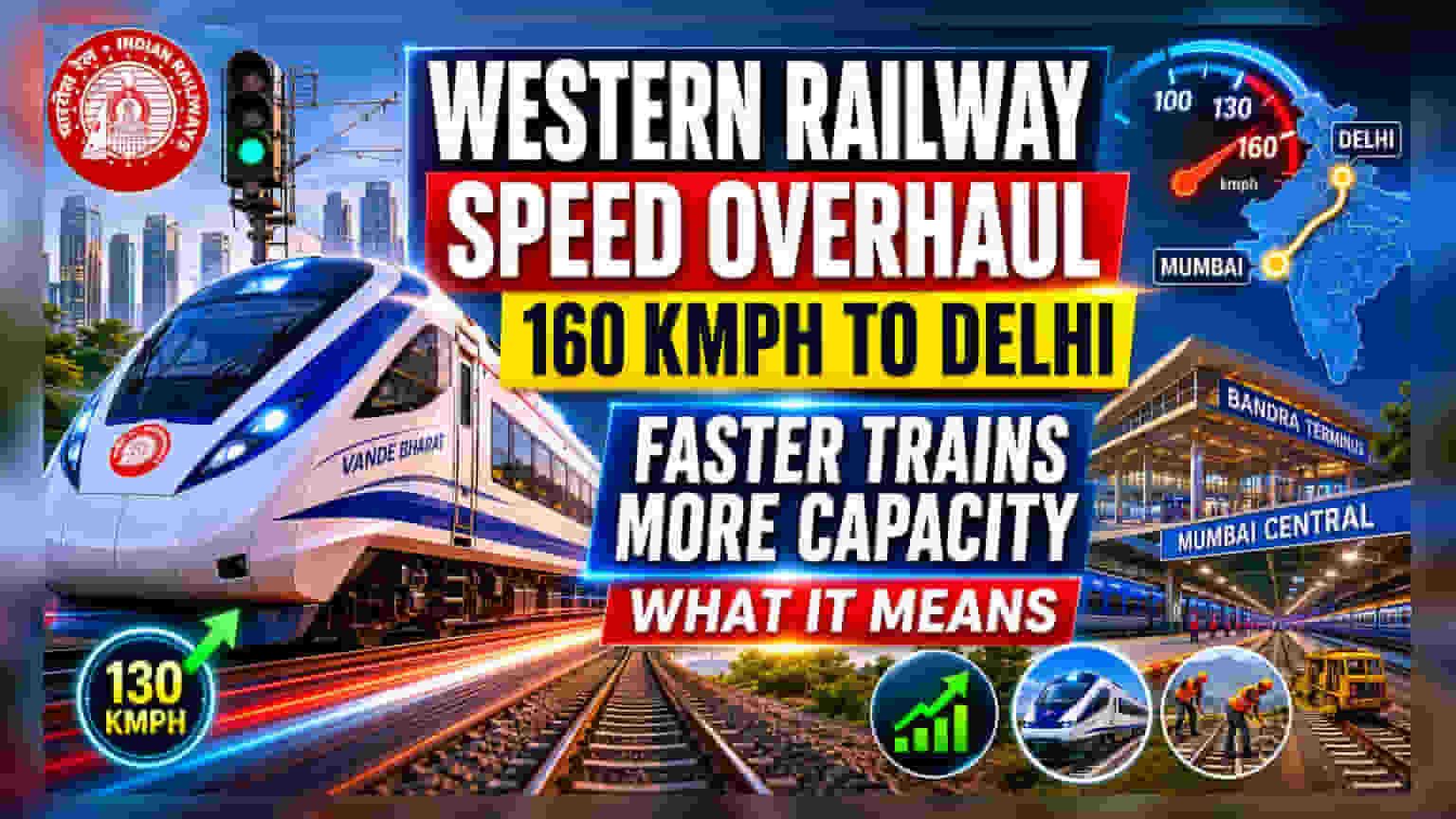
Western Railway is upgrading tracks to support 160 kmph on the Delhi route and 130 kmph elsewhere to boost capacity. While these infrastructure improvements aim to reduce travel times, the network is also navigating a 2% decline in passenger volume, partly due to competition from expanding metro services.
What Happened
Western Railway is launching a significant infrastructure overhaul to increase train speeds across its network. The primary objective is to raise the maximum permissible speed on the critical Mumbai-Delhi corridor to 160 kmph. Additionally, the railway is upgrading other major routes to support speeds of 130 kmph, up from the current 100-110 kmph range. This initiative is designed to modernize operations, improve track capacity, and facilitate faster travel between major economic hubs.
The project also includes station redevelopment and expansion, specifically at Bandra Terminus and Mumbai Central. At Bandra, the railway plans to add ten new stabling lines to accommodate more train services, while Mumbai Central will see platform extensions to support 24-coach trains. These changes are intended to streamline logistics and allow for a higher frequency of train operations.
Business Impact and Capacity Gains
For Indian Railways, infrastructure upgrades are essential for improving asset turnover. By shifting freight traffic to the Western Dedicated Freight Corridor (DFC), Western Railway aims to free up the existing network for more passenger trains. This operational shift is a standard strategy to resolve congestion issues on trunk routes. For companies involved in railway engineering, construction, and rolling stock manufacturing—such as those involved in track laying, signaling, and supplying Vande Bharat trains—sustained investment in these projects supports revenue visibility. The request for new Vande Bharat sleeper coaches further highlights the push toward fleet modernization.
The Competition and Traffic Reality
While infrastructure improvements are a clear positive for long-term efficiency, the immediate ground reality is more complex. Western Railway reported a 2% decline in passenger traffic over the last two months, following a 0.2% dip in the previous financial year. This trend suggests that commuters are increasingly shifting toward alternative modes of transport, particularly in urban areas. The expansion of Mumbai’s Metro network is emerging as a significant competitor, offering reliable, high-frequency travel that is drawing away a portion of the suburban and short-distance passenger base. This shift acts as a counterbalance to the railway's capacity expansion plans.
Execution and Operational Risks
Large-scale railway projects, such as track upgrading for high-speed transit and station redevelopment, carry inherent execution risks. These include potential delays in land acquisition, cost overruns due to material price fluctuations, and the logistical challenge of upgrading infrastructure without disrupting current train operations. Additionally, the success of these upgrades in boosting revenue depends on the railway’s ability to regain lost passenger volumes and effectively utilize the capacity created by the Dedicated Freight Corridor.
What Investors Should Track
The most important monitorables for this story are the commissioning timelines for the track upgrades and the progress of the station redevelopment work. Investors and industry watchers will also track whether passenger traffic stabilizes or continues to decline as metro competition grows. Finally, the allocation of new Vande Bharat rolling stock and the actual impact of the Dedicated Freight Corridor on freight-to-passenger capacity transfer will be key indicators of how effectively the network is being optimized.