 Whalesbook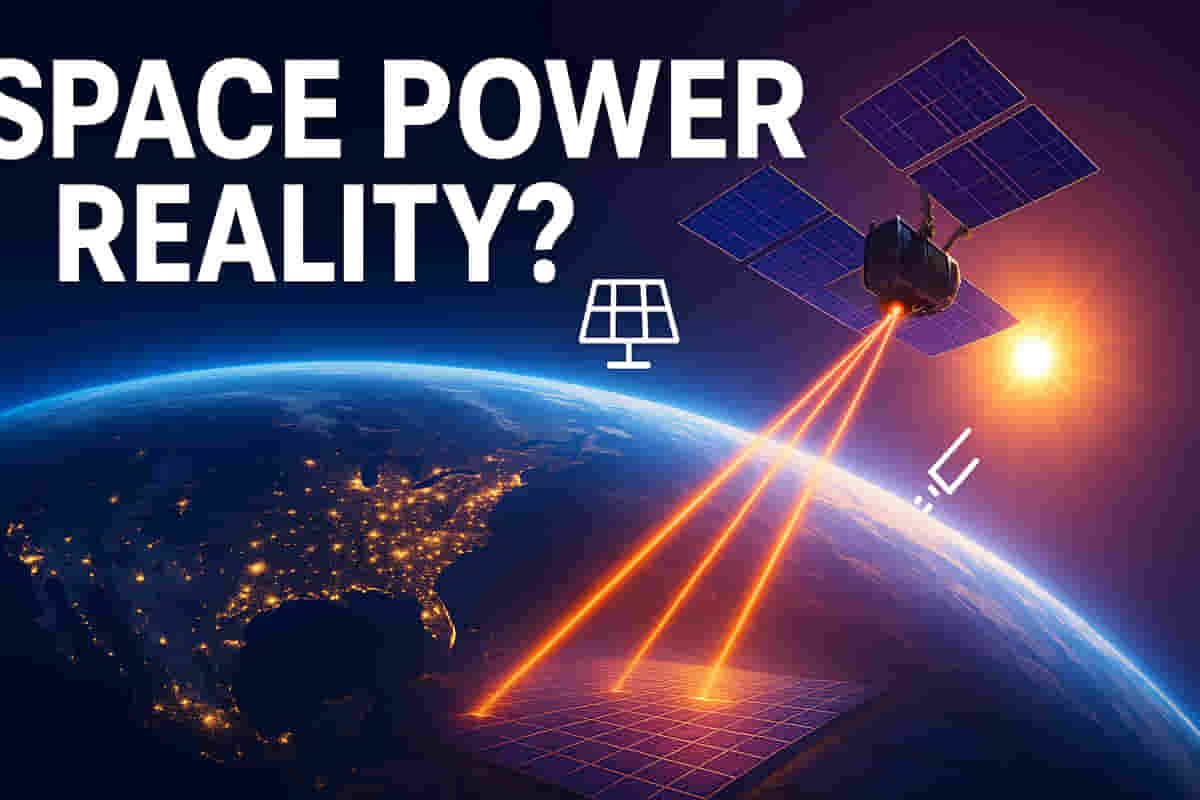
Overview Energy has officially launched, announcing ambitious plans to harness solar power from space and transmit it to Earth for a nearly continuous energy supply. The startup aims to overcome the limitations of Earth-based solar by collecting sunlight in orbit and beaming it down, potentially revolutionizing the renewable energy landscape.
The company's innovative approach involves deploying large solar arrays in geosynchronous orbit, approximately 22,000 miles above Earth. These space-based collectors will gather sunlight continuously. The harvested energy will then be converted and transmitted to Earth using infrared lasers directed towards ground-based, utility-scale solar farms. This system is designed to allow for power generation even when it's nighttime or cloudy on Earth, effectively providing round-the-clock renewable energy. An airborne demonstration successfully transmitted power via laser over a 5-kilometer distance, showcasing the core technology.
Overview Energy has secured $20 million in funding to date. Key investors supporting this venture include the Aurelia Institute, Earthrise Ventures, Engine Ventures, EQT Foundation, Lowercarbon Capital, and Prime Movers Lab. This significant backing reflects growing investor confidence in the potential of space-based energy solutions, which are moving from science fiction to plausible reality, partly due to decreasing space launch costs.
Despite the technological promise, significant hurdles remain. Deploying infrastructure in space is considerably more expensive than on Earth. Furthermore, the technology for wirelessly transmitting substantial amounts of power from orbit to the planet's surface is still in its early stages. Overview Energy is not alone in this pursuit; companies like Aetherflux are also developing laser-based systems, while others such as Emrod and Orbital Composites/Virtus Solis are exploring microwave-based power transmission.
Microwave transmission is less affected by atmospheric conditions like clouds compared to infrared lasers, which can be absorbed by water droplets. However, microwave systems require entirely new ground stations, whereas Overview's plan to use existing solar farms could offer an advantage. A major concern for any wireless power transmission system is safety. Beams must be tightly controlled to prevent collateral damage to aircraft and birds. While Overview's reuse of solar farms might mitigate some issues, convincing the public about the safety of energy beams from space and ensuring the laser system's efficiency—minimizing energy loss during conversion—will be critical.
Overview Energy has outlined an ambitious timeline. The company plans to launch a satellite into low Earth orbit in 2028 for testing, followed by a move to geosynchronous orbit. The ultimate goal is to begin transmitting megawatts of power from geosynchronous orbit by 2030. This venture faces stiff competition not only from other emerging space-based power concepts but also from rapidly advancing grid-scale battery storage and potentially nuclear fusion technology.
Impact
- This technology, if successful, could fundamentally change the global energy landscape by providing a consistent source of renewable power, reducing reliance on fossil fuels and mitigating the intermittency issues of current solar and wind power.
- It poses a long-term challenge to existing energy storage solutions like batteries and could spur further innovation in related fields such as aerospace engineering, laser technology, and wireless energy transfer.
- Impact Rating: 7/10 (for future technological disruption, 2/10 for immediate stock market impact)
Difficult Terms Explained
- Geosynchronous Orbit: An orbit around the Earth at an altitude of approximately 22,236 miles (35,786 km), where a satellite's orbital period matches the Earth's rotation. This allows the satellite to remain above a fixed point on the Earth's surface.
- Infrared Lasers: Lasers that emit light in the infrared part of the electromagnetic spectrum, which is invisible to the human eye and can be used for transmitting energy.
- Utility-Scale Solar Farms: Large-scale installations designed to generate electricity for the power grid, typically ranging from tens to hundreds of megawatts in capacity.
- Electromagnetic Spectrum: The entire range of electromagnetic radiation, including radio waves, microwaves, visible light, ultraviolet, X-rays, and gamma rays, differing in wavelength and frequency.
- Megawatt (MW): A unit of power equal to one million watts, commonly used to measure the output of power plants and large electrical devices.