

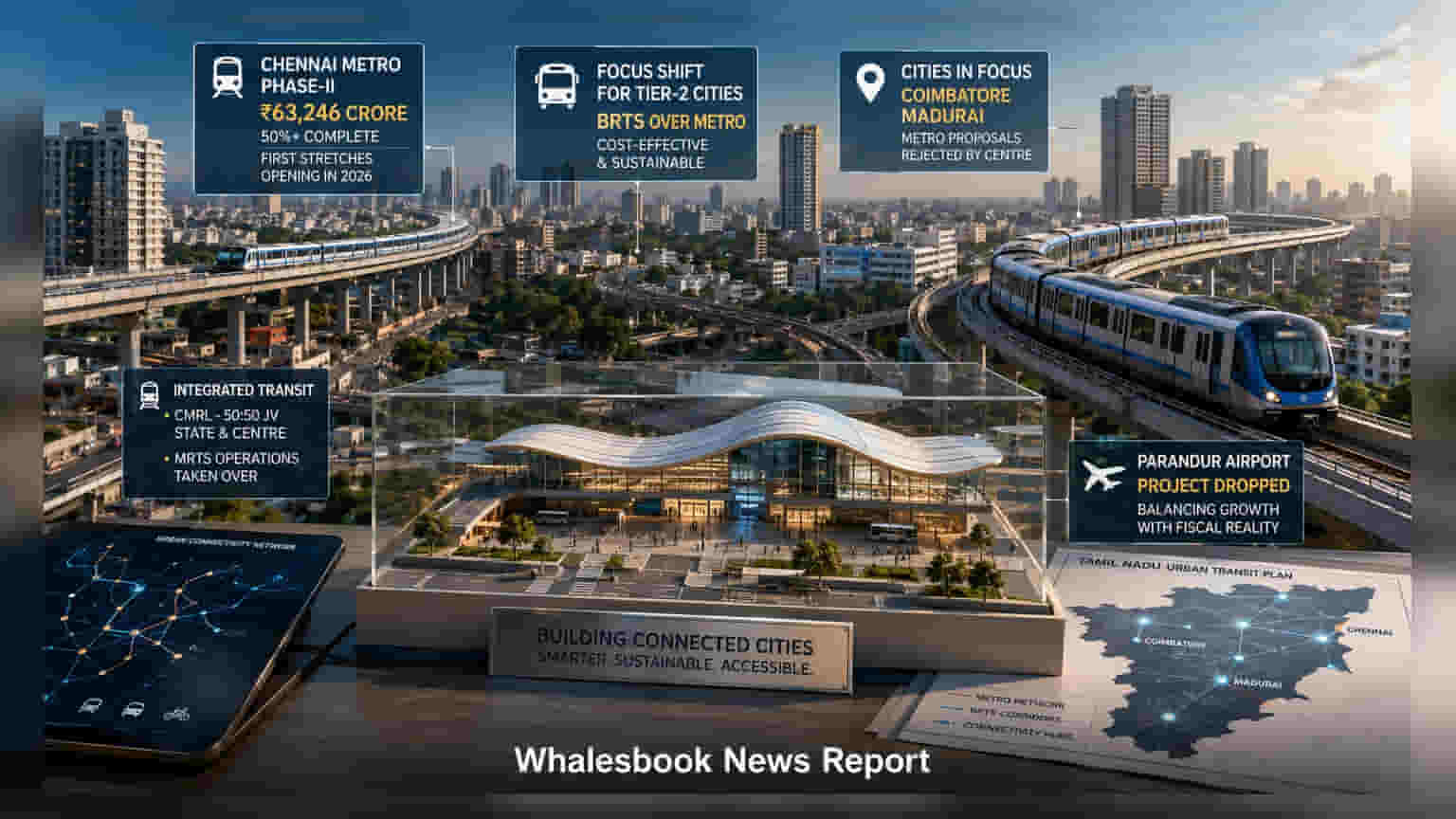
The Tamil Nadu government’s plans to expand Metro rail networks to cities like Coimbatore and Madurai have faced repeated pushback from the Union Ministry of Housing and Urban Affairs. While the Centre advocates for cost-effective Bus Rapid Transit Systems (BRTS), the state remains focused on its massive Chennai Metro Phase-II project, balancing infrastructure ambitions with significant capital spending requirements.
Tamil Nadu’s strategy to modernize urban transport faces a reality check as the Union government continues to resist Metro rail expansion in regional cities, suggesting a pivot toward bus-based solutions. While the state government has been aggressive in proposing Metro rail corridors for urban centers like Coimbatore and Madurai, the Union Ministry of Housing and Urban Affairs has rejected these proposals multiple times, most recently in July 2026. The Centre maintains that for these cities, a Bus Rapid Transit System (BRTS) provides a more financially sustainable alternative than the high-cost, high-ridership infrastructure required for Metro rail.
This friction over project viability comes as the state manages a massive commitment to the Chennai Metro Phase-II project. This project, estimated at ₹63,246 crore, is currently over 50% complete, with initial stretches expected to open later in 2026. Beyond construction, the state has also moved to take over the assets and operations of the existing Mass Rapid Transit System (MRTS) from the Southern Railway to unify transit management within the capital. The Chennai Metro Rail Limited (CMRL) acts as the primary agency for these efforts, functioning as a 50:50 joint venture between the state and central governments.
These transit priorities are being re-evaluated alongside broader state fiscal management. Notably, the Tamil Nadu government officially decided in late August 2026 to drop the proposed greenfield airport project at Parandur. This decision highlights the ongoing challenge of balancing large-scale infrastructure ambitions with limited resources and the state’s existing debt burden.
For the infrastructure and engineering sector, these developments serve as a reminder that state-led projects are increasingly scrutinized for financial and operational efficiency. Companies involved in transport infrastructure will be tracking whether the state pivots toward smaller, bus-based construction projects or continues to negotiate with the Centre for rail-based transit funding. The primary financial concern remains the state’s fiscal health, as high capital spending on the Chennai Metro continues to influence budgetary allocations. Future updates will likely center on the commissioning timeline for the first segments of Chennai Metro Phase-II and whether the state can reach a compromise with the Centre on transit models for its secondary cities.