

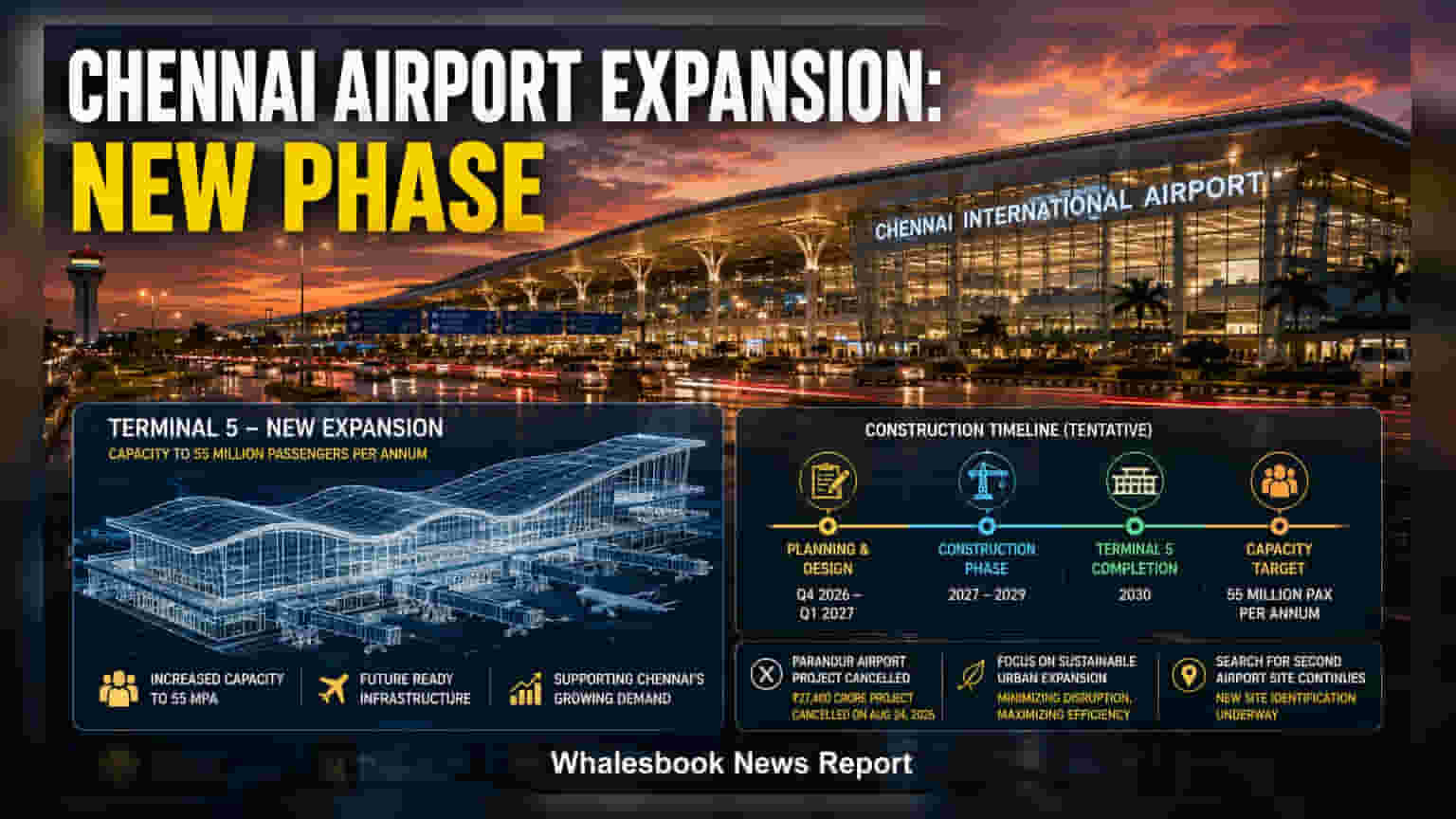
The Tamil Nadu government has officially scrapped the ₹27,400-crore Parandur greenfield airport project due to local opposition regarding land and environmental issues. State authorities have pivoted to expanding the existing Chennai International Airport, targeting a capacity of 55 million passengers annually. Investors are now watching how this change impacts long-term aviation infrastructure and regional traffic management.
The Tamil Nadu government, led by Chief Minister C. Joseph Vijay, officially cancelled the proposed ₹27,400-crore Parandur greenfield airport project on August 24, 2026. This decision ends years of uncertainty surrounding the project, which faced significant opposition from local farmers and residents in Ekanapuram and nearby villages. Concerns over the displacement of agricultural communities and the ecological impact on local water bodies were the primary reasons cited for the cancellation.
Following this pivot, the state is now focusing on the immediate expansion of the existing Chennai International Airport at Meenambakkam. The government plans to construct a fifth terminal (Terminal 5) to increase the facility's capacity to 55 million passengers annually. This strategy is intended to address urgent capacity constraints while officials restart the search for an alternative, less contentious site for a second airport to support long-term state growth.
Challenges of Urban-Locked Infrastructure
While the expansion of the current airport provides a shorter-term solution to rising traffic demand, it presents inherent operational risks. Unlike a new greenfield site, the Meenambakkam facility is situated in a densely populated urban area, which limits the scope for massive horizontal expansion. Building new infrastructure like Terminal 5 requires balancing construction schedules with ongoing flight operations, which can lead to cost overruns and project delays. Furthermore, the surrounding area is already prone to traffic congestion, and improving connectivity to the airport remains a complex logistics challenge.
Potential Risks and Capacity Limits
For investors and stakeholders, the core concern is the long-term feasibility of this strategy. Industry estimates suggest that even with the planned expansion, the existing airport could reach full capacity saturation between 2028 and 2032. If passenger numbers continue to grow at the current pace, the state will face a recurring need for additional aviation infrastructure. The lack of a finalized, large-scale airport site has already drawn criticism from opposition leaders, who argue that the delay could impact the state’s economic competitiveness and ability to attract large-scale logistics investments.
Monitorables for the Future
Investors and observers are now watching for three main updates. First, the specific timeline and budget allocation for the new Terminal 5 construction at Meenambakkam. Second, the progress on resolving the status of the land already acquired for the abandoned Parandur project. Finally, the search for a new, viable site for a secondary airport remains a critical factor. The ability of the state to identify a location that avoids the land and ecological disputes of the previous project will be essential for avoiding similar delays in the future.