 Whalesbook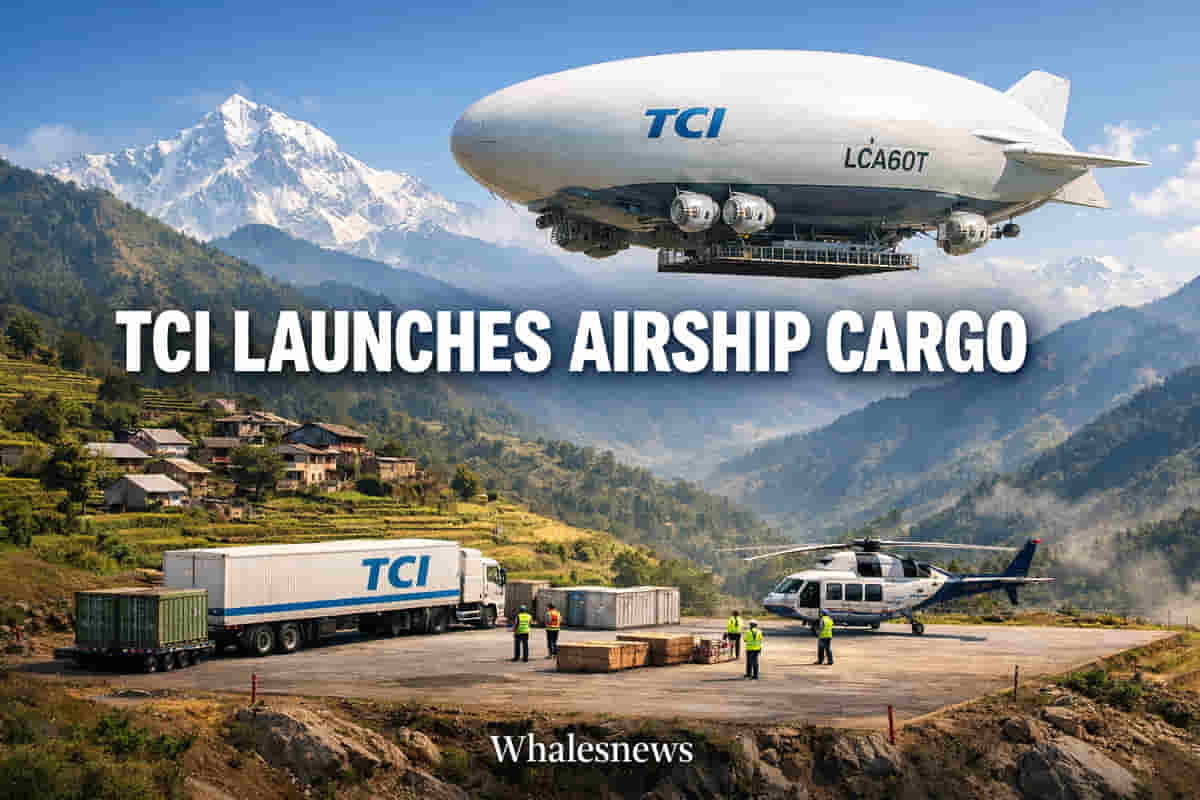


Strategic Analysis & Impact
Transport Corporation of India Limited (TCI), a prominent player in India's logistics sector, has announced a significant strategic collaboration with French group FLYING WHALES. This partnership heralds the introduction of pioneering cargo airship technology to India, aiming to redefine heavy-lift and remote-location transportation.
The collaboration, formalized through a Memorandum of Understanding (MOU), was unveiled during an official summit between the President of the French Republic and the Prime Minister of India, underscoring its geopolitical and economic significance. The core of this partnership lies in integrating FLYING WHALES' Large Capacity Airship 60 Tonnes (LCA60T) into TCI's extensive logistics network. The LCA60T is a rigid cargo airship designed with a substantial payload capacity of 60 tons. Its key innovation is the ability to load and unload cargo while hovering, eliminating the need for traditional ground infrastructure like runways or airports. This capability is particularly game-changing for accessing remote, landlocked, or infrastructure-scarce regions across India.
This venture is positioned to address several critical challenges in the Indian logistics landscape. With India's logistics sector accounting for approximately 13-14% of its GDP and facing issues like high operational costs and regulatory hurdles [5, 12], the LCA60T offers a potential solution for efficient and cost-effective movement of heavy or bulky goods. Furthermore, the technology aligns with growing global and national imperatives for decarbonizing transportation. The LCA60T is designed to be powered by hybrid-electric propulsion, with plans for a transition to hydrogen fuel cells, significantly reducing CO2 emissions compared to traditional freight transport methods [9, 16, 20].
Potential applications for this technology are vast and diverse, spanning critical sectors such as Defense, Energy, Infrastructure, construction, disaster relief, and healthcare services. The ability to rapidly deploy aid or essential supplies to disaster-stricken areas or to remote project sites without relying on established transport links could prove invaluable [20, 31].
FLYING WHALES is also contemplating establishing its third global hub in Tamil Nadu, India, and TCI's collaboration is seen as a catalyst for accelerating this ambition within the Indian market. This move could position India as a central node for FLYING WHALES' industrial and commercial expansion in the Middle East and Asia-Pacific regions.
Financial Context & Performance
While this announcement is primarily strategic, it's worth noting TCI's recent financial performance. In the third quarter of fiscal year 2024, TCI reported a revenue of approximately INR 10.02 billion, a modest 3.7% year-on-year growth. EBITDA stood at INR 1.276 billion, a slight decrease from the previous year, with EBITDA margins contracting to 12.73% from 13.61% YoY. Profit After Tax (PAT) saw a decline of 7.44% YoY to INR 802 million [4, 10]. Despite these quarterly figures showing some pressure on margins, the company has maintained a net debt-free position with substantial cash reserves [11]. The company's supply chain management (SCM) business has shown robust growth, driven by the automobile sector [10, 11].
Risks & Outlook
While the introduction of airship technology is revolutionary, it also carries inherent risks. The LCA60T is a novel technology, and its successful integration, scalability, and economic viability in the Indian context will require extensive testing, regulatory approvals, and substantial investment. The operational costs, maintenance, and the reliability of such airships in diverse Indian weather conditions are factors that will need to be closely monitored. Dependence on foreign technology and potential supply chain disruptions for manufacturing or maintenance could also pose challenges.
The outlook is cautiously optimistic, banking on the government's continued focus on infrastructure development and the growing demand for efficient and sustainable logistics solutions. If successful, this venture could unlock significant growth potential for TCI by opening up new market segments and offering unique value propositions that competitors cannot easily match. Investors will be watching for pilot project successes, regulatory clearances, and the pace of technology adoption.
Peer Comparison
Transport Corporation of India (TCI) operates in a competitive Indian logistics market dominated by players like Blue Dart Express, Delhivery, Gati, and Mahindra Logistics [5, 13, 17]. The Indian logistics market is projected to grow significantly, driven by e-commerce, government infrastructure development (like PM Gati Shakti), and GST implementation [5, 7, 8]. While competitors are focused on expanding their road, rail, and air cargo networks, TCI's move into airship technology is a bold differentiation strategy. Competitors are also investing in technology for efficiency and sustainability, but none are currently exploring heavy-lift airships for general cargo. The Indian logistics sector is characterized by fragmented road transport but consolidation is increasing, with companies like DHL, FedEx, and UPS also having a significant presence [5, 22]. The sector faces challenges including high operational costs, regulatory hurdles, and the need for better modal balance, with road transport dominating freight movement [5, 7, 8]. TCI's airship venture aims to address the challenge of connectivity in remote areas, an aspect not typically covered by existing multimodal strategies.