 Whalesbook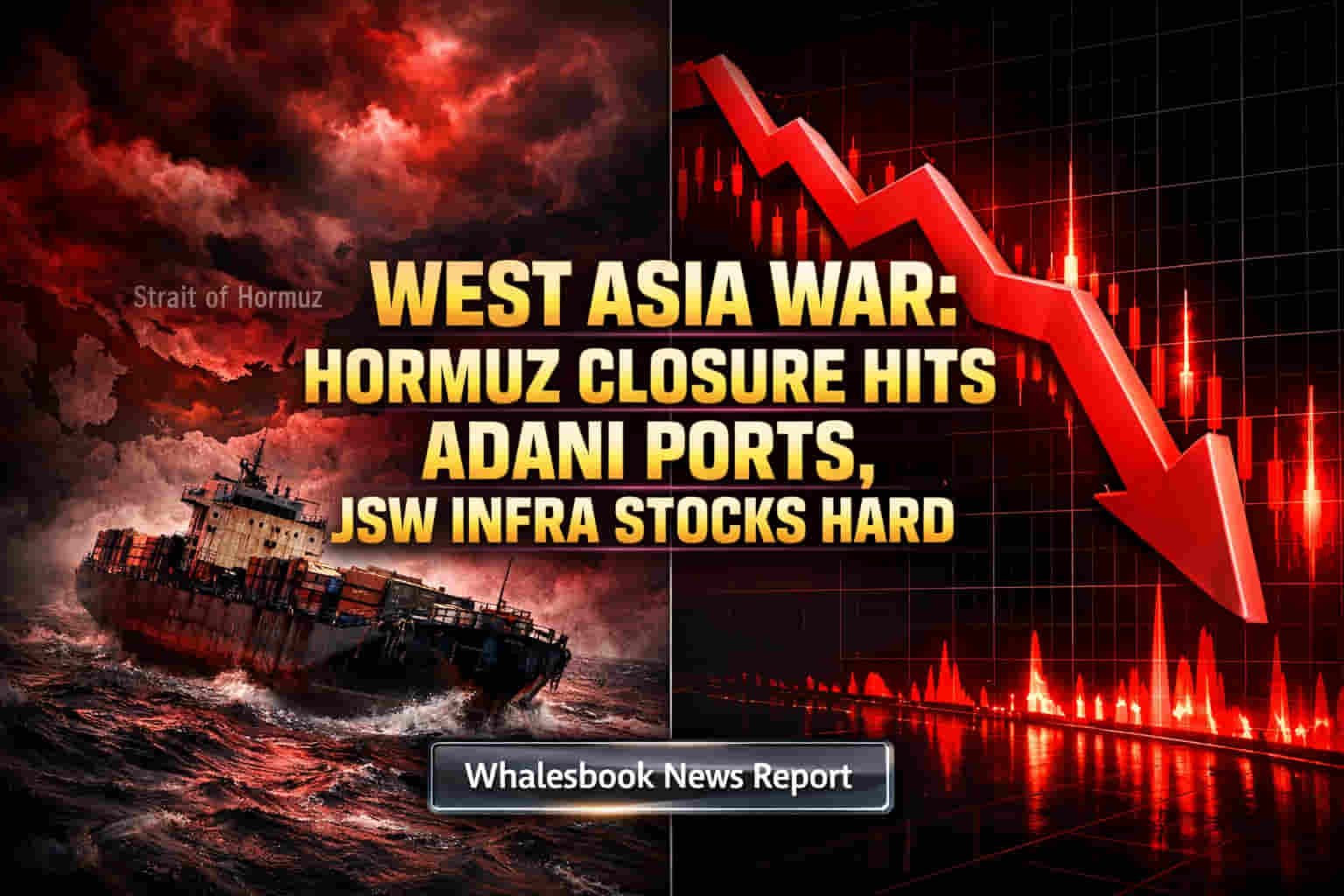
THE SEAMLESS LINK
The intensification of geopolitical tensions in the Middle East, culminating in disruptions around the Strait of Hormuz and Bab el-Mandab, is casting a long shadow over global trade arteries and, by extension, India's critical logistics and port infrastructure. While the immediate market reaction on March 2, 2026, showed stock price declines across several key players, the deeper implications lie in the potential for sustained impacts on cargo volumes, operational costs, and India's broader economic stability.
The Core Catalyst: Market Reaction to Geopolitical Shockwaves
On Monday, March 2, 2026, the market reacted negatively to the escalating conflict. Adani Ports & Special Economic Zone (APSEZ) saw its shares fall over 2% as geopolitical tensions intensified. This immediate downturn reflects investor apprehension regarding the company's extensive port operations and its role in handling a significant portion of India's trade, which is directly exposed to these maritime chokepoints. Other companies in the sector also experienced pressure, underscoring the sector-wide sensitivity to regional instability. Historically, geopolitical shocks in the Middle East have led to market volatility, with significant, albeit often temporary, sell-offs, such as the ~3% drop in Adani Ports stock in early October 2024 due to Iran-Israel tensions and a nearly 10% fall over ten days in June 2025 following concerns over Haifa Port operations. However, such events have typically not resulted in permanent value destruction, with markets often recovering within months.
The Analytical Deep Dive: Navigating Trade Vulnerabilities
The disruption in vital shipping lanes poses a multifaceted challenge. Analysts estimate that approximately 31% of India's export-import cargo had exposure to the Middle East and North Africa (MENA) region as of FY25 [cite: Input News]. Any prolonged closure or restriction could force vessels to reroute around the Cape of Good Hope, significantly increasing transit times, fuel consumption, and insurance premiums, thereby inflating freight charges and potentially leading to 'blank sailings' [cite: Input News]. This scenario directly impacts domestic port throughput and the competitiveness of Indian exporters, particularly for bulk commodities and low-margin goods.
Company-Specific Exposures:
- Adani Ports and Special Economic Zone (APSEZ): As India's largest private port operator, APSEZ handled 41.3 MMT of cargo in June 2025 alone and achieved its highest ever half-yearly cargo handling of 244.20 MMT in H1 FY26. While its container traffic saw a 20% YoY surge in H1, its exposure to the conflict zone includes Haifa Port in Israel, which contributes a modest 1.5% to EBITDA but carries significant geopolitical risk [cite: Input News, 15]. The company's stock experienced a notable decline in June 2025 following missile strikes near Haifa. APSEZ has a P/E ratio around 28.5x as of February 2026.
- JSW Infrastructure: The company's liquid storage terminal in Fujairah, UAE, generated an estimated $36 million in EBITDA in FY25, representing about 13% of its total EBITDA [cite: Input News]. While much of its cargo is domestically linked, operational disruptions at Fujairah could weigh on profitability. Planned expansions in Oman also face execution risks amid regional instability. Analysts have noted an 'elevated P/E' for JSW Infrastructure.
- Gujarat Pipavav Port: This operator benefits from a zero-debt balance sheet, a rarity among its peers. With a P/E ratio of approximately 18.2x as of February 2026, it appears more conservatively valued than some competitors. However, it remains susceptible to volume pressures if Red Sea-routed services face prolonged disruptions.
- Aegis Logistics: Primarily handling oil, gas, and chemicals, Aegis Logistics is heavily reliant on Middle Eastern LPG imports (over 90% in FY25). Disruptions or price spikes could slow LPG demand growth, impacting its business. The company's stock has seen a 1-year return of -14.09% and trades at a P/E of around 37.5x.
- GMR Airports: Potentially facing reduced international passenger traffic if flights to the Gulf are curtailed, affecting high-margin non-aeronautical revenues. The company exhibits significant financial weaknesses, including a negative P/E ratio (around -592x) and poor ROE/ROCE over the past three years, suggesting a higher inherent risk profile.
Sectoral and Macro Context:
The Indian logistics sector, valued at approximately ₹9-12 lakh crore and contributing 13-14% to GDP, is projected to grow significantly. However, the current industry P/E ratio of 27.6x is below its 3-year average, indicating investor pessimism regarding long-term growth rates. This pessimism is compounded by the current geopolitical instability, which threatens to reverse gains in logistics efficiency. India's dependence on Middle Eastern energy imports—nearly 40% of crude oil and over 50% of LNG pass through the Strait of Hormuz—amplifies these concerns. A $10 per barrel rise in crude oil prices could increase India's import bill by over $2 billion annually and shave 0.3-0.4% off GDP growth. Efforts to diversify energy sources, such as increased US LPG imports, offer a hedge but cannot fully mitigate immediate transit and cost concerns.
⚠️ THE FORENSIC BEAR CASE
While the geopolitical event itself is a significant risk, the underlying financial structures and exposures of these companies reveal deeper vulnerabilities. Adani Ports' strategic investment in Haifa Port, a critical Israeli asset, now presents a direct geopolitical risk, particularly after recent missile strikes targeting the area. Though the port asserts operational security, continued tensions could impact Adani's operations and investor confidence, as seen in its stock's recent performance.
GMR Airports stands out with a highly negative P/E ratio and concerning negative returns on equity and capital employed, signalling deeper operational or financial struggles beyond sector-specific headwinds. Aegis Logistics, despite good historical profit growth, faces headwinds from a poor sales growth trajectory over five years and its significant reliance on a single import region for a critical commodity like LPG. Prolonged supply disruptions or price volatility could disproportionately affect its margins, especially as it navigates the transition away from polluting fuels for households.
Gujarat Pipavav Port, while boasting a debt-free balance sheet and a reasonable P/E, is not immune to volume pressures. The overall macro environment, characterized by rising global energy prices and potential currency depreciation due to a widening import bill, creates a challenging operating climate for all import-dependent businesses. The possibility of escalating Middle East conflict could further destabilize oil supplies and global shipping, turning supply chain risks into sustained inflation and economic drag.
The Future Outlook
Analysts have recently lifted price targets for JSW Infrastructure and raised fair value estimates for GMR Airports, suggesting a belief in eventual recovery, albeit with revised margin expectations. However, these forward-looking estimates are predicated on a more stable geopolitical environment than currently exists. The current conflict injects a significant layer of uncertainty, which could outweigh positive sector growth trends. The Indian logistics sector, despite its robust growth projections, faces immediate headwinds from increased operational costs and reduced cargo predictability. Investors will closely monitor the duration and intensity of the Middle East conflict, alongside company-specific responses to diversify trade routes and manage costs, as key determinants of future performance. The trend towards greater diversification in India's energy imports, particularly with the US, may offer some long-term resilience but does little to assuade immediate transit and cost concerns for existing supply chains.