 Whalesbook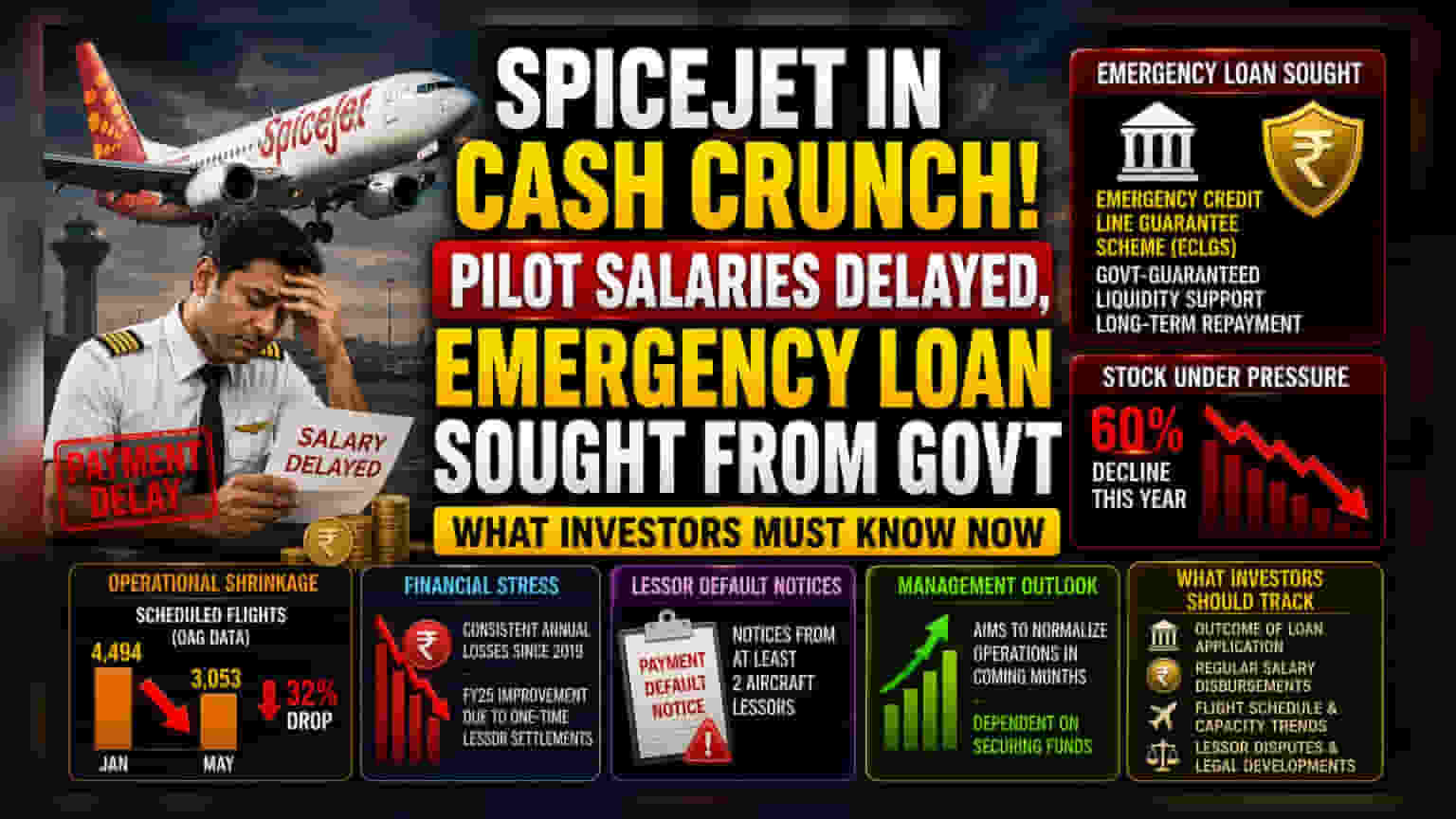


What Happened
SpiceJet is currently facing a liquidity crunch, resulting in delays in salary payments for its pilots. These payment issues have been noted as far back as March, with the airline confirming that it is clearing dues in a phased manner. To manage this financial pressure, the airline has approached the Indian government to seek an emergency loan under the Emergency Credit Line Guarantee Scheme. This scheme is designed to provide government-guaranteed liquidity to companies facing financial difficulties, allowing for long-term repayment. The management has attributed part of this cash flow challenge to external factors, such as the conflict in the Middle East, which has impacted operating costs and fuel expenses.
Why This Matters For Investors
The request for an emergency government loan is a critical indicator of the company’s current cash position. For investors, the ability of an airline to meet its payroll obligations is often seen as a proxy for its immediate operational health and ability to manage day-to-day expenses. When an airline struggles to pay staff, it typically reflects broader liquidity issues that can affect its ability to maintain aircraft, pay lessors, and sustain regular flight schedules. The company has stated that it expects to normalize its operations over the coming months, but this will heavily depend on securing the necessary funding to cover immediate liabilities.
Operational and Financial Reality
The airline's operational data shows a clear trend of consolidation. Recent data from aviation analytics firm OAG indicates that SpiceJet’s scheduled flights dropped to 3,053 in May, a significant decline from 4,494 flights in January. While the company is attempting to improve its fleet capability by returning a Boeing 737 MAX to service and leasing new Airbus A320 aircraft, these efforts are taking place against a backdrop of reduced overall capacity. Financial performance has also been a long-standing challenge, with the airline reporting consistent annual losses since 2019. While there was a brief period of improvement in the fiscal year ending March 2025, that was largely attributed to one-time gains from lessor settlements rather than core business profitability.
The Risk and Uncertainty Factor
Investors are facing a situation where the company has a long history of recurring financial stress. Since at least 2014, the airline has intermittently struggled with deferred staff payments, which highlights a persistent underlying cash flow problem. Furthermore, the company has recently faced payment default notices from at least two aircraft lessors. These notices are a significant risk, as they can lead to legal disputes, asset seizures, or the forced grounding of aircraft. The stock price has seen a sharp decline of 60% this year, reflecting the market’s reaction to these cumulative financial pressures.
What Investors Should Track
The immediate monitorable is the outcome of the loan application. Securing the government-guaranteed loan would provide a necessary buffer, but it would also add to the company’s long-term debt obligations, which investors should analyze in the context of future interest payments. Additionally, the regularity and consistency of salary disbursements will be a key signal of whether the cash flow situation is truly improving. Investors may also want to keep a close watch on the company’s flight schedule data and any further updates regarding lessor disputes, as these will directly influence the airline’s capacity to generate revenue in the coming quarters.