

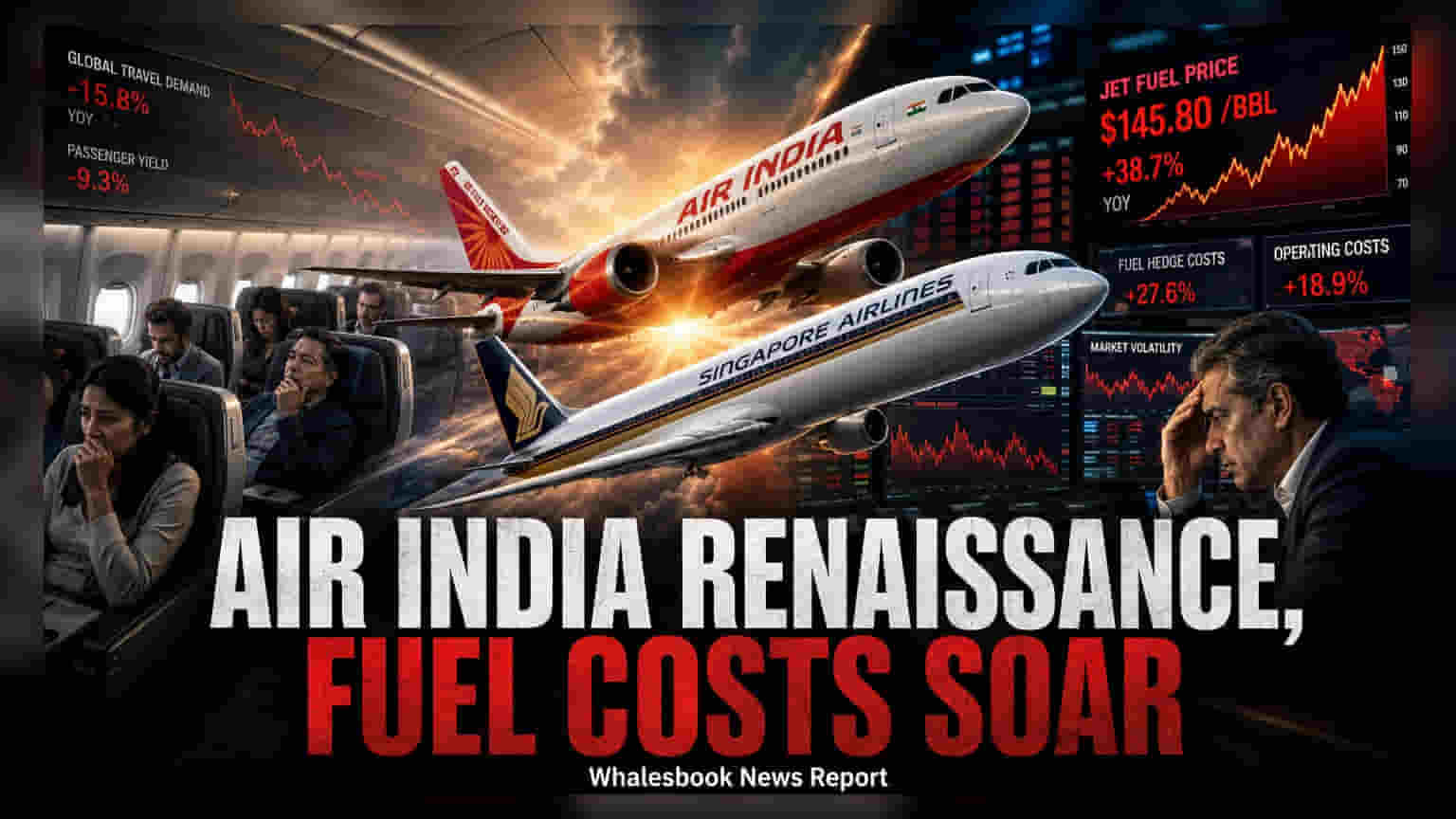
Singapore Airlines reported a $76 million net loss for the April-June quarter as high fuel prices offset record revenues. The group’s 25.1% stake in Air India remains a key focus as the Indian carrier continues its fleet and service transformation. While travel demand stays strong, rising operating costs and geopolitical pressures continue to challenge the airline's profitability.
Detailed Coverage
Singapore Airlines (SIA) reported a net loss of $76 million for the quarter ending June 2026, despite achieving record revenue. The group generated $5,714 million in revenue, marking a 19.3% increase compared to the same period last year. However, this growth was overshadowed by a sharp rise in operating expenses, which climbed 27.9% to $5,609 million, largely driven by surging fuel costs.
Fuel Costs Impact Margins
The aviation sector continues to face significant pressure from volatile jet fuel prices. Singapore Airlines reported that its net fuel costs rose by 78.5% to $2,253 million. The conflict in the Middle East has kept global fuel prices elevated, and while the airline implemented fare and cargo rate adjustments to manage these expenses, these measures were not enough to fully cover the increased costs. The group noted that even with gains from fuel hedging, the sheer scale of the price increase significantly reduced operating profits, which fell to $299 million for the quarter.
Air India Transformation and Partnership
Singapore Airlines highlighted that its 25.1% stake in Air India remains a central pillar of its long-term strategy. The transformation plan for Air India is moving ahead, with active progress in fleet renewal and aircraft retrofitting. Both partners, Tata Sons and Singapore Airlines, are focused on enhancing operational efficiency and service quality. However, the investment in Air India also contributed to the group’s financial performance this quarter, with the Indian carrier recording losses of $42 million, which impacted the overall bottom line for the SIA Group.
Market Demand and Outlook
Despite the financial challenges, the group noted that passenger demand remains resilient. SIA and its low-cost carrier, Scoot, carried a record 10.9 million passengers during the quarter, and cargo demand has shown strength, particularly in sectors related to semiconductor and data center logistics. Looking ahead, the group is deepening its commercial ties with Air India through expanded codeshare agreements and integrated loyalty programs, which are expected to roll out further in the coming months.
For investors, the primary monitorables remain the stability of global jet fuel prices and the speed of Air India’s turnaround. While the revenue growth shows that demand is not the main issue, the ability of the group to manage non-fuel expenditures and successfully integrate its expanded network with the Indian market will be key factors in future profit recovery.