

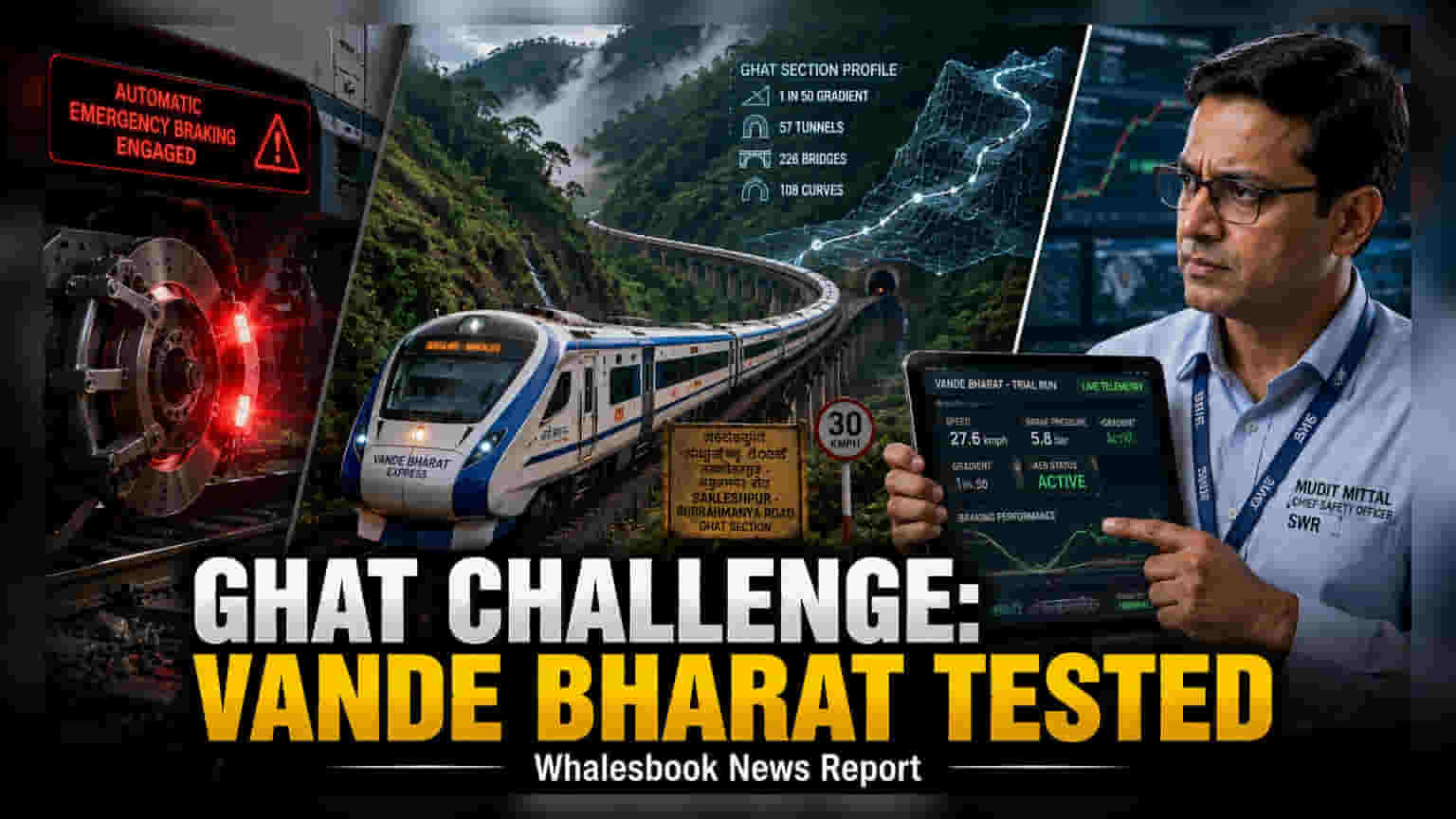
South Western Railway has started field trials of a 20-car Vande Bharat Express on the challenging Sakleshpur-Subrahmanya Road stretch. This testing of the automatic emergency braking system is a crucial step to prove the train's feasibility on difficult mountain terrains, potentially opening new routes for high-speed rail travel.
South Western Railway (SWR) has initiated safety trials for the Vande Bharat Express on the demanding Sakleshpur-Subrahmanya Road section in the Western Ghats. These trials are part of a broader effort to assess whether the semi-high-speed train can safely operate on one of the country's most technically complex railway stretches.
The testing, conducted by the Mysuru Division, focuses on a specially modified 20-car rake manufactured by the Integral Coach Factory (ICF) in Chennai. A critical component of these trials is the performance of the Automatic Emergency Braking (AEB) system, which is vital for safe navigation through the Ghat section. The route presents significant engineering challenges, including a 1-in-50 gradient, 57 tunnels, 226 bridges, and 108 sharp curves. Due to these geographical constraints, the Commissioner of Railway Safety has capped the maximum speed for this specific stretch at 30 kmph.
The successful completion of these trials is essential before the service can be launched between Bengaluru and Mangaluru. While the route was fully electrified by December 2025, the steep incline and winding paths of the Western Ghats require rigorous safety validation for high-speed train sets compared to flat terrain operations. Officials from the Research Designs and Standards Organisation (RDSO) are overseeing the technical and operational data collection, including braking performance, acceleration, and stability during the Ghat descent and ascent.
For the broader railway ecosystem, these trials are significant. The Vande Bharat project involves a wide network of domestic manufacturers providing everything from coach shells and wheels to braking systems and electrical components. Demonstrating that these trains can handle difficult mountain geography, such as the Western Ghats, potentially opens the door for the Railway Board to introduce similar services in other hilly or mountainous regions of India. This could lead to a sustained demand for specialized rolling stock and maintenance equipment.
However, operational risks remain. The Sakleshpur-Subrahmanya Road section is geographically sensitive and prone to landslides, especially during the monsoon season, which has historically caused service disruptions. Investors in the railway supply chain often monitor the pace of new route launches and the operational reliability of the Vande Bharat fleet, as these factors influence future government procurement and tender cycles. The next important step will be the final safety clearance report from the RDSO, which will determine the commercial feasibility of the proposed service.