

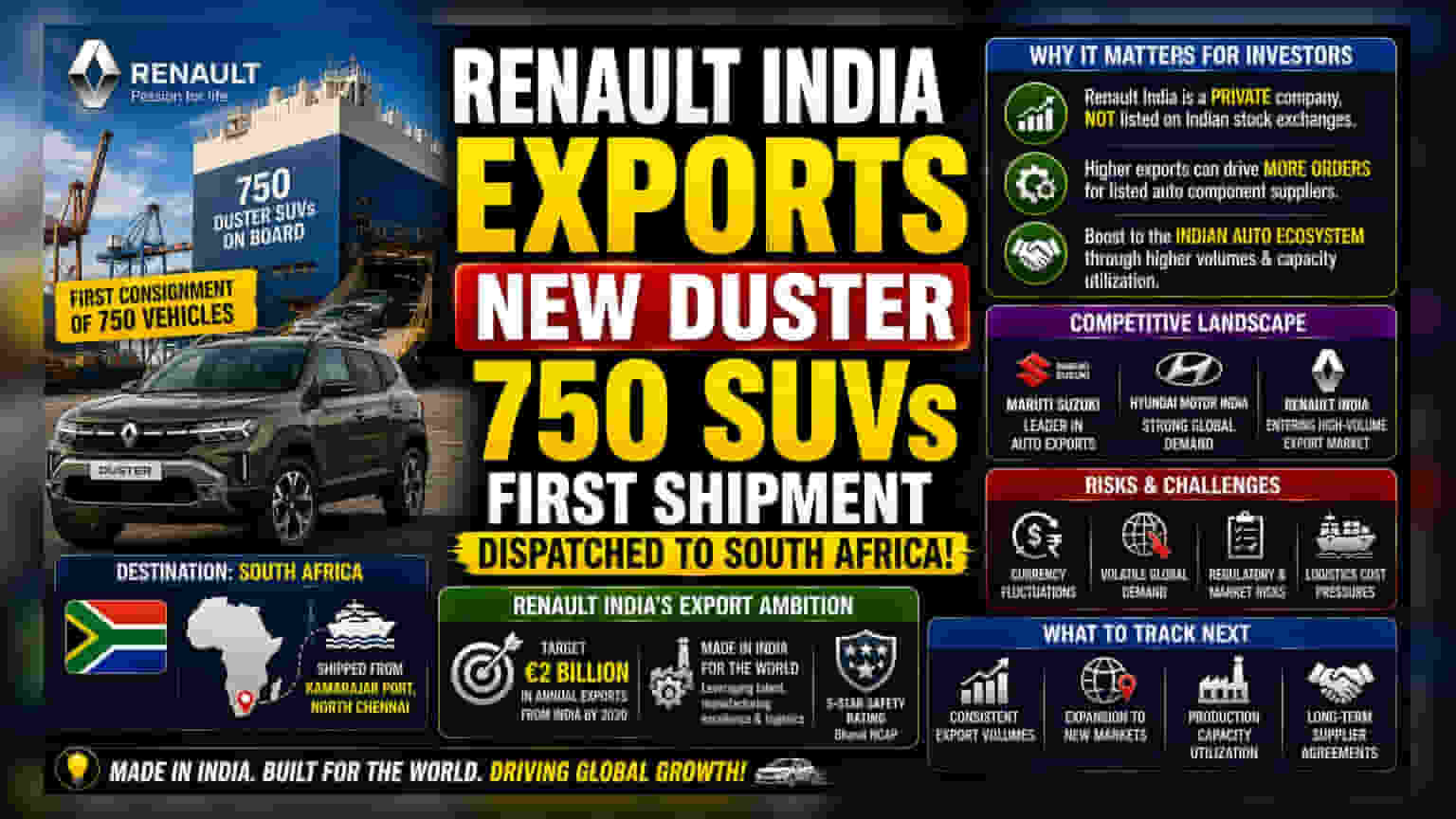
Renault India has commenced shipping its new Duster model, with an initial batch of 750 units sent to South Africa. This export move aligns with the company’s target to reach €2 billion in annual exports from India by 2030. While Renault India is not a listed company, the development highlights the expanding role of Indian manufacturing hubs in the global automotive supply chain.
What Happened
Renault India has officially started its export program for the all-new Duster SUV. The company dispatched its first consignment of 750 vehicles from the Kamarajar port in North Chennai. These vehicles are headed for the South African market, with plans to expand to other international regions in the coming months. This shipment marks a shift in how Renault Group utilizes its Indian operations, moving from a domestic-focused setup to a more global manufacturing model.
The Growth Strategy and €2 Billion Target
Renault Group has set an ambitious goal to achieve €2 billion in annual exports from India by 2030. The company is positioning its Indian operations as a key industrial hub, leveraging local manufacturing capabilities, engineering talent, and a competitive logistics network. The new Duster, which is built on the Renault Group Modular Platform, serves as the flagship product for this export strategy. The vehicle has also secured a 5-star safety rating from Bharat NCAP, a factor that is often important for meeting international market standards.
Why This Matters for Indian Investors
It is important for investors to note that Renault India is a private subsidiary of the French automaker Renault Group and is not listed on the Indian stock exchanges. Therefore, investors cannot buy shares of Renault India directly. However, the success of such export programs is significant for the broader Indian automotive ecosystem. When multinational car companies increase exports from India, it often leads to higher volume orders for listed auto-ancillary companies that supply components like tires, glass, electrical systems, and forgings. Investors may watch for supply chain benefits that could reach listed component manufacturers as Renault expands its export reach.
Sector Context and Competition
India has become a major hub for global automotive exports, with companies like Maruti Suzuki and Hyundai Motor India consistently ranking as the largest exporters of passenger vehicles from the country. Renault’s entry into this high-volume export market places it in competition with these established players, who have long-standing trade agreements and logistics networks. The success of Renault's plan will depend on how efficiently it can scale production at the Chennai plant while maintaining cost competitiveness against other global manufacturing hubs.
Risks and Market Challenges
Expanding into international markets involves several risks. Fluctuations in currency exchange rates can impact profitability, and global demand for SUVs can be unpredictable. Additionally, the South African and other international markets have their own local competition and regulatory requirements. If demand in export markets weakens, or if logistics costs rise significantly, the company’s ambitious €2 billion export target could face pressure. Investors tracking the auto-ancillary sector should be aware that these global demand risks are inherent to any company relying heavily on international exports.
What to Track Next
For investors following the automotive supply chain, the key monitorables include the consistency of Renault’s export volumes and the company’s success in penetrating other international markets beyond South Africa. Future updates on production capacity utilization at the Chennai plant and any long-term supplier agreements for these export-bound vehicles will be meaningful indicators for the Indian auto-component ecosystem.