

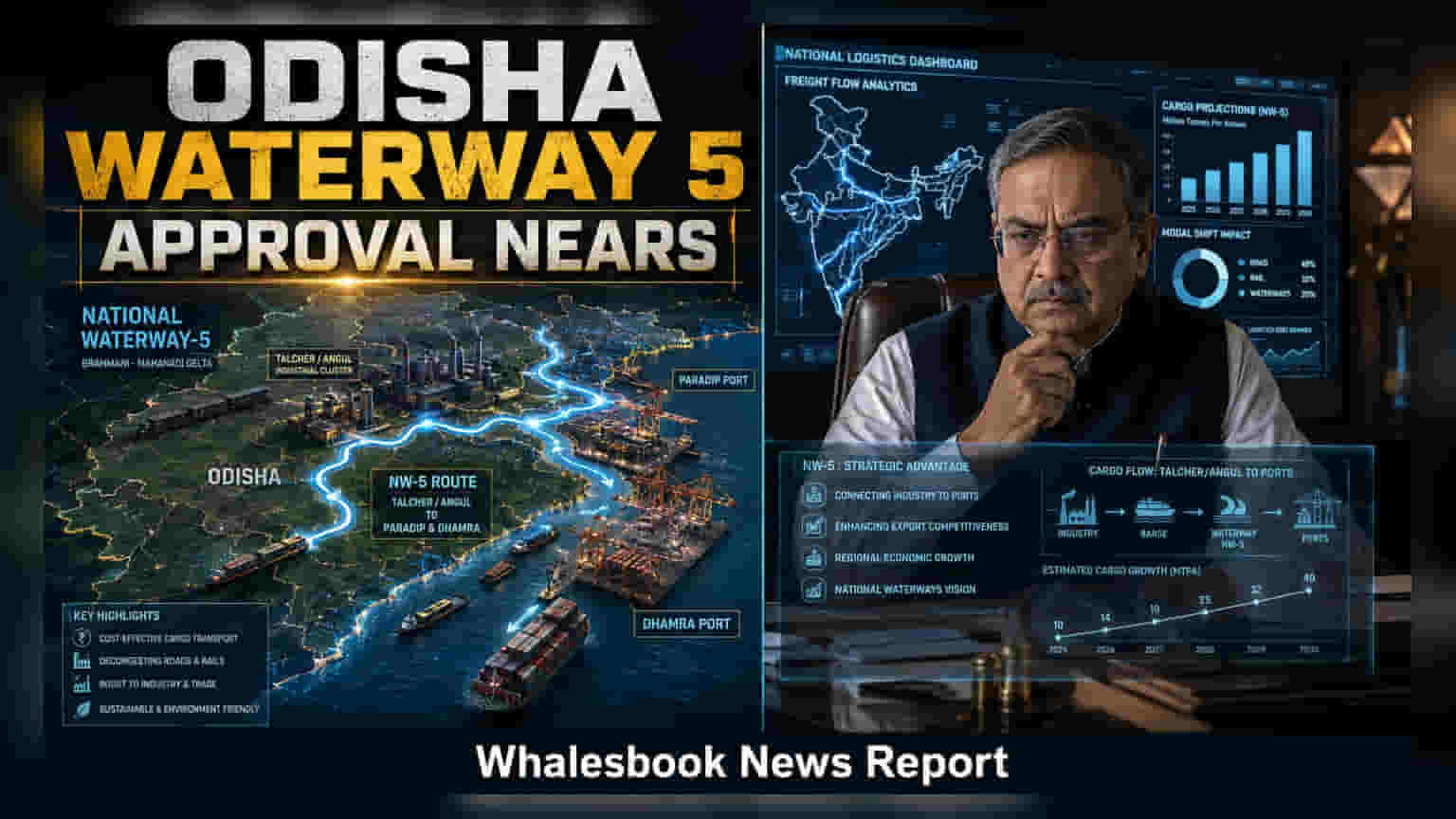
The ambitious project to connect Odisha's mineral-rich industrial belts to major ports is advancing through government approval stages. Managed by the Inland Waterways Consortium, this ₹12,204 crore initiative aims to lower logistics costs for cargo, though investors should note the project's history of delays and technical complexities.
The National Waterway 5 (NW-5) project in Odisha has moved closer to implementation, with key government bodies currently reviewing the proposal. The Public Private Partnership Appraisal Committee and the Public Investment Board are evaluating the project, which aims to create a dedicated waterway route connecting the industrial zones of Talcher and Angul with the ports of Paradip and Dhamra.
This infrastructure initiative, estimated at ₹12,204 crore, is designed to serve as a high-capacity logistics artery for the state's mineral-rich region. By establishing a reliable inland water route, the government intends to facilitate the transport of coal and industrial goods to the coast, reducing the pressure on road and rail networks.
To drive this project, a Special Purpose Vehicle (SPV) named the Inland Waterways Consortium of Odisha Limited (IWCOL) has been formed. This entity brings together the Inland Waterways Authority of India, the Odisha state government, the Paradip Port Authority, and Mahanadi Coalfields Limited. The involvement of these diverse stakeholders is intended to align planning with execution, ensuring that port infrastructure and terminal connectivity are developed in sync with the waterway channels.
While the project is part of a national strategy to increase the share of inland waterways in cargo transport, it comes with significant challenges. The initiative has faced recurring delays since it was first conceptualized around 2008 due to funding concerns and questions regarding its economic viability. Maintaining the required water depth—known as draft—in the Brahmani River remains a technical hurdle, likely necessitating the construction of expensive barrages and locks to ensure year-round navigation.
For investors and industry observers, the project represents a long-term play in the logistics and infrastructure space. The financial and operational success of this waterway will depend on how efficiently the consortium manages land acquisition, environmental clearances, and the complex engineering requirements of river navigation. Past infrastructure projects of this scale in India have often faced cost overruns and timeline extensions, which serve as a reminder of the execution risks involved.
The next critical update for the project will be the final cabinet approval and the subsequent tendering process for the construction of terminals and river navigation infrastructure. Market watchers will likely track the commissioning timelines and the projected impact on logistics costs for coal and mineral transporters in the region.