

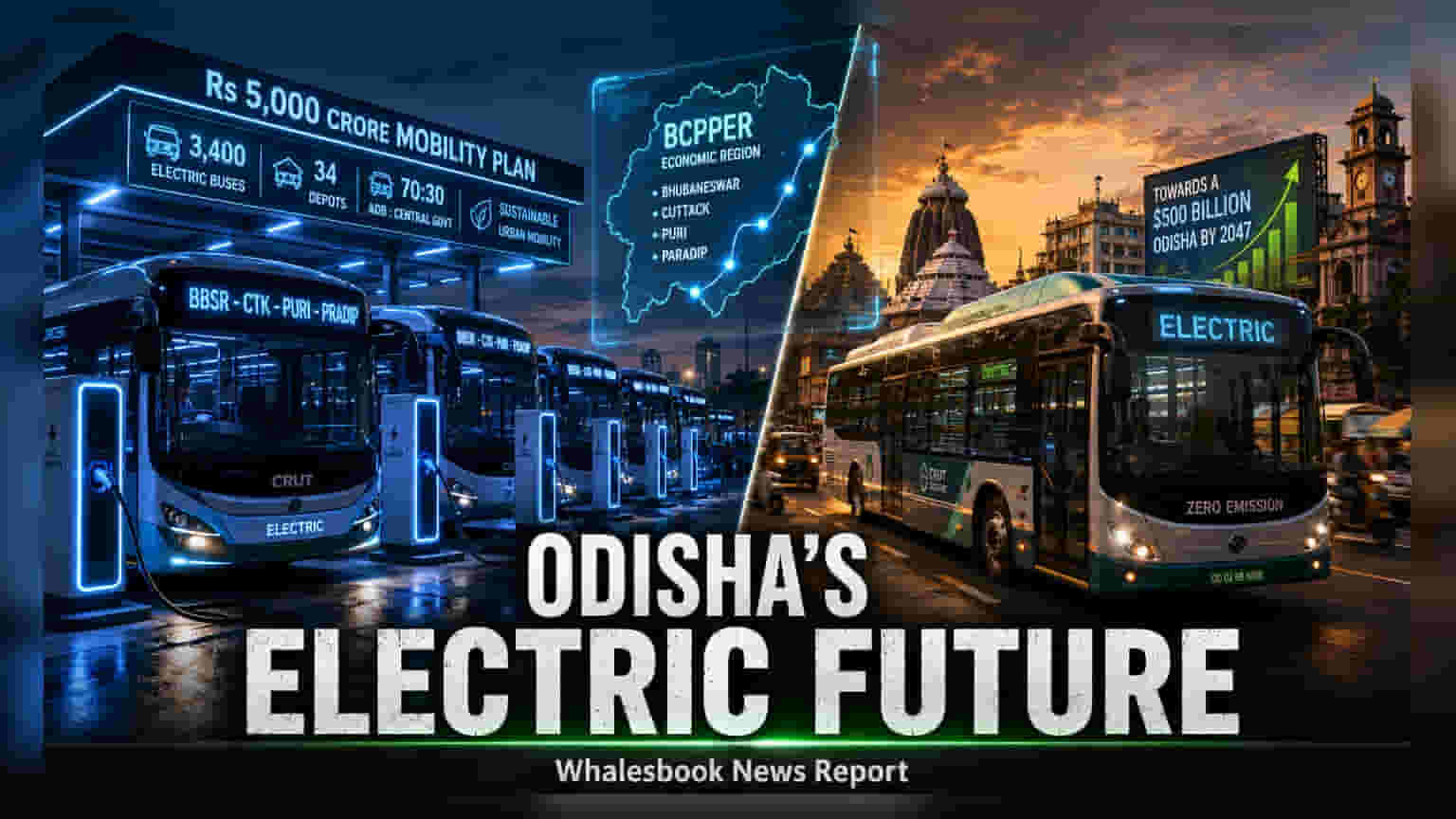
The Odisha government has proposed a Rs 5,000 crore investment to modernize public transport across the Bhubaneswar-Cuttack-Puri-Paradip Economic Region (BCPPER). Supported by the Asian Development Bank and the Central government, this massive infrastructure push focuses on electric buses and charging networks. While this is a government project and not a publicly traded company, the scale of development offers significant downstream opportunities for infrastructure and EV-related companies.
The Odisha government is preparing a Rs 5,000 crore comprehensive mobility plan to transform urban transport in the Bhubaneswar-Cuttack-Puri-Paradip Economic Region (BCPPER). This initiative, managed by the state-run Comprehensive Region Urban Transport (CRUT), aims to integrate 19 urban local bodies into a cohesive economic corridor. The project is designed to act as a catalyst for Odisha’s goal of reaching a $500 billion economy by 2047.
Funding and Scope
The funding model for this project is primarily based on a 70:30 ratio. The Asian Development Bank (ADB) is expected to provide Rs 3,500 crore (70%) as a loan, while the Central government will contribute Rs 1,500 crore (30%). This financial structure underscores the state’s reliance on multilateral funding to support large-scale urban infrastructure.
The physical scope of the project is substantial. The plan includes the deployment of 3,400 electric buses and the construction of 34 dedicated depots, along with extensive charging infrastructure. CRUT aims to use these assets to solve first and last-mile connectivity challenges, effectively reducing the dependence on private vehicles in one of Odisha's most critical economic zones.
Investor and Sector Context
It is important to note for market participants that CRUT is a state-controlled Special Purpose Vehicle (SPV) and not a publicly traded entity. Consequently, there is no direct stock ticker or share price movement associated with this project. However, the initiative is highly relevant to the broader Indian infrastructure and electric vehicle (EV) sectors.
Large government projects of this nature typically provide a substantial order pipeline for private sector players. Engineering, Procurement, and Construction (EPC) firms, electric bus manufacturers, charging station providers, and digital transit software companies are likely to be the key beneficiaries. As the tender processes for these specific components commence, companies with a strong presence in the eastern Indian infrastructure market will be the ones to watch.
Implementation Risks
While the project holds promise for regional development, it faces several execution risks typical of large, multi-district government infrastructure schemes. The final financial structure, including the formal loan agreement with the Asian Development Bank, is still under review. Any delay in securing this capital could push back project timelines.
Furthermore, the project involves complex coordination across 19 urban local bodies. Historically, similar large-scale projects have faced challenges related to land acquisition, regulatory clearances, and inter-departmental cooperation. Achieving the operational goal of non-fare revenue—such as land-value capture and asset monetization—will also require high technical expertise and sustained management efficiency.
The next critical update for observers will be the formalization of the funding agreement and the release of initial tenders for bus procurement and construction. Investors tracking the EV and infrastructure sectors should monitor these developments as indicators of the project's progress.