

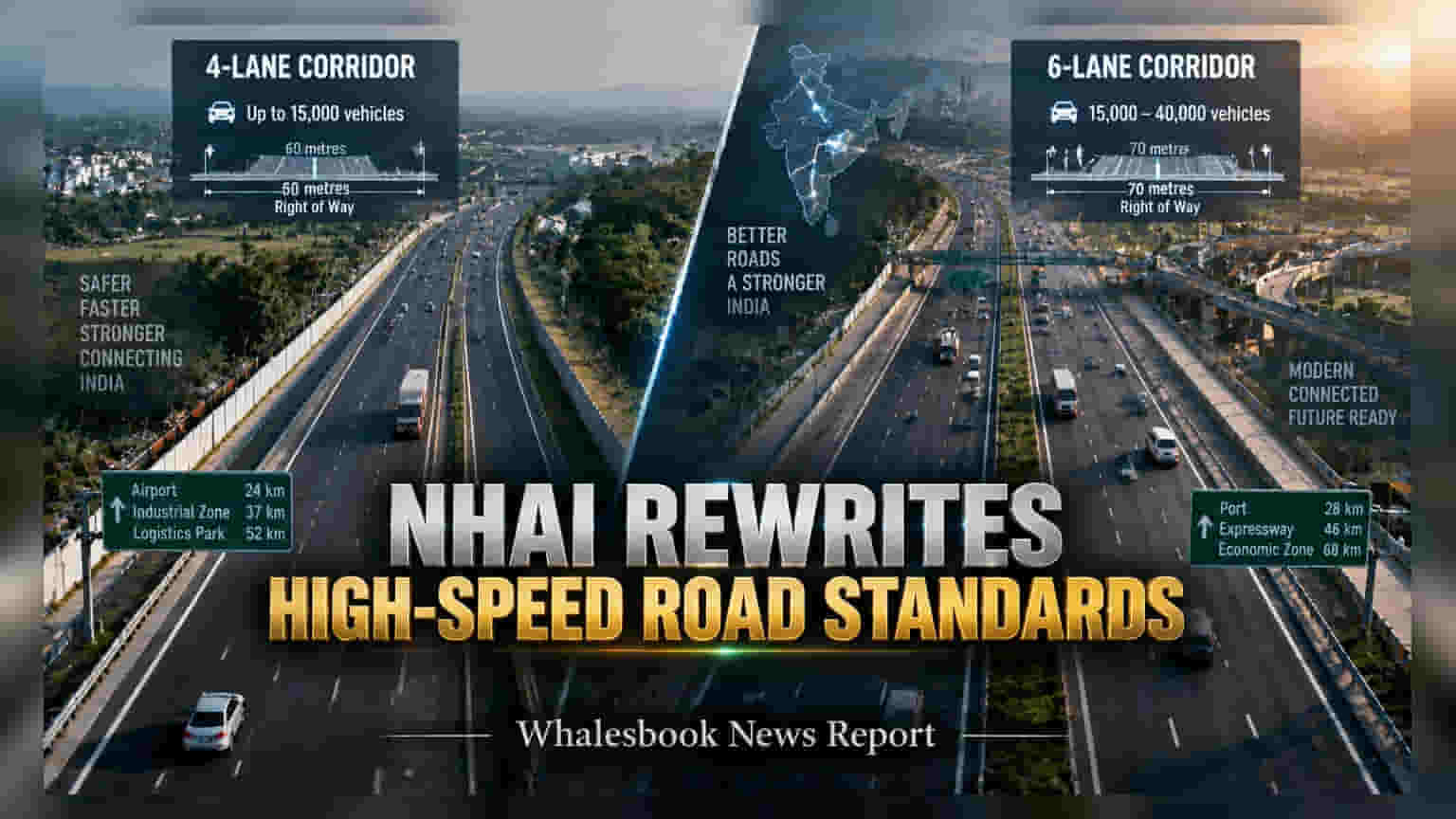
The National Highways Authority of India has launched standardized design rules for access-controlled high-speed corridors. By linking road width and structural requirements to traffic density, the framework aims to reduce project planning errors. This update provides more predictability for infrastructure developers as the government works toward its goal of creating 50,000 km of high-speed corridors under the Viksit Bharat 2047 roadmap.
The National Highways Authority of India (NHAI) has introduced a new, standardized design framework for upcoming access-controlled high-speed national highways. This initiative aims to remove inconsistencies in how projects are planned and executed, ensuring that infrastructure capacity is better aligned with projected traffic needs. By creating a common technical baseline, the authority intends to streamline the process from project conception to construction.
Matching road design to traffic volumes
The new guidelines create a clear link between expected vehicle counts and road dimensions. For corridors anticipating up to 15,000 vehicles, the requirement is set for a four-lane highway with a 60-metre right-of-way. Projects handling between 15,000 and 25,000 vehicles will still feature four traffic lanes, but must now utilize a six-lane structure and a 70-metre right-of-way to accommodate future growth. For high-density routes with 25,000 to 40,000 vehicles, the rules mandate six-lane highways built on a six-lane structure with a 70-metre right-of-way.
This change is significant because previous variations in Detailed Project Reports (DPRs) often led to design revisions during the construction phase. By standardizing these requirements, developers and contractors may face less ambiguity during the tendering and execution stages.
New safety and connectivity requirements
Beyond road width, the NHAI has implemented stricter rules for safety and navigation. High-speed corridors will now require a one-metre-high boundary wall along the outer edges. This design element is intended to prevent unauthorised access and minimize collision risks from stray animals, which is a critical safety consideration for roads where vehicles travel at high speeds.
Additionally, the framework mandates specific advance information for exits and entry points, helping drivers plan their movements safely. Interchanges and ramps will also be mandatory at key crossings with other major roads, expressways, and arterial routes. The plan ensures that these highways remain connected to essential economic nodes such as ports, airports, industrial zones, and major logistics parks.
Impact on infrastructure developers
For investors monitoring the infrastructure sector, the standardization of technical norms may lead to more predictable bidding and execution. When project specifications are uniform, the risk of cost overruns due to mid-project design changes may decrease. However, the requirement for boundary walls and upgraded structure capacities could influence the initial capital expenditure for new projects. The broader market effect will depend on how quickly the NHAI transitions these projects from the planning stage to active tendering and land acquisition. As the country aims to build 50,000 km of high-speed corridors, stakeholders will be observing how these standardized designs impact project timelines and profit margins across the sector.