

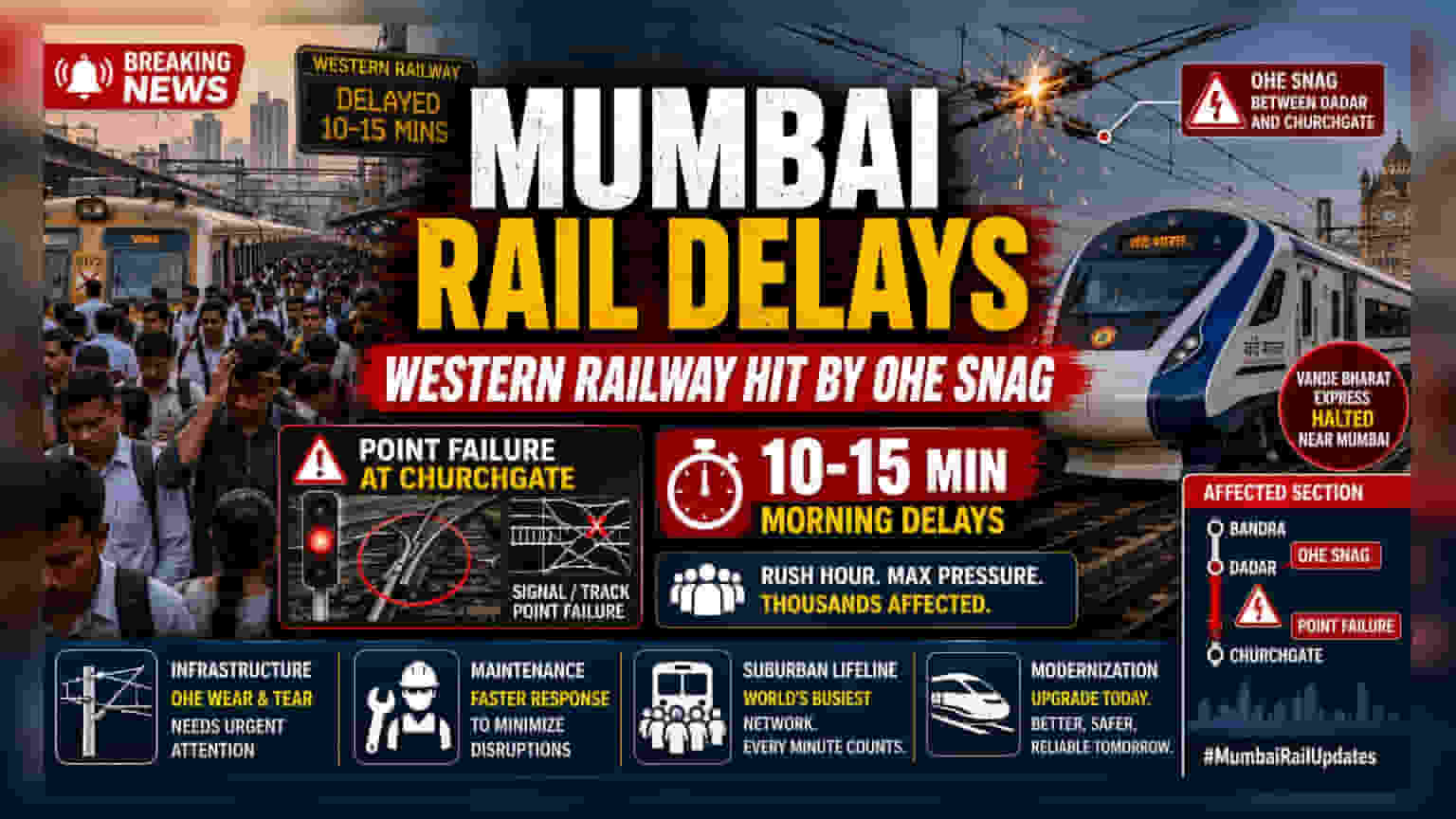
Western Railway suburban services experienced 10-15 minute delays on Friday morning following an overhead equipment snag between Dadar and Churchgate and a point failure at Churchgate station. The incident, which disrupted the morning rush hour and the Ahmedabad-bound Vande Bharat Express, underscores the ongoing maintenance requirements for India's high-traffic urban transit corridors.
What Happened
Mumbai’s Western Railway commuters faced significant travel delays on Friday, June 26, 2026, due to multiple technical failures during the morning rush hour. The disruptions began around 6:00 am with an overhead equipment (OHE) snag on the down-fast line between Dadar and Churchgate. This issue impacted the schedule of the Ahmedabad-bound Vande Bharat Express, which was brought to a stop shortly after departing from Mumbai Central.
As the network attempted to recover, a secondary point failure occurred at Churchgate station between 8:10 am and 8:40 am. This compounded the morning commute, leading to bunching of trains from the Virar corridor and delays of 10 to 15 minutes across the suburban network. Western Railway confirmed that the OHE issue was resolved by 7:22 am, though the cascading effect of the point failure continued to impact train movements into the peak morning hours.
Infrastructure And Operational Efficiency
While localized disruptions are common in dense transit networks, incidents involving both OHE power supply and point failures highlight the operational complexities of the Mumbai suburban rail system. This network serves as a critical artery for the financial capital’s workforce. For investors observing the infrastructure space, the reliability of these systems remains a core theme, especially as the government accelerates the integration of high-speed assets like the Vande Bharat Express into existing, high-density tracks.
The Focus On Rail Modernization
India has been on a sustained path of upgrading rail infrastructure, with significant capital expenditure directed toward track doubling, electrification, and the expansion of the Vande Bharat fleet. These modernization efforts are designed to improve speed and safety. However, the operational reality of India’s rail network involves managing high-frequency suburban traffic alongside long-distance express trains. Balancing these two distinct operational demands requires continuous maintenance and signal upgrades. Analysts often monitor how quickly these infrastructure challenges are mitigated, as reliable rail connectivity is essential for sustaining economic productivity in major urban hubs.
What Investors Should Track
For those tracking the Indian railway sector, the key monitorables extend beyond the successful launch of new trains. Investors typically observe:
- Maintenance Capex: How the Indian Railways balances expansion with the upkeep of aging or high-traffic signaling and power infrastructure.
- Operational Efficiency: The ability of the network to minimize downtime during technical snags, which directly impacts the efficiency of the overall rail ecosystem.
- Modernization Timeline: Updates on signaling upgrades and track enhancements that are intended to reduce the frequency of failures like the ones witnessed in the Churchgate-Dadar section.
While these incidents are specific to daily suburban operations, they reflect the broader challenges inherent in scaling and upgrading one of the world's most heavily utilized rail networks.