

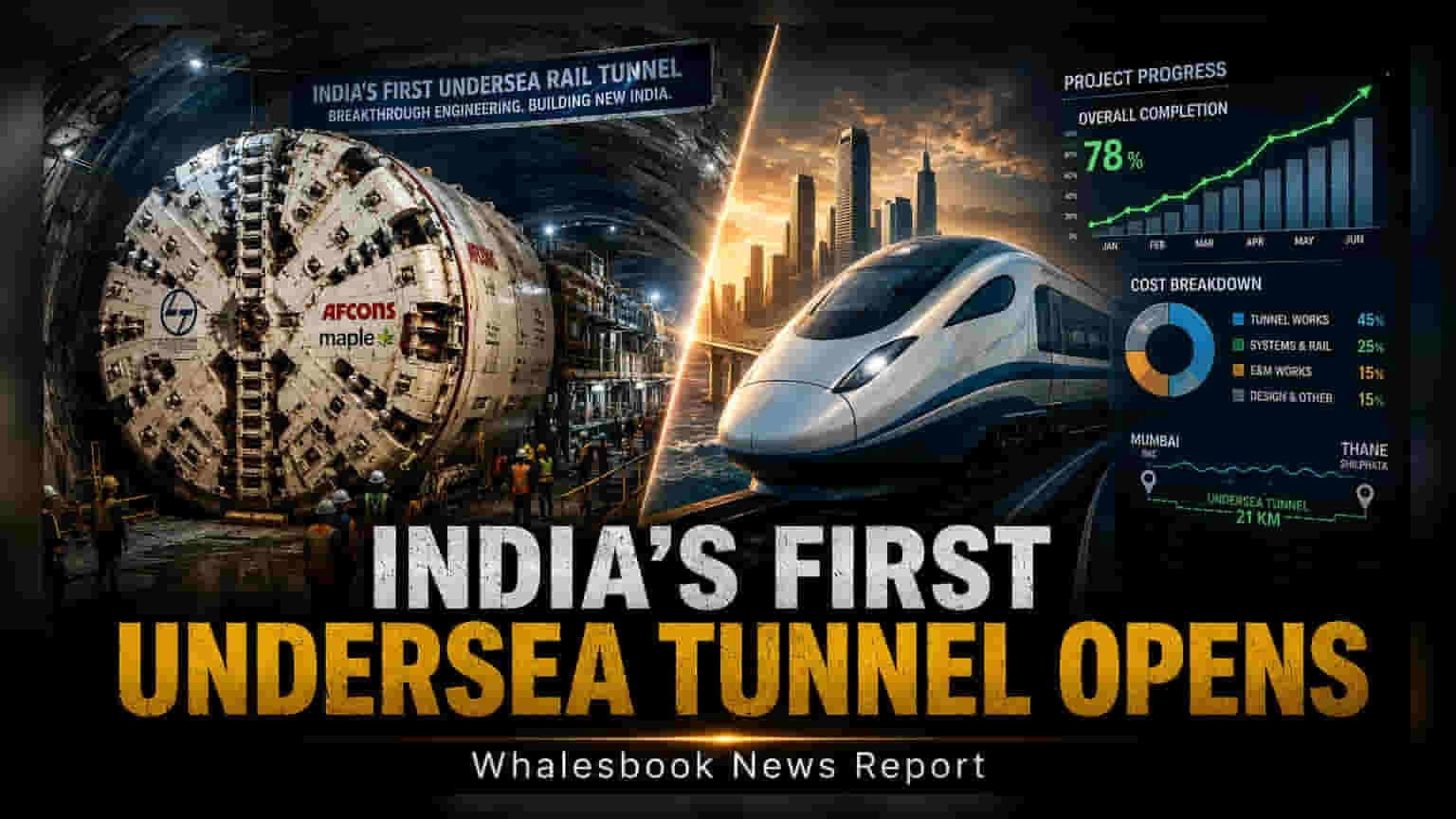
Work on India’s first undersea rail tunnel has accelerated as a second massive tunnel boring machine began excavating beneath Thane Creek. This 7-km undersea stretch is a vital component of the 21-km underground network for the 508-km high-speed corridor. Investors are tracking progress on the Rs 1.08 lakh crore project, which relies on long-term Japanese funding to manage construction costs.
A major milestone in India's infrastructure development was reached this Saturday as a second colossal tunnel boring machine (TBM) commenced excavation beneath Thane Creek. This event marks the active phase of India’s first undersea rail tunnel, a 7-kilometer section that serves as a key engineering component of the Mumbai-Ahmedabad bullet train corridor.
Strategic Importance of the Underground Network
The undersea tunnel is a central part of a larger 21-kilometer underground route designed to connect the Bandra Kurla Complex in Mumbai to the rest of the high-speed line. While 5 kilometers of this network have already been completed using the New Austrian Tunnelling Method, the current TBM deployment focuses on the remaining 16-kilometer stretch between Sawli and Bandra Kurla Complex. The project's successful execution is critical, as it bypasses the logistical difficulties of land acquisition and urban density in the Mumbai suburban sector.
Engineering Scale and Safety Standards
The TBM involved in this phase is among the largest used for rail infrastructure in India, featuring a 13.6-meter diameter cutterhead. Weighing 3,200 tonnes and spanning 96 meters, the machine is designed to operate under immense pressure. To manage the complex geology beneath the seabed, the project utilizes a pressurized liquid bentonite slurry circuit, which provides structural stability during excavation.
Safety remains a primary monitorable for this project given the dense urban environment above the tunnel. The site includes advanced monitoring technology, such as real-time gas sensors, optical displacement systems, and seismographs, to ensure that the surrounding buildings remain unaffected by the deep-level vibrations. These systems are part of a comprehensive support infrastructure that includes on-site power substations and concrete plants to minimize project delays.
Financial Structure and Funding
The overall cost for the 508-kilometer corridor is estimated at Rs 1.08 lakh crore. The project is funded through a mix of government contributions and external debt. Specifically, the Government of India has committed Rs 10,000 crore, while the state governments of Gujarat and Maharashtra have provided Rs 5,000 crore each. The majority of the funding is sourced through a long-term loan from Japan, secured at a 0.1% interest rate.
For investors, the long-term viability of the project depends on steady execution timelines and the management of high capital spending. As the project enters this intensive tunneling phase, stakeholders will track the pace of boring, the success of structural monitoring, and the ongoing coordination between state agencies and international contractors to ensure the project remains within its estimated budget and timeline.