 Whalesbook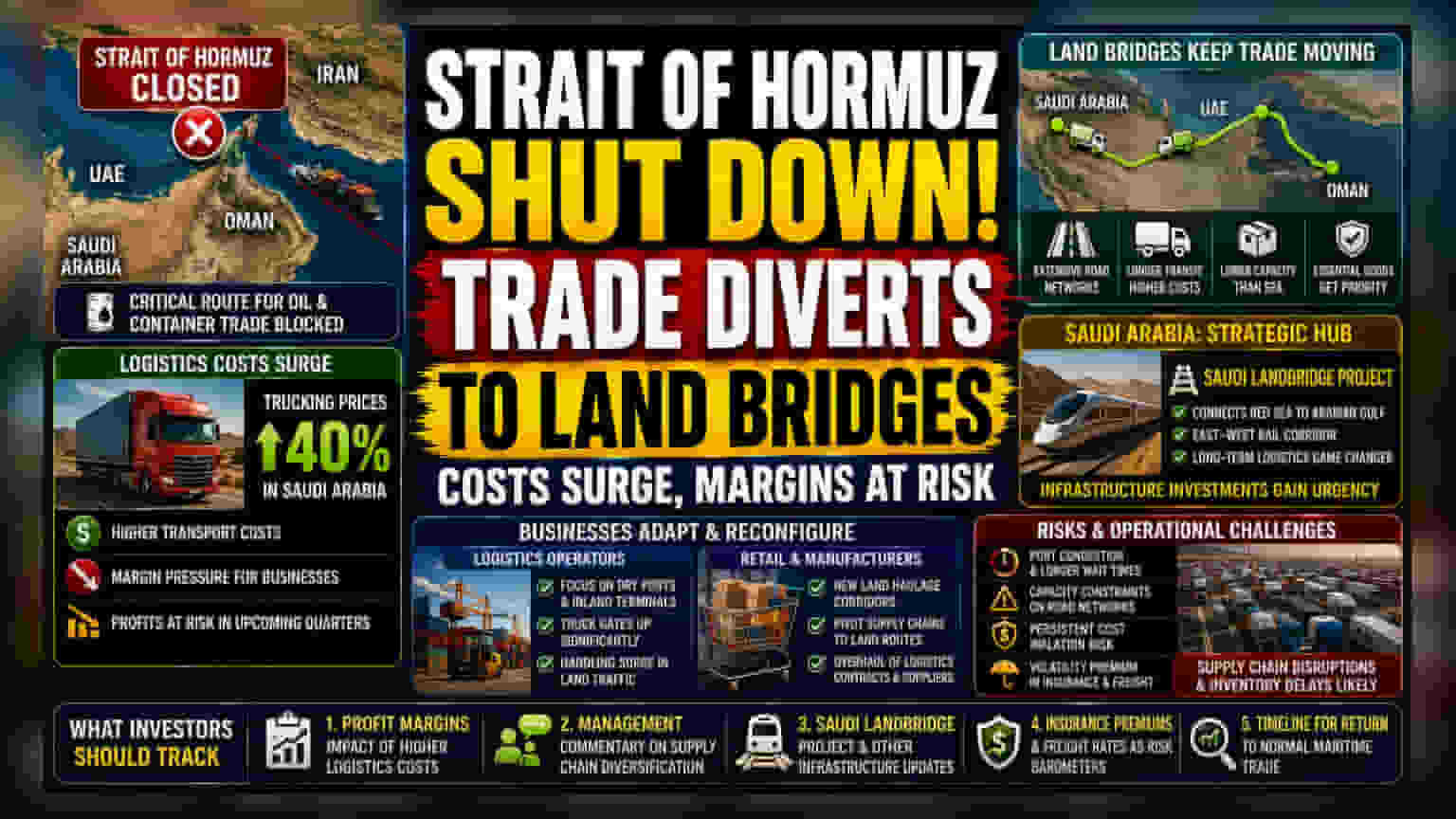


The closure of the Strait of Hormuz has forced regional businesses to switch to costly land routes. With trucking prices surging by roughly 40%, investors are tracking the impact on supply chains, margin stability, and the long-term shift toward infrastructure projects like the Saudi Landbridge.
What Happened
The Strait of Hormuz, one of the world's most critical maritime corridors for oil and container trade, has been effectively closed due to regional geopolitical tensions. This has triggered a massive logistical reshuffling across the Middle East. With maritime traffic blocked, businesses are now relying on extensive land bridges—a network of roads and trucking routes—connecting Saudi Arabia, the United Arab Emirates, and Oman to keep goods moving.
This shift is not merely a short-term workaround. It represents a significant change in how regional trade is handled. Companies are moving away from traditional port-to-port maritime shipping in the Gulf and are instead utilizing long-distance road haulage to bypass the blocked waterway, despite the higher operational costs and slower transit times.
Why This Matters For Investors
The primary concern for investors in this situation is the sharp rise in logistics and transportation costs. Reports indicate that trucking prices in Saudi Arabia have surged by approximately 40% as demand for overland capacity has skyrocketed. For companies dependent on these routes, this translates into immediate margin pressure. Businesses cannot easily pass these costs on to consumers, which may lead to reduced profitability in the upcoming quarters for companies with significant exposure to Middle Eastern trade.
Furthermore, the reliance on road networks is not a perfect substitute for maritime shipping. Road infrastructure has significantly lower carrying capacity compared to large container vessels. This creates a bottleneck that prioritizes essential goods like food and medicine, potentially causing delays for non-essential industrial or consumer goods. Investors should watch for companies reporting supply chain disruptions or inventory delays in their next quarterly updates.
Adaptation and Business Strategy
Major logistics and retail players are actively reconfiguring their supply chains to navigate this new environment. For instance, port operators are diversifying their activities, with some focusing on dry ports—inland shipping terminals—to manage the surge in truck traffic. Operators are expanding their capacity, with some locations reporting a significant increase in daily truck gates compared to pre-crisis levels.
Retailers are also rethinking their sourcing and transport models. By establishing new land haulage corridors from key entry points, companies are trying to maintain consistency in supply. However, this transition is capital-intensive and requires a complete overhaul of existing logistics contracts and supplier agreements.
The Strategic Role of Saudi Infrastructure
Saudi Arabia is emerging as a critical hub in this new trade architecture. The Kingdom’s ongoing investment in the Saudi Landbridge project—a long-planned rail corridor connecting the Red Sea to the Arabian Gulf—has gained renewed strategic urgency. While this project is designed for long-term integration, the current crisis highlights the necessity of such east-west overland connections. For investors, the development of this project is a key factor to watch, as it could fundamentally change the region's logistics efficiency once operational, potentially reducing long-term dependence on a single maritime chokepoint.
Risks and Operational Challenges
The shift to land-based logistics comes with notable risks. The surge in traffic is causing significant congestion at key ports, such as Jeddah Islamic Port, where wait times have increased. There is also the risk of capacity constraints—the current road infrastructure is simply not designed to handle the volume of trade that was previously moved by sea.
If the blockage remains, businesses may face persistent cost inflation. Additionally, there is the risk of a 'volatility premium' where insurance and operational costs remain elevated even if the immediate conflict subsides, as companies may be slower to trust the Strait of Hormuz again. Investors should be wary of companies that have a high concentration of their revenue or supply chain linked to Gulf maritime transit without a clear diversification strategy.
What Investors Should Track
The most important monitorable for investors is the timeline for the normalization of maritime trade. While provisional agreements are often discussed, a full return to normalcy is expected to be a gradual process. Investors should also watch:
- Profit margin updates in upcoming quarterly reports to see if companies are absorbing these higher logistics costs or passing them to customers.
- Management commentary regarding supply chain diversification and their ability to pivot to alternative routes.
- Updates on the Saudi Landbridge project and other infrastructure improvements that could alleviate long-term logistics bottlenecks.
- Any changes in insurance premiums or freight rates, which act as a proxy for how the market perceives the risk in the region.