

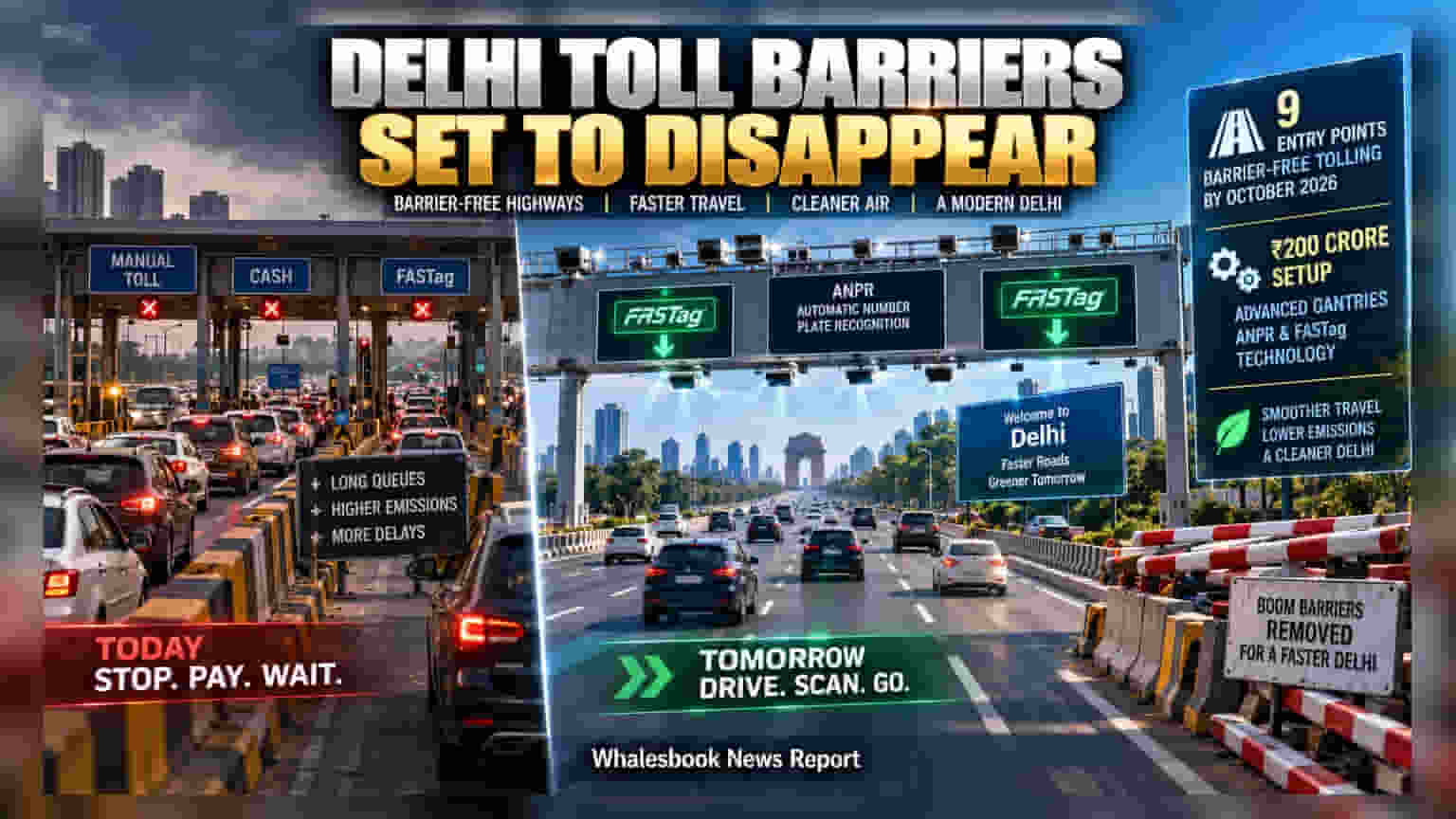
The Municipal Corporation of Delhi plans to implement multi-lane free-flow tolling at nine highway entry points by late October 2026. The project, which replaces physical barriers with FASTag and automated camera systems, is currently awaiting final clearance from the National Highways Authority of India. The contractor, Sahakar Global, is responsible for the ₹200 crore infrastructure investment amid risks of implementation delays and potential traffic disruptions.
The Municipal Corporation of Delhi (MCD) is pushing to launch a new multi-lane free-flow tolling system at nine major highway entry points by the end of October 2026. This initiative aims to reduce congestion and vehicle emissions by removing traditional boom barriers and replacing them with automatic number plate recognition (ANPR) and FASTag technology. However, the timeline remains uncertain as the corporation is still waiting for a mandatory no-objection certificate from the National Highways Authority of India.
Infrastructure Investment and Contractor Role
The implementation involves installing advanced gantries and camera systems that allow vehicles to pass through toll plazas without stopping. Sahakar Global Limited, the contractor responsible for toll collection across 154 MCD-managed plazas, is tasked with the infrastructure rollout. Under the terms of the tender, the company is expected to invest approximately ₹200 crore to install this technology. It is important for readers to note that Sahakar Global is an unlisted company, meaning it does not trade on public stock exchanges, though it is subject to industry credit ratings.
Implementation Hurdles and Risks
The project faces significant operational challenges that could impact its success. Installing gantries at high-traffic corridors like the Delhi-Meerut Expressway or the Ghazipur entry point requires precise coordination to avoid severe traffic jams. There is also the risk of financial strain; industry reports have previously flagged that profit margins for toll-collection contracts can be thin, making the ₹200 crore capital expenditure a significant commitment for the contractor. Furthermore, the tendering process for these projects has previously faced political controversy and allegations of irregularities, which investors and stakeholders often monitor for governance risks.
Broader Sector Context
Delhi's project is part of a larger national push toward barrier-free highway travel. The Union Ministry of Road Transport and Highways has been aggressively promoting the switch to electronic toll collection, with the goal of covering the majority of national highway toll plazas under a barrier-free system by 2027. This move is driven by the success of FASTag, which has already helped boost national toll revenue by billions of rupees. While the move towards automation is expected to lower operating costs and reduce fuel wastage caused by long queues, the transition depends on technical reliability and smooth adoption by road users.
What Investors Should Monitor
For those tracking the logistics and infrastructure sector, the immediate monitorable is the receipt of the no-objection certificate from the National Highways Authority of India. Without this clearance, the MCD cannot proceed with the installation of the equipment. Additionally, the performance of the ANPR technology under heavy, mixed-vehicle traffic conditions will be a test for the system’s reliability. Any delay in the project or failure of the technology to capture tolls accurately could lead to revenue losses and potential contractual disputes between the civic body and the operator.