

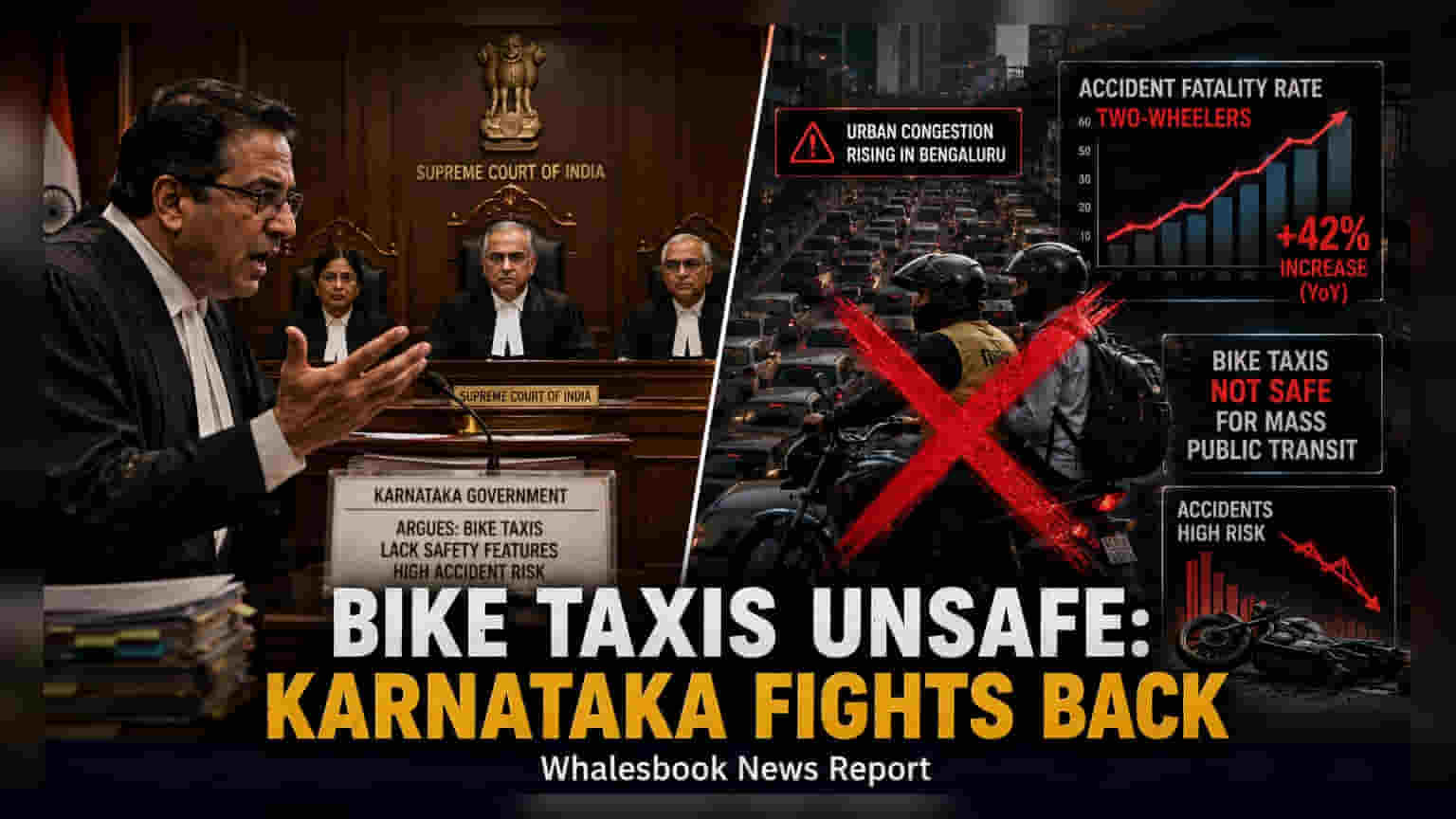
The Karnataka government has approached the Supreme Court to challenge a ruling that allowed bike taxis, citing severe safety and congestion concerns. This legal battle creates significant uncertainty for ride-hailing platforms like Ola, Uber, and Rapido, which face potential revenue loss and increased regulatory compliance costs in a key urban market.
The Karnataka government has officially presented its arguments before the Supreme Court, seeking to restrict the use of motorcycles as commercial bike taxis. The state is challenging a January 2026 High Court order that had previously categorized motorcycles as transport vehicles and directed authorities to issue permits for their operation.
At the heart of the government's argument is the claim that motorcycles lack the necessary passenger safety features found in traditional public transport vehicles. The state maintains that high accident and fatality rates associated with two-wheelers make them unsuitable for mass public transit. Beyond safety, the government has also cited urban congestion as a reason for its opposition, arguing that the restriction is a necessary public interest measure rather than an outright ban on commercial motorcycle use, such as for food or package delivery.
For investors and stakeholders in the gig economy, this dispute is significant because it directly impacts the business models of major ride-hailing platforms like Ola, Uber, and Rapido. These companies have invested heavily in building bike-taxi networks, which offer an affordable, high-frequency service option for urban commuters. The legal uncertainty poses a direct risk to revenue streams in Bengaluru, one of India's most important markets for these aggregators.
The regulatory pressure goes beyond just the operational dispute. Companies are currently navigating the Karnataka Platform-Based Gig Workers (Social Security and Welfare) Act, 2025, which mandates a 1% welfare fee on payouts to gig workers to fund social security measures. Added to this, transport authorities in Bengaluru have been actively seizing motorcycles operating as bike taxis without valid commercial permits. This combination of legal challenges and ongoing enforcement creates a difficult operating environment, potentially raising compliance costs and limiting the scalability of bike-taxi services in the state.
The Supreme Court’s decision will be the final word on whether these services can continue to operate legally as passenger transport. Until the court provides clarity, investors may track whether companies continue to face supply-side disruptions or increased enforcement actions on the ground. The outcome will likely set a precedent for how other states approach similar gig-economy regulations in the future.